
Daily Current Affairs UPSC 31 July 2024
Welcome to our daily current affairs blog post for UPSC aspirants! In today's edition, we will be discussing the most significant events and news updates that took place on 31st July 2024. Staying updated with current affairs is crucial for UPSC preparation, as it not only helps you stay informed but also enhances your understanding of various subjects. So, let's dive into the important happenings of the day and explore their potential impact on the upcoming UPSC examinations.

Fully Accessible Route (FAR) Bonds
- RBI has removed 14-year and 30-year government securities from the Fully Accessible Route (FAR).
- Previously, foreign investors had unrestricted access to these bonds through FAR.
- The change is expected to shift foreign investment towards shorter-term bonds.
- The FAR was introduced by RBI to allow non-residents to invest in specific Government of India dated securities.
- Eligible investors under FAR are defined as any "person resident outside India" according to the Foreign Exchange Management Act, 1999 (FEMA).
Dividend Equalisation Fund (DEF)
- RBI has instructed UCBs to stop setting up DEFs, which are used to pay dividends in future years when profits are insufficient or when the bank has posted a net loss.
- Current rules do not allow UCBs to make payments from previously accumulated profits or reserves.
- As a temporary solution, RBI has allowed UCBs to transfer the money in the DEF to general reserves or free reserves for better treatment of these balances for regulatory capital purposes.
National Apprenticeship and Training Scheme (NATS)
- The Ministry for Education has introduced the NATS 2.0 Portal for the National Apprenticeship and Training Scheme.
- The portal will make it easier for individuals to register and apply for apprenticeships.
- NATS is a program launched by the Government of India under the Apprentices Act, 1961 to skill Indian youth.
- The program offers practical training for Graduate, Diploma students, and Vocational certificate holders for a duration of 6 months to 1 year.
- Apprentices receive a stipend during their training, with 50% of it reimbursable to the employer from the Government.
- Upon completion of the apprenticeship, participants will receive a Certificate of Proficiency.
Sturgeon
- A report by the World-Wide Fund for Nature identified four species of sturgeon as some of the most endangered fish species in the world.
- The species include the Stellate sturgeon, Russian sturgeon, beluga (Critically Endangered on the IUCN list), and sterlet (Endangered on the IUCN list).
- Sturgeons are large, freshwater, or anadromous fishes found in north temperate regions.
- These ancient fishes evolved 250 million years ago during the Jurassic period and are considered genetic "living fossils."
- Sturgeons are heavily exploited worldwide for their roe/eggs (caviar) and meat.
- Since 1998, international trade in all species of sturgeons has been regulated under CITES to protect them from further exploitation.
Seine River
- The men's triathlon event at the Paris Olympics in 2024 has been delayed because of the pollution levels in the Seine River.
- The Seine River is the second longest river in France, following the Loire River.
- It originates from the Burgundy wine region in northeastern France and flows in a north-westerly direction towards the Normandy coast, where it eventually meets the English Channel.
- The drainage system of the Seine River is crucial for transporting most of the inland waterway traffic in France.
Impact of Temperature on Flight Take off
- Flights at the Ladakh Airport were cancelled due to high temperatures.
- Impact of temperature on flight take off.
- Aircraft wings are curved on top, causing air to move faster over the top of the wings.
- Faster-moving air creates lower pressure above the wing as per Bernoulli's principle.
- Difference in pressure generates lift force under the wings for take off.
- Higher temperatures expand the air, making it less dense.
- Less dense air means fewer molecules available for lift underneath the wings.
World Heritage Committee(WHC)
- The 46th Session of the World Heritage Committee (WHC) successfully concluded in New Delhi, responsible for implementing the World Heritage Convention of UNESCO.
- The WHC also determines the use of the World Heritage Fund and has the final decision on whether a property is added to the World Heritage List.
- One major outcome was the addition of Moidams from Assam, increasing India's total number of World Heritage sites to 43.
- India pledged $1 million to the UNESCO World Heritage Centre during the session.
- Another significant development was the signing of the first-ever 'Cultural Property Agreement' between India and the US to prevent the illicit trafficking of antiquities from India to the USA.
Keeladi
Terracotta pipelines were discovered in Keeladi, showing advanced water management knowledge.
- The alignment of the pipelines was crucial in the water management system
- Keeladi is a site from the Sangam age, located near the river Vaigai and Madurai
- Excavations at Keeladi indicate the presence of an urban civilization during the Sangam age
Saheed Udham Singh (1899 -1940)
Observance of Martyrdom Day of Shaheed Udham Singh
- Shaheed Udham Singh was born in Sangrur district (Punjab).
- He was greatly influenced by Bhagat Singh.
- Witnessed the Jallianwala Bagh Massacre in 1919 and vowed to seek revenge.
Key Contributions/Work of Shaheed Udham Singh
- He formed the Azad Party in Chicago as part of the Ghadar Party.
- On 13th March 1940, he assassinated Michael O'Dwyer, the Lieutenant Governor of Punjab during the Jallianwala Bagh massacre.
Values demonstrated by Shaheed Udham Singh
- Courage
- Perseverance
- Patriotism

Tragedy Strikes: Multiple Deaths in Wayanad Landslides
- Wayanad district in the Western Ghats experienced landslides due to heavy rain.
- The Western Ghats is the second most landslide-prone region in India after the Himalayas.
- The Western Ghats often experiences landslides during the monsoon season because of its steep slopes and deep soil.
- The high soil depth in the Western Ghats allows for more water retention, leading to increased porewater pressure and ultimately causing landslides.
About Landslides
- Landslides happen when the force of gravity on hill slope material is greater than the friction holding it in place, leading to slope failure.
- According to the Geological Survey of India, about 12.6% of India's land area, which is approximately 0.42 million sq. km, is at risk of landslides.
Causes of Landslides
- Natural Causes: Landslides can occur due to natural events such as flooding, earthquakes, and snowmelt that undercut slopes.
- Anthropogenic Causes: Human activities like overgrazing, deforestation, and terrain cutting can also contribute to landslides.
Effects of Landslides
- Floods: Landslides can lead to floods by diverting river courses or blocking channels.
- Disruption of Traffic: Landslides can disrupt transportation routes, causing inconvenience and delays.
Challenges in Monitoring and Prevention of Landslides
- Localized Factors: Unlike other disasters, landslides are largely influenced by localized factors, making it difficult to gather information and monitor landslide possibilities.
- Cost-Intensive: Monitoring and preventing landslides can be costly due to the need for detailed information and localized monitoring efforts.
Key Initiatives
- The National Disaster Management Authority (NDMA) has developed a National Landslide Risk Management Strategy in 2019.
- The National Landslide Susceptibility Mapping (NLSM) Programme has been implemented, with the Geological Survey of India (GSI) completing landslide susceptibility mapping.
- The Indian Institute of Technology (IIT) Delhi has created the first high-resolution Indian Landslide Susceptibility Map (ILSM).
- The National Landslide Forecasting Centre (NLFC) has been launched in Kolkata, with plans to operationalize the regional Landslide Early Warning System (LEWS) nationwide by 2030.
"FAO Updates IFM Voluntary Guidelines"
- FAO recently released updated IFM voluntary guidelines for managing wildfire risks after 20 years.
- The new guidelines were developed by the Global Fire Management Hub (GFMH), a collaboration between FAO and UNEP established in 2023.
- The guidelines aim to provide updated and comprehensive strategies for managing wildfire risks effectively.
Key Principles of IFM
- Economic: The new guidelines aim to maximize benefits and minimize wildfire losses through an efficient IFM program.
- Environmental: Consider the interactions between climate change, vegetation, and fire regimes in fire planning and management.
- Equity: Take into account the impacts of fire from all stakeholder perspectives, including gender, as wildfires can affect them differently.
- Human health: Use early detection and warning systems to reduce health impacts and adapt fire danger ratings with reliable weather forecasts.
Key Strategic Action of IFM
- Integrated Fire Management: Take action before, during, and after a fire while avoiding the introduction of invasive species through fire suppression and equipment.
- Planned fire: Allow some fires to burn within defined parameters in fire-dependent ecosystems as a component of wildfire prevention.
- Fire Awareness Programmes: Develop programs that respect cultural and social norms, including the use of fire for agriculture, forestry, and traditional purposes.
- Knowledge transfer: Collaborate with scientists, Indigenous Peoples, and local experts to enhance policies, regulations, and practices.
About wildfires
- Annual Burn Area: Approximately 340 to 370 million hectares of Earth's surface are burned by wildfires each year.
- Projected Frequency: Extreme wildfires are expected to increase by about 50% by the end of the century.
- Impact of Climate: Climate change will lead to hotter, drier, and longer fire seasons due to increased drought, high temperatures, and strong winds.
- Consequences of wildfires: Extreme wildfires can harm sustainable development, threaten livelihoods, and produce significant greenhouse gas emissions.
"China's New Bridge at Pangong Lake"
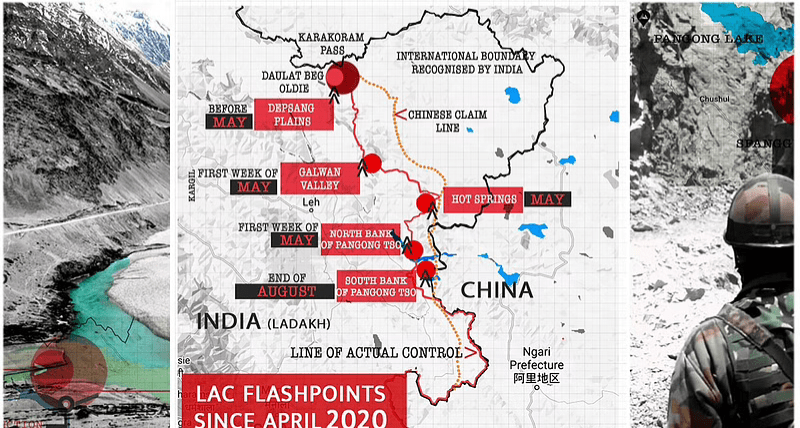
- The bridge is situated in an area controlled by China for the past 60 years and is close to the Line of Actual Control in Ladakh.
- It allows Chinese troops to quickly move between the North and South banks of Pangong Lake.
- India is building the Shinkun La tunnel, which is 4.1 kilometers long, to establish all-weather connectivity between Himachal Pradesh and Ladakh.
Border dispute between India and China
- The border between India and China is not officially marked or defined.
- India believes the Line of Actual Control (LAC) to be 3,488 km in length, while China only recognizes it as approximately 2,000 km.
- This difference in perception of the border's length can lead to disputes and tensions between the two countries.
- LAC is separated into three sectors: Western Sector (Ladakh), Middle Sector (Himachal Pradesh and Uttarakhand), and Eastern Sector (Arunachal Pradesh and Sikkim).
- In the Western Sector, India recognizes the Johnson Line as the border while China claims the McDonald Line as the true border.
- The Middle Sector is largely undisputed.
- In the Eastern Sector, China claims the entire Arunachal Pradesh as part of the Tibetan Autonomous Region.
- The alignment of LAC follows the MacMahon Line, established during the 1914 Simla Convention, which China does not accept.
RBI's Directive on Wilful Defaulters and Large Defaulters
- The guidelines have been issued in accordance with specific laws such as the Reserve Bank of India Act, Banking Regulation Act, and Credit Information Companies (Regulation) Act.
- The purpose of these guidelines is to establish a fair and transparent process for identifying borrowers who are deliberately defaulting on their loans.
- By March 2023, a total of 16,883 accounts with a combined borrowing of Rs 3.5 lakh crore had been identified as wilful defaulters.
Key Provisions of the Direction
- Wilful Defaulter: A wilful defaulter is someone who has defaulted on payments of ₹25 lakh or more and meets certain criteria. Criteria for Wilful Default:
- A borrower is considered a wilful defaulter if they have the capacity to pay but still fail to meet payment obligations.
- Other signs of wilful default include diverting funds, siphoning off funds, disposing of assets used as collateral, or not investing equity when able to do so.
- Large Defaulter: A borrower with a default of ₹1 crore and above, where legal action has been taken or the account is classified as doubtful or loss.
- Identification: Lenders must establish an Identification Committee to review evidence of wilful default.
Measures to be Taken
- Initiation of Criminal Proceedings by Lenders
- Penal Measures: No additional credit facilities, no credit for new ventures, not eligible for credit restructuring.
- Preventive Measures: Proper credit appraisal, monitoring of fund usage.
AERB Grants Permission for PFBR Criticality Approach
- The 500 MWe sodium-cooled Prototype Fast Breeder Reactor (PFBR) is situated in Kalpakkam, Tamil Nadu.
- It is India's first indigenous PFBR and was commissioned by Bharatiya Nabhikiya Vidyut Nigam Limited (BHAVINI), a Government Company under the Department of Atomic Energy (DAE).
First Approach to Criticality
- Criticality is the initial step of bringing a reactor to a self-sustaining chain reaction for the first time.
- The completion of core loading signifies the first approach to 'criticality', which involves placing nuclear fuel assemblies inside the core of a nuclear reactor.
Fast Breeder Reactor Overview
- A Fast Breeder Reactor (FBR) is a nuclear reactor that uses fast neutrons to generate more nuclear fuel than they consume while producing power.
- FBRs use Uranium-Plutonium Mixed Oxide (MOX) fuel and have a Uranium-238 "blanket" surrounding the fuel core for nuclear transmutation to produce more fuel.
- The operationalisation of PFBR will mark the beginning of stage II of India's three-stage nuclear power programme, with Thorium transmuting into fissile U-233 for use as fuel in the third stage.
Atomic Energy Regulatory Board (AERB)
- Established by the President in 1983 under the Atomic Energy Act, 1962.
- AERB's regulatory authority is derived from rules and notifications under the Atomic Energy Act and Environment (Protection) Act, 1986.
- The mission of AERB is to ensure the safe use of ionizing radiation and nuclear energy in India to prevent undue risks to the health of people and the environment.
"SEBI's Consultation Paper on Index Derivatives"
- A consultation paper is looking to implement measures that will improve investor protection and market stability in derivative markets, all while supporting continued capital formation.
About Index derivatives
- Derivatives are financial agreements that derive their worth from an underlying asset such as a commodity, security, currency, or index.
- Futures and Options (F&O) are popular examples of derivatives that are commonly traded in the financial markets.
Need for Strengthening Index Derivatives Framework
- A significant amount of household savings, estimated to be between ₹50,000 to ₹60,000 crore, has been lost due to excessive speculative trading in derivatives.
- There has been a notable increase in retail investors participating in equity derivatives, with the percentage of individual trades in index options rising from 2% in FY 2018 to 41% in FY 2024.
Key Changes Proposed
- The minimum contract value will be increased in stages from ₹5 lakh to ₹10 lakh to ₹15 lakh to ₹20 lakh, potentially reaching up to ₹30 lakh after six months.
- The number of strike prices for an index derivatives contract will be limited to 50 at launch to avoid spreading trading activity and liquidity too thin.
- Strike price is the agreed-upon price at which an option contract can be exercised.
- Members will be required to collect option premiums from clients upfront.
About F&O
- Futures Contract: A contract that allows the buyer to purchase or sell a specific quantity of an instrument at a set price and time.
- Examples include stock futures, index futures, currency futures, and interest futures.
- Options Contract: A contract that gives the buyer the right (but not the obligation) to buy or sell a security at a predetermined price within a specific timeframe.
- Major types of option contracts are Call Options and Put Options.