
Daily Current Affairs UPSC 09 August 2024
Welcome to our daily current affairs blog post for UPSC aspirants! In today's edition, we will be discussing the most significant events and news updates that took place on 9th August 2024. Staying updated with current affairs is crucial for UPSC preparation, as it not only helps you stay informed but also enhances your understanding of various subjects. So, let's dive into the important happenings of the day and explore their potential impact on the upcoming UPSC examinations.

Floating Solar Project
- SJVN Limited, a Mini Ratna Schedule 'A' CPSU under the Ministry of Power, has completed the commissioning of the 90 MW Omkareshwar Floating Solar Project in Khandwa, Madhya Pradesh.
- The Floating Solar Project involves the installation of solar panels on floating structures located on water bodies like lakes, reservoirs, and ponds.
- According to the World Bank, India has the potential to generate 280-300 GW of power through floating solar projects.
- The benefits of floating solar projects include reduced water evaporation, cooler operating temperatures, and conservation of land.
Antarctica’s winter heatwave
- Antarctica is experiencing a heatwave for the second time in two years during the winter season.
- Ground temperatures have been 10 degrees Celsius higher than normal on average since mid-July.
- Scientists attribute the higher temperatures to the weakening of the polar vortex.
- The polar vortex is a band of cold air and low pressure systems that spins around the poles of the Earth in the stratosphere.
- The vortex typically keeps cold air trapped over Antarctica, but it has been disrupted this year by large-scale atmospheric waves.
Credit Information Companies (CICs)
- RBI has increased the frequency of reporting credit information by lenders to Credit Information Companies (CICs) from monthly to fortnightly or shorter intervals to improve transparency in the system.
- CICs collect public data, credit transactions, and payment histories of individuals and companies related to loans and credit cards, such as TransUnion CIBIL Limited.
- Using the collected data, CICs create credit reports and generate credit scores.
- Banks and Non-Banking Financial Institutions use the credit scores from CICs to assess the creditworthiness of borrowers before granting loans or issuing credit cards.
- CICs are licensed by RBI and regulated by the CIC Regulation Act, 2005, as well as RBI guidelines.
Isostasy
- Recent study explains how plateaus and escarpments are formed through Isostasy.
- Isostasy is the balance between crust blocks and the underlying mantle.
- It involves a line of equality where land mass above sea level is supported below sea level.
- Isostasy is not a force but a natural adjustment by crust blocks of different thicknesses.
- Isostasy uses energy to balance mass.
- Processes like ice sheet waning, erosion, sedimentation, and volcanism can disrupt isostasy.
Rashtriya Vigyan Puraskar
- The central government has released the full list of recipients for the inaugural Rashtriya Vigyan Puraskar 2024 awards.
- The Rashtriya Vigyan Puraskar is a new award introduced by the Government of India to honor individuals or teams who have made significant contributions in the fields of Science, Technology, and Innovation.
- The main objective of the award is to acknowledge and celebrate the remarkable achievements of scientists, technologists, and innovators in various areas of science and technology.
- The Rashtriya Vigyan Puraskar consists of four categories of awards: Vigyan Ratna for lifetime achievement, Vigyan Shri for scientists of all ages, Vigyan Yuva for scientists under 45 years, and Vigyan Team for collaborative research efforts.
Pyrocumulonimbus Cloud
- Recent wildfires in the US and Canada have led to the formation of Pyrocumulonimbus clouds.
- Pyrocumulonimbus clouds are created by extremely hot wildfires and volcanic eruptions.
- These clouds can produce lightning but do not typically result in much rain.
- Not every wildfire will result in the formation of pyrocumulonimbus clouds.
- The process involves intense heat from the fire warming the surrounding air, causing it to rise into the atmosphere.
- As the hot air rises, it carries water vapor, smoke, and ash, which then condenses to form a pyrocumulus cloud.
- If the upward movement of hot air intensifies, the pyrocumulus cloud can evolve into a pyrocumulonimbus cloud.
Clouded Leopard
- International Clouded Leopard Day was recently celebrated in Aizawl, Mizoram
- The Clouded Leopard is classified as Vulnerable by the IUCN
- The Wildlife (Protection) Act 1976 lists the Clouded Leopard under SCHEDULE I and IV
- CITES has listed the Clouded Leopard under Appendix I
- The Clouded Leopard is named after the distinctive 'clouds' on its coat
- It has a long tail in relation to its body size and is more comfortable in trees than on the ground
- The Clouded Leopard's habitat includes Southern China, Bhutan, Nepal, northeast India, Myanmar, Thailand, Vietnam, Malaysia, Cambodia, Laos, and Bangladesh
- Threats to the Clouded Leopard include habitat loss, defragmentation, poaching, and illegal wildlife trade.
Digital Watermarking
- OpenAI is developing a method to add a digital watermark to AI-generated content to prevent its misuse.
- Digital watermarking involves inserting a unique code into digital files like images, audio, or videos.
- This technique is crucial for protecting copyrights, maintaining integrity, securing digital assets, preserving intellectual property rights, and fighting against piracy.
New Zealand (Capital: Wellington)
- The President of India gave a speech at the New Zealand International Education Conference, where India is being honored as the 'Country of Honour' this year.
Political Features
- New Zealand is an island country located in the South Pacific Ocean, situated between the Tropic of Capricorn and the Antarctic Circle.
- The country consists of two main landmasses, the North Island and the South Island, which are separated by the Cook Strait.
Geographical Features
- New Zealand is part of the Pacific Ring of Fire and features the alluvial Canterbury Plains and a high central plateau known as Central Otago.
- The country is home to active volcanoes such as Mount Ruapehu and White Island, as well as the highest peak, Mount Cook.
- New Zealand also boasts the largest glacier, the Tasman Glacier, and the largest natural lake, Lake Taupō.

CDSCO Waives Local Clinical Trials
- Rule 101 of the New Drugs and Clinical Trials Rules, 2019 allows the Drugs Controller General of India (DCGI) to specify certain countries for waiver of local clinical trials for new drug approval.
- Countries like USA, UK, Japan, Australia, Canada, and EU can now supply drugs to India without the need for local trials.
- The waiver covers five categories including orphan drugs, gene and cellular therapy products, new drugs for pandemic situations, special defense purposes, and drugs with significant therapeutic advances.
Significance of the Current Waiver
- The waiver ensures the availability of the latest medicines for diseases like cancer, rare diseases, and autoimmune diseases.
- It reduces costs for public procurement by governments under schemes like Ayushman Bharat.
- Pharmaceutical companies save costs on conducting local trials.
About Central Drugs Standard Control Organisation (CDSCO)
- CDSCO, under the Ministry of Health & Family Welfare, is the National Regulatory Authority of India responsible for drug approval, clinical trials, and setting standards for drugs.
- Clinical trials are conducted in four phases:
- Phase I: In this phase, a small group of volunteers is used to determine the safe dosage range of a drug and identify any potential side effects.
- Phase II: In this phase, the drug is given to a larger group of individuals, typically 100 to 300, including patients with the specific disease being targeted to assess its effectiveness.
- Phase III: In this phase, the drug is tested on a larger scale with groups of 1,000 to 3,000 patients to compare its effectiveness to other commonly used treatments.
- Phase IV: Once the drug or treatment has been approved by the Drug Controller General of India (DCGI), it is marketed for public use.
Proposed Waqf (Amendment) Bill, 2024 introduced in Parliament
- The bill will make changes to the Waqf Act, 1995, replacing the term "Waqf" with "Unified Waqf Management, Empowerment, Efficiency and Development."
- Previous amendments were made in 2013 based on recommendations from the High-Level Committee chaired by Justice (Retired) Rajinder Sachar and the Joint Parliamentary Committee report.
Key Features of the Bill
- A database of waqf properties must be registered on a portal within six months of the act coming into effect.
- The bill defines "waqf" as property dedicated by a practicing Muslim for at least five years.
- The bill ensures representation of women and non-Muslims on the Central Waqf Council and state boards.
- The Central Government can order audits of waqf properties by an auditor appointed by the Comptroller and Auditor-General of India or a designated officer.
- Disputes over property ownership will be decided by the District Collector.
Objectives of the Bill
- The bill aims to address issues related to State Waqf Boards' powers, registration, and survey of waqf properties.
- It seeks to improve the efficiency of managing and administering waqf properties.
About Waqf Properties
- Waqf properties are movable or immovable assets dedicated for charitable purposes in the name of God through a deed or instrument.
- These properties are managed by a legal entity with nominated members forming the Waqf board.
- The Central Waqf Council (CWC), established in 1964, oversees and advises state-level Waqf Boards in India.
"Great Barrier Reef at Risk from Record Ocean Heat"
- Study in Nature journal shows repeated mass coral bleaching on GBR due to high sea surface temperatures.
- Five bleaching events from 2016-2024.
- Coral bleaching occurs when stressed corals expel algae, turning white.
- Factors include heat stress, UV radiation, pollution, low tides, ocean acidification.
About Great Barrier Reef
- Largest coral reef system in the world.
- Located off the coast of Queensland, Australia in the Coral Sea.
- UNESCO World Heritage site since 1981.
About Coral Reefs
- Invertebrate animals in the Cnidaria group.
- Formed by millions of polyps creating carbonate structures.
- Most coral reefs found in tropical waters.
- Australia, Indonesia, Philippines have one-third of world's coral reefs.
- In India, reefs found in Gulf of Kutch, Gulf of Mannar, Andaman & Nicobar, Lakshadweep, Malvan.
Importance of Coral Reefs
- Highest biodiversity of any ecosystem.
- Protect coastlines from storms and erosion.
- Act as carbon sink.
Conservation Efforts for Coral Reefs
Global:
- Global initiatives like Global Fund for Coral Reefs, Global Coral Reef Monitoring Network, Coral Triangle Initiative.
- Coral Triangle in western Pacific Ocean includes Indonesia, Malaysia, Philippines, Papua New Guinea, Timor Leste, Solomon Islands.
India:
- India's efforts include Marine Protected Areas, Coral restoration using Biorock technology.
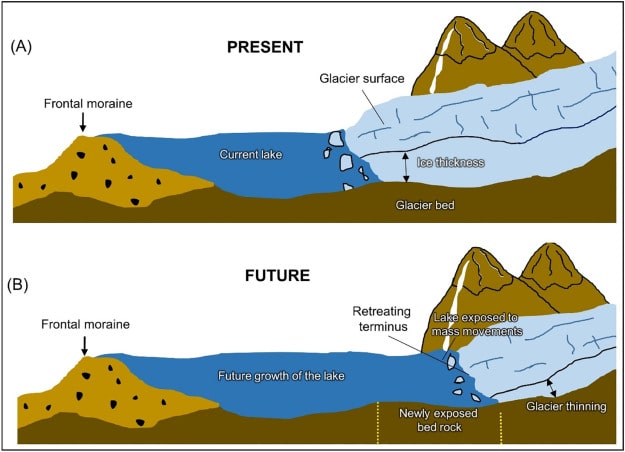
Government to assess dam designs for GLOF vulnerability
- The Ministry of Power has identified 47 dams, including 38 commissioned and nine under-construction dams, as potentially affected by GLOFs from glacial lakes.
- The Central Water Commission (CWC) has decided to review the design flood of all existing and under-construction dams vulnerable to GLOFs after the Teesta-III dam collapse.
About Glacial Lake Outburst Flooding (GLOFs)
- GLOFs occur when the water levels of glacial lakes breach their boundaries, causing large amounts of water to flow into nearby streams and rivers.
Reasons of GLOFs:
- Geological factors: Earthquakes, breaches of moraine dams.
- Morphological factors: Mass movement into glacial lakes, water seepage through glacial structures.
- Physical factors: Excessive precipitation, Cryoseism events in the glacial cryosphere.
- Anthropogenic factors: Climate change, global warming.
Challenges of GLOFs
- Unpredictable events can happen suddenly with minimal warning.
- Loss of life can be significant, such as the 2013 Lake outburst in Kedarnath valley which resulted in around 6,000 deaths.
- Remote areas, like Chamoli's Rishighanga valley, are susceptible to Glacial Lake Outburst Floods (GLOFs) as seen in 2021.
Strategies to Manage GLOFs Risks
- Implementing hazard risk zonation and mapping, monitoring glacial lakes using technology, and imposing restrictions and regulations on construction activities in hazard-prone areas are key strategies to manage GLOFs risks.
"New Boilers Bill, 2024 Proposed in Rajya Sabha"
- The new bill will repeal the Boilers Act, 1923 which aimed to ensure uniformity in technical regulations for boilers across India.
- The Indian Boilers (Amendment) Act, 2007 introduced third-party inspection and certification.
- The new bill includes decriminalized provisions in line with the Jan Vishwas (Amendment of Provisions) Act, 2023.
Key Features of the Bill
- Competent authority will be defined as an institution recognized for granting certificates to welders for boiler welding.
- Unauthorized structural alterations to boilers will be punishable with imprisonment or fines.
- The Central Government has the power to address difficulties in implementing the Boilers Act, 2024 within three years.
- The Central Boilers Board will be established to regulate boiler design, manufacture, erection, and use.
Objective of the Bill
- The bill aims to regulate the manufacture and use of boilers to ensure the safety of individuals and property from boiler explosions.
- It prohibits the use of unregistered and uncertified boilers, mandates accident reporting, and promotes uniformity in registration and inspection processes.
Importance of Industrial Boilers
- Industrial boilers are crucial for burning fuel in large quantities, reaching high temperatures and pressures, and handling high-energy steam.
"Juangs of Keonjhar Granted Habitat Rights by District Committee"
- Other indigenous groups like the Jaungs in Jajpur, Paudi Bhuyans in Deogarh, and Bharia PVTG in Madhya Pradesh, as well as the Kamar PVTG and Baiga PVTG in Chhattisgarh, have rights to their traditional lands.
Habitat Rights
- The Forest Rights Act (FRA) of 2006 introduced Habitat Rights for Scheduled Tribes and other forest dwellers.
- Habitat is defined as the customary habitat and other habitats in reserved and protected forests of tribal groups and pre-agricultural communities.
- Habitat Rights are granted after consultation with community members, traditional leaders, women leaders, district and forest administration.
- The significance for Particularly Vulnerable Tribal Groups (PVTGs) includes rights over their customary territory, socio-cultural practices, intellectual knowledge, traditional knowledge, and conservation of natural and cultural heritage.
About Particularly Vulnerable Tribal Groups (PVTGs)
- There are 75 PVTGs recognized by the government, with Odisha having the highest number at 13.
- PVTGs are identified based on criteria such as low literacy, economic backwardness, and traditional lifestyle.
- These groups have specific rights over their habitats to protect their cultural and natural heritage.
Juang Tribe in Odisha
- The Juang tribe resides in various regions of Odisha and is divided into Hill and Plain Juang.
- Originally known as Patuas, they were skilled in shifting cultivation and crafts like making combs and tobacco cases.
- Habitat rights are essential for the Juang tribe to preserve their traditional way of life and cultural practices.