
Daily Current Affairs UPSC 30 June and 01 July 2024
Welcome to our daily current affairs blog post for UPSC aspirants! In today's edition, we will be discussing the most significant events and news updates that took place on 30th June and 1st July 2024. Staying updated with current affairs is crucial for UPSC preparation, as it not only helps you stay informed but also enhances your understanding of various subjects. So, let's dive into the important happenings of the day and explore their potential impact on the upcoming UPSC examinations.

Santhal Rebellion
- Celebration of the 169th anniversary of the Santhal rebellion.
- Hool diwas celebrated on June 30 every year in remembrance of the rebellion.
- Overview of the Santhal Rebellion (1855-1856)
- Leaders: Siddho, Kanho, Chand, Bhairav, Phulo, and Jhano.
- Location: Rajmahal Hills.
- Cause: exploitation and oppression by British colonial authorities and moneylenders.
- Recognition by Karl Marx as India's first organized mass revolution.
- Implementation of the Santhal Pargana Tenancy Act of 1876 by the British post-rebellion.
- Creation of territories known as 'Santhal Paraganas'.
- Prohibition of Santhals transferring land to non-Santhals.
Employees’ Pension Scheme
- EPS scheme has been changed to allow members with less than six months of contributory service to withdraw benefits, whereas. previously they had to complete 6 months of service.
- EPS 1995 is overseen by the Ministry of Labour & Employment.
- EPS is a pension scheme that combines defined contribution and defined benefit elements, with contributions from employers and the central budget.
- Withdrawal benefits are available to EPS members who leave the scheme before completing 10 years of service.
- The minimum superannuation pension under EPS is Rs.1000.
Anti dumping duty
- India has started an investigation into the import of glass fibre from China, Thailand, and Bahrain to determine if anti-dumping measures are necessary.
- Anti-dumping duty is imposed when goods are exported at a price lower than their normal value, which is considered unfair trade practice.
- The purpose of anti-dumping duty is to protect domestic industries from being harmed by cheap imports.
- The use of anti-dumping measures is allowed by the WTO Anti-dumping Agreement to ensure fair competition in international trade.
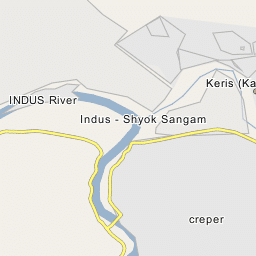
Shyok River
- Five soldiers killed in tank accident in Shyok river.
- Shyok river is a right tributary of the Indus River.
- Originates from Rimo glacier and joined by Nubra River.
- Main rivers of Nubra Valley.
- Drains northern Karakoram mountains.
- Placer deposit contains Gold.
- Shyok village is last Indian village on road to Daulat Beg Oldie (DBO).
Smart City Mission
Extension of Smart City Mission timeline
- The central government has decided to extend the Smart City Mission timeline until March 2025.
About Smart City Mission
- Ministry: The Smart City Mission falls under the Ministry of Housing and Urban Affairs (MoHUA).
- Launch: The mission was launched in 2015 as a Centrally Sponsored Scheme.
- Objective: The mission aims to promote cities that offer core infrastructure, a clean and sustainable environment, and a high quality of life through the application of 'smart solutions'.
Eco-friendly supercapacitors
- Researchers at Government College for Women, Thiruvananthapuram, have created activated carbon from coconut husks for supercapacitors.
- The method aims to provide sustainable and efficient green solutions for high-performance supercapacitors.
- Activated carbon is an ideal material for supercapacitors due to its high surface area.
- Supercapacitors are electrochemical energy storage devices that store and deliver charge through reversible adsorption and desorption of ions.
Gandhi Sarovar
Avalanche at Gandhi Sarovar
- Also known as Chorabari Tal.
- Located near Kedarnath Temple in Uttarakhand.
Gandhi Sarovar
- Originally known as Kanti Sarovar.
- Originates from the Chorabari Bamak Glacier.
- Believed to be where Lord Shiva imparted yoga knowledge to the Saptrishis.
Kedarnath Temple
- One of the 12 Jyotirlingas dedicated to Lord Shiva in India.
- Part of the Char Dham circuit in Uttarakhand along with Yamunotri, Gangotri, and Badrinath.
Liberalised Remittances Scheme (LRS)
- Introduced in 2004 by the RBI.
- Allows all resident individuals, including minors, to remit up to USD 2,50,000 per financial year.
- Can be used for any permissible current or capital account transaction or a combination of both.
- No restrictions on the frequency of remittances.
Eligibility for the Scheme
- Not available to corporates, partnership firms, Hindu Undivided Family (HUF), Trusts, etc.
Prasanta Chandra (P.C.) Mahalanobis
- MoSPI launched eSankhyiki portal on Statistics Day to improve data management and dissemination.
- Statistics Day celebrates P.C. Mahalanobis' birth anniversary.
- P.C. Mahalanobis founded Indian Statistical Institute and established National Sample Survey and Central Statistical Organisation.
- Mahalanobis Plan focused on public sector development and industrialization.
- Mahalanobis received Padma Vibhushan and Mahalanobis International Award for lifetime achievements in statistics in developing countries.
- Mahalanobis distance is a statistical measure named after him.

"New Criminal Laws in Effect Today (1 July)"
- Section 106(2) of the Bharatiya Nyaya Sanhita (BNS) put on hold. Punishment in hit and run cases affected.
Significance of New Criminal Laws
- Reformative Justice: Community service as an alternative to imprisonment.
- Modernizing the Justice System: Indian Penal Code (1860) outdated and not reflective of current criminal norms.
- Seamless Flow of Information: Improving coordination and collaboration between parties involved in investigations and judicial proceedings.
| New Act | Replacing | Major Points |
|---|---|---|
| Bharatiya Nyaya Sanhita 2023 | Indian Penal Code, 1860 |
|
| Bharatiya Nagarik Suraksha Sanhita 2023 | Criminal Procedure Code, 1973 |
|
| Bharatiya Sakshya Adhiniyam 2023 | Indian Evidence Act, 1872 |
|
"World Bank Boosts India's Green Energy with $1.5 bn Loan"
- Second round of funding in a series of two operations under Low-Carbon Energy Programmatic Development Policy Operation.
- Goal is to accelerate the development of low-carbon energy in India.
- Three pillars of the operation:
- Promoting green hydrogen to strengthen policies and regulations.
- Scaling up renewable energy to increase penetration, reduce costs, and improve grid integration.
- Enhancing climate finance for low-carbon energy investments to launch India's carbon market and enable private sector investments.
Why India is being Supported
- Anticipated increase in energy demand in India and heavy dependence on coal.
- India's significant contribution to achieving global climate change goals.
- Need to assist India in meeting long-term (Net Neutrality by 2070) and short-term (by 2030 under NDCs) targets.
- Efforts required to reduce carbon emissions in challenging industrial and transportation sectors.
Government program to support low carbon energy growth
- Support for large-scale grid-connected Solar Parks and PM KUSUM scheme.
- Implementation of National Green Hydrogen Mission.
- Incentives for adopting electric and hybrid vehicles through FAME Scheme - I & II.
"Tracking Progress: 2024 SDGs National Indicator Report"
- The Ministry of Statistics and Programme Implementation (MoSPI) collaborated with various stakeholders to create the SDG-NIF.
- The SDG-NIF is an annual report that aids in monitoring the progress of Sustainable Development Goals (SDGs) at the national level.
- The 2030 Agenda for Sustainable Development focuses on 17 SDGs and 169 associated targets.
- These goals aim to address various global challenges and promote sustainable development.
Key Highlights of SDG-NIF
SDG Goals Indicators
| SDG Goals | National Indicator | 2015 – 16 | 2023 – 24 |
|---|---|---|---|
| No Poverty | Distribution of poverty among men, women, and children of all age groups | 24.85% | 14.96% |
| Number of Self-Help Groups (SHGs) linked to bank credit | 18.32% | 14.96% | |
| Zero hunger | Gross Value Added in agriculture per worker in Indian Rupees | 61,427 | 87,609 |
| Gender Equality | Number of women-exclusive SHGs within bank-linked SHGs | 88.92% | 97.53% |
| Clean water and sanitation | Percentage of rural population using improved drinking water sources | 94.57% | 99.29% |
| Reduced inequalities | Allocation percentage of budget for welfare of Scheduled Castes (SCs) and Scheduled Tribes (STs) | 2.86% | 6.19% |
| Sustainable cities and communities | Percentage of wards with complete door-to-door waste collection services | 43% | 97% |
Progress in Other Goals
Health and Well-being (Goal 3)
- Maternal Mortality Ratio has decreased from 130 per 1,00,000 live births in 2014-16 to 97 per 1,00,000 live births in 2018-20.
- Under-five mortality rate has decreased from 43 per 1000 live births in 2015 to 32 per 1000 live births in 2020.
Quality Education (Goal 4)
- Gross Enrolment Ratio in higher secondary education has increased from 48.32 in 2015-16 to 57.60 in 2021-22.
- This indicates progress towards achieving Goal 4 of ensuring inclusive and quality education for all.
"Bustard Recovery Program Receives Funding Approval"
- The conservation program for the Great Indian Bustard and Lesser Florican has been ongoing since 2016 with the goal of long-term recovery.
- The program is being implemented by the Wildlife Institute of India and a proposed next phase is planned from 2024 to 2033.
- The program includes various conservation efforts such as habitat development, in-situ conservation, completing a conservation breeding center, and releasing captive-bred birds.
About Great Indian Bustard and Lesser Florican
- The Great Indian Bustard and Lesser Florican are both species of Bustards found in India, along with the Bengal Florican and Houbara Bustard.
Great Indian Bustard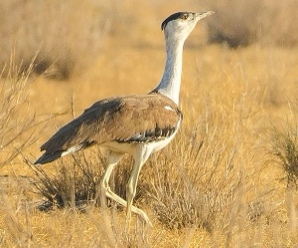
Conservation Status:
- Protected under Schedule I and IV of the Wildlife Protection Act, 1972.
- Classified as Critically Endangered by the IUCN.
- Listed under Appendix I of CITES.
- Included in a Species Recovery Program.
Behaviour and Characteristics:
- Males do not participate in incubation or caring for young.
- Found in grassland habitats in the Indian subcontinent.
- Omnivorous and opportunistic eaters.
Habitat:
- Primarily found in Rajasthan and Gujarat.
- Small populations also exist in Maharashtra, Karnataka, and Andhra Pradesh.
Lesser Florican
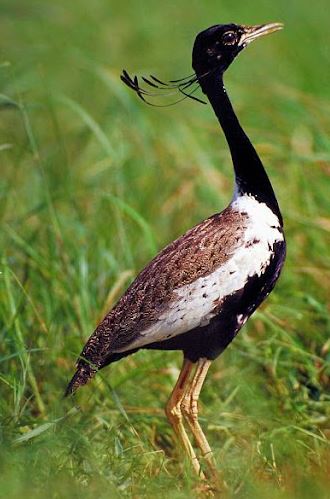
Conservation Status
- Listed under Schedule I of the Wildlife Protection Act, 1972.
- Classified as Critically Endangered by the IUCN.
Behaviour and Characteristics
- Found in grasslands and endemic to the Indian subcontinent.
- Male floricans are typically shorter and lighter than females.
- Omnivorous diet and known for aerial courtship displays.
Habitat
- Found in Rajasthan, Gujarat, Madhya Pradesh, and parts of Andhra Pradesh, Maharashtra, and Karnataka.
"Climate Change's Impact on Marginal Farmers"
- The Forum of Enterprises for Equitable Development (FEED) released a report focused on advocating for marginalized farmers.
Key Highlights
- Vulnerability to Extreme Weather Events: More than 1/3rd of marginal farmers faced extreme weather events at least twice in five years.
- Impact on Agriculture Income: Climate change could lead to a 15-18% reduction in annual agricultural income, and up to 20-25% in unirrigated areas.
- Livelihood Diversification: Over 86% of farmers have had to change their occupations due to climate impacts, including temporary migration and seeking work under MGNREGA.
- Challenges in Adopting Climate Resilient Agricultural Practices: High upfront costs, limited knowledge about options, small land holdings, and lack of physical resources are major hurdles in adopting Climate Resilient Agricultural practices.
Key Recommendations
- Strengthen existing platforms like the Global Alliance for Climate-Smart Agriculture.
- Shift focus from land productivity to water productivity.
- Implement a mission mode approach for education, training, orientation, and extension support for farmers.
Categories of Farmers Based on Landholding
- Marginal: Less than 1 hectare.
- Small: 1-2 hectares.
- Semi-Medium: 2-4 hectares.
- Medium: 4-10 hectares.
- Large: 10 hectares and above.
"Importance of Constitutional Morality in India"
- Constitutional morality involves following the principles of the Constitution not just in words but also in spirit, focusing on values like sovereignty, social justice, and equality.
- The term was first coined by British historian George Grote, who highlighted the importance of balancing freedom and restraint, allowing citizens to criticize constitutional authorities while still obeying them.
- Dr. B.R. Ambedkar believed that constitutional morality is essential for the peaceful functioning of a democratic Constitution, but it must be nurtured as it is not an innate feeling.
- The connection between the form of administration and the Constitution is crucial, as changing the former can undermine the latter without altering its structure. Ambedkar suggested including forms of administration in the Constitution to maintain consistency with its spirit.
Some constitutional provisions related to Constitutional Morality
- Fundamental Rights protect individuals from state power abuse.
- Fundamental Duties outline citizens' responsibilities to the nation.
- Separation of powers allows for checks and balances in the government.
Supreme Court Judgements related to Constitutional Morality
- Krishnamoorthy case (2015) stressed the importance of constitutional morality for good governance.
- Justice K S Puttaswamy case (2018) reiterated the duty to uphold constitutional morality by nullifying unconstitutional laws.
- Navtej Singh Johar Case (2018) highlighted the prioritization of constitutional morality over societal norms in striking down Section 377 of the IPC.