
Daily Current Affairs UPSC 26 September 2024
Welcome to our daily current affairs blog post for UPSC aspirants! In today's edition, we will be discussing the most significant events and news updates that took place on 26th September 2024. Staying updated with current affairs is crucial for UPSC preparation, as it not only helps you stay informed but also enhances your understanding of various subjects. So, let's dive into the important happenings of the day and explore their potential impact on the upcoming UPSC examinations.

Asian Infrastructure Investment Bank
- The Union Finance Minister requested the Asian Infrastructure Investment Bank (AIIB) to help low-income countries access financial resources.
- AIIB is a multilateral development bank founded in 2016 with a mission to finance infrastructure projects in Asia and beyond.
- The bank is headquartered in Beijing, China and has 110 members, including 96 Full Members and 14 Prospective Members.
- China holds the largest share of voting power in AIIB at 26.6%, followed by India at 7.6% and Russia at 6%.
- In 2018, AIIB was granted Permanent Observer status in the United Nations General Assembly and UN Economic and Social Council meetings.
Central Silk Board
- The recent celebration marked the platinum jubilee of the Central Silk Board.
- The Central Silk Board is a statutory body established in 1948 by an Act of Parliament under the Ministry of Textiles.
- The board's mandate includes advising the government on sericulture and silk industry matters, as well as standardizing production processes.
- The headquarters of the Central Silk Board is located in Bengaluru.
- India is the second largest silk producer in the world, accounting for 42% of global production in 2023.
- Karnataka contributes around 32% of India's total silk production, followed by Andhra Pradesh.
- The types of silk produced in India include Mulberry, Eri, Tasar, and Muga.
Asia Power Index, 2024
- India has moved up to the 3rd position in the Asia Power Index 2024, surpassing Japan.
- The USA and China hold the 1st and 2nd rankings in the index, respectively.
- The Asia Power Index, launched by the Lowy Institute in 2018, assesses power dynamics in the Asia-Pacific region annually.
- It evaluates 27 countries in the region based on their ability to influence and respond to the external environment.
- A country's power score is determined by a weighted average of 8 measures, including resource-based and influence-based factors, with a total of 131 individual indicators.
Philadelphi Corridor
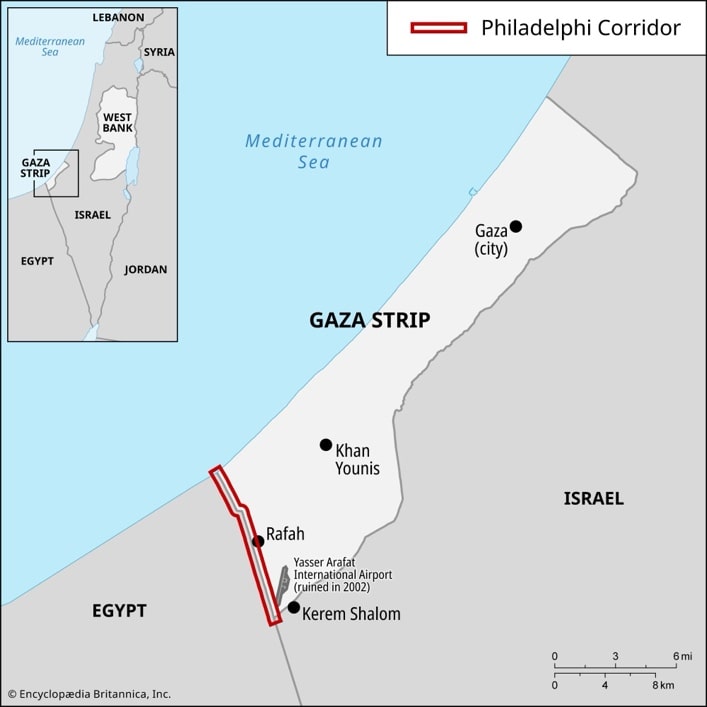
- Israel has insisted on controlling the Philadelphi corridor as part of ceasefire negotiations with Hamas.
- The Philadelphi corridor is a strip of land that is nine miles long and 100 meters wide along the Gaza-Egypt border, which includes the Rafah crossing.
- Following the Israeli withdrawal from Gaza in 2005, the Philadelphi corridor was designated as a demilitarized border zone.
- The corridor stretches from the Mediterranean Sea to the Kerem Shalom crossing with Israel.
- After Israel's withdrawal, the responsibility for the Philadelphi corridor fell to Egypt and the Palestinian Authority.
Government Securities (G-Secs)
- Recently, the yield on 10-year G-Secs dropped to its lowest level in 32 months.
- G-Secs are tradable instruments issued by central or state governments to acknowledge their debt obligations.
- G-Secs are considered risk-free gilt-edged instruments because they carry practically no risk of default.
- There are two types of G-Secs: Treasury bills with original maturities of less than one year, and Government bonds or dated securities with original maturities of one year or more.
- The Central Government issues both treasury bills and bonds, while State governments only issue bonds known as State Development Loans (SDLs).

ABHED (Advanced Ballistics for High Energy Defeat)
- DRDO and IIT Delhi researchers have collaborated to create ABHED, which is a type of Light Weight Bullet Proof Jackets.
- These jackets are made from polymers and indigenous boron carbide ceramic material.
- The design of ABHED is based on studying different materials at high strain rate and using modeling and simulation techniques.
Differential Rotation of Sun
- Astronomers have used data from the Kodaikanal Solar Observatory to map the differential rotation of the Sun's Chromosphere.
- Differential rotation of the Sun refers to the varying rotational speeds at different latitudes, with the equator spinning faster than the poles.
- The Sun's equator completes one rotation in about 25 days, while the poles take around 35 days due to its gaseous/plasma composition.
- Understanding the Sun's differential rotation is important for predicting solar cycles and magnetic storms on Earth.
- The Kodaikanal Solar Observatory, operated by the Indian Institute of Astrophysics, is celebrating its 125th anniversary and was chosen for its location near the equator and high-altitude, dust-free environment.
Women in Space Leadership Programme (WiSLP)
- WiSLP is a program that is part of the UK-India Education and Research Initiative.
- The Department of Science and Technology and the British Council collaborated to launch WiSLP.
- The goal of WiSLP is to support institutions in promoting women's leadership in space sciences through gender-inclusive practices.
- The program will focus on creating mentoring networks and integrating a gender perspective into areas like astrophysics to enhance scientific innovation.
Thiruvalluvar
Establishment of Tiruvalluvar Chair for Tamil Studies at the University of Houston
- Tiruvalluvar, also known as Valluvar, was a renowned Tamil poet and philosopher
- He was born in Madurai, the capital of the Pandyas
- His work, Thirukurals (Sacred Verses), consists of 1330 couplets on ethics, politics, economy, and love
- The couplets are divided into 133 chapters categorized into Aaram (Righteousness), Porul (Wealth), and Kamam (Love)
- One of his famous quotes is "Falsehood takes the place of truth when it results in unblemished common good"
- Tiruvalluvar Day is celebrated on January 15 or 16 in Tamil Nadu to honor his contributions
- His values include Egalitarianism, Integrity, Harmony, among others.

"10 Years of Make in India: A Milestone Celebration"
Launched in 2014 with the goal of turning India into a global manufacturing hub.
Make in India Initiative Overview
- Objectives include attracting investment, promoting innovation, developing skills, protecting intellectual property, and creating top-notch manufacturing infrastructure.
Four Pillars of Make in India
- New Processes: Focus on improving ease of doing business to encourage entrepreneurship.
- New Infrastructure: Emphasis on providing state-of-the-art technology infrastructure.
- New Sectors: Identified 27 sectors for development in manufacturing, infrastructure, and services.
- New Mindset: Government aims to facilitate rather than regulate.
Nodal Agencies
- Department for Promotion of Industry and Internal Trade for the manufacturing sector.
- Department of Commerce for the service sector.
Impact of Make in India Initiative
- Foreign Direct Investment (FDI): FDI inflow increased by 119% to $667.4 billion from 2014-24 compared to the previous decade.
- Employment: The manufacturing sector saw an increase in employment from 57 million in 2017-18 to 64.4 million in 2022-23.
- Exports: India's merchandise exports exceeded $437 billion in FY 2023-24.
- Ease of Doing Business: India's ranking in the World Bank's Doing Business Report improved significantly from 142nd in 2014 to 63rd in 2019.
Sector-wise Success Stories
- Transportation: Vande Bharat Express Train.
- Defence Manufacturing: INS Vikrant, India's first domestically made aircraft carrier.
- Electronics: Samsung established the World's Largest Mobile Factory in Noida.
Key Reforms taken to facilitate implementation of Make in India
- Semiconductor Ecosystem Development initiatives include programs like Semicon India Program
- The National Single Window System (NSWS) platform helps speed up investor clearances
- PM Gatishakti is a GIS-based platform that improves infrastructure planning and reduces logistics costs
- The National Logistics Policy (NLP), 2022 aims to lower logistics costs and enhance efficiency
- Other initiatives include One-District-One-Product (ODOP), Industrial Corridors, etc.
"Promoting Sustainable Food Systems Through India's Trade Agreements"
The Policy Brief addresses regulatory challenges and offers policy suggestions to promote a sustainable food system, transition from food security to nutrition security, and improve the quality of agricultural production, exports, and income for farmers.
What is Sustainable Food System (SFS)?
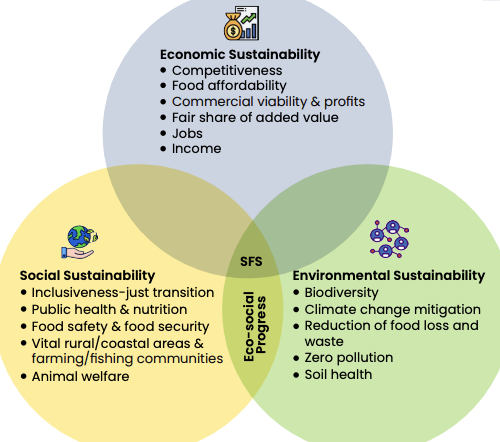
The system provides sustainable food security, safety, and nutrition for everyone, while also being economically, socially, and environmentally sustainable.
Issues in India's Sustainable Food System
- Lack of coordination among government agencies such as APEDA, Spices Board, and the Export Inspection Council leads to divided responsibilities in the case of spices.
- There is a lack of data and information on policies and schemes, including the absence of impact assessments.
- Challenges in supply chain traceability and technology use include fragmented supply chains and a lack of strong public-private partnerships for technology transfer on farms.
- Trade-related issues such as sporadic bans or export duties and rejection of exports due to non-compliance with SPS standards are also prevalent.
Key Recommendations for Sustainable Food System Development
- Develop a comprehensive vision document with specific goals to reduce food waste and harmful pesticide use.
- Streamline coordination among regulators by establishing a single nodal agency for exports.
- Implement farm-to-fork product traceability systems like 'GrapeNet' for monitoring exports.
- Reduce trade barriers by enhancing quality testing and certification processes.
- Promote good agricultural practices, such as those highlighted during the International Year of Millets 2023.
WHO Releases Clinical Trial Best Practices
- Guidance is focused on improving the efficiency of clinical research, reducing waste, and ensuring that clinical trials remain active and functional for endemic conditions, as well as being adaptable during emergencies or pandemics.
- Clinical trials are meticulously monitored research studies that assess the safety, efficacy, and effectiveness of new medical treatments, drugs, devices, or interventions.
Persistent Challenges to Clinical Trials
- Clinical trials waste is caused by unclear research questions, redundant research, and inefficient trial processes.
- Inadequate funding for clinical trial infrastructure leads to unfair access to affordable and safe interventions, as seen during the COVID-19 pandemic.
- Other issues include a global divide between high and low-income countries, lack of diversity in trial cohorts, and mistrust in research due to lack of standardized practices.
Key Highlights of the Guidance
- Identify national research programs and their funding that focus on regional and global health priorities.
- Ensure that local research ethics committees have diverse members and operate independently with the ability to make decisions autonomously.
- Promote the use of automated and digital processes to improve the speed, efficiency, and transparency of clinical trials.
- Advocate for diversity in trial cohorts by including pregnant and lactating women who have unique healthcare needs.
Regulation of Clinical Trials in India
- Clinical trials of new drugs are regulated by Schedule Y of the Drugs and Cosmetic Rules, 1945.
- Good Clinical Practice (GCP) guidelines are issued by the Central Drugs Standard Control Organisation (CDSCO).
- The sponsor and investigator must be aware of the approval process for conducting clinical trials of vaccines.
- Safety data of medical devices in animals should be obtained and potential risks should be considered.
- Informed consent is necessary before any diagnostic procedures are conducted.
- Ethical guidelines for biomedical research on human participants were established in 2006 and for research involving children in 2017 by the ICMR.
"NBFCs Thrive Despite Scale-based Regulation: RBI"
- The RBI's recent article, 'Peeling the Layers: A Review of the NBFC Sector in Recent Times,' emphasized that NBFCs have remained strong after the implementation of Scale-based Regulation in 2022.
- NBFCs are registered companies under the Companies Act, 1956/2013 that are involved in activities such as providing loans, acquiring marketable securities, leasing, hire-purchase, insurance, and chit business.
What is SBR for NBFCs?
- SBR stands for Segregation of NBFCs, which categorizes NBFCs into four layers based on their size, activity, and perceived level of riskiness.
- Each tier is subject to different regulatory requirements tailored to its size and risk profile.
Key Highlights of the RBI Article
- Resilient Financial Landscape: The sector maintained double-digit credit growth, adequate capital levels, a low delinquency ratio, and registered a consistent rise in profitability.
- Improved Asset Quality: Gross Non-performing Asset (GNPA) ratio has decreased significantly for both government and non-government NBFCs.
- Concerns: Emerging risks and challenges, especially from cybersecurity and climate risks, are highlighted in the article.
SBR Framework for NBFCs

"India's National Health Accounts Estimates Released for 2020-21 and 2021-22"
- The NHA estimates are published every year by the Union Ministry of Health & Family Welfare.
- These estimates offer a detailed overview of how money moves through India's healthcare system from various funding sources.
- The estimates are created using the 'A System of Health Accounts (SHA), 2011' framework, allowing for comparisons with other countries.
Major Findings
| Parameter | 2014-15 | 2021-22 |
|---|---|---|
| Government Health Expenditure (GHE) in countries total health expenditure (THE) | 29% | 48% |
| GHE’s share in the country’s total GDP | 1.13% | 1.84% |
| Per capita GHE (tripled) | Rs 1,108 | Rs 3,169 |
| Out-of-Pocket Expenditures on Healthcare (OOPE) | 62.6% | 39.4% |
| Social Security Expenditure (SSE) in the THE | 5.7% | 8.7% |
Key Definitions:
- OOPE refers to the payments made by individuals when they receive healthcare services or goods.
- The government's initiatives to provide financial protection and universal health coverage have helped decrease OOPE.
- For example, Ayushman Bharat PMJAY has resulted in savings of over Rs 1 lakh crore.
- SSE encompasses government-funded health insurance, medical reimbursement for government employees, and social health insurance programs.
"Finance for Sustainable Cooling: New Report Released"
- The report was created collaboratively by the IFC and the Cool Coalition led by UNEP.
- It focuses on the investment requirements and financial shortfalls in sustainable cooling, while also showcasing potential opportunities for private investors.
- Sustainable cooling involves utilizing environmentally friendly refrigerants for cooling purposes in order to avoid any harm to the environment, including climate effects.
Why there is a need of Sustainable Cooling Solutions?
- Break the cycle of using solutions that contribute to global warming to meet cooling demands.
- Developing countries currently account for about 66% of emissions related to cooling, a number that could rise to over 80% by 2050.
- The sustainable cooling market is projected to exceed USD 600 billion annually by 2050, offering a significant opportunity for developing economies.
- Addressing climate change can help reduce the approximately 500,000 deaths per year attributed to global warming.
- Sustainable cooling solutions can also contribute to achieving Sustainable Development Goals like SDG 13 on Climate Action.
Challenges faced by Developing Countries
- Systemic Issues:
- Demand Side: Developing countries face challenges such as high upfront costs and high risk when it comes to accessing funding for businesses.
- Supply Side: Small companies in developing countries struggle with limited funding sources and supply chain issues that hinder their growth.
- Not considered a traditional financial sector or asset class: Developing countries often do not have access to traditional financial services or investment opportunities, making it difficult for them to attract capital for development.
Key Recommendations
- Enhance Minimum Energy Performance Standards, efficiency, and sustainability criteria to regulate and protect.
- Increase public funding, attract private investments, and create tailored funding models such as retail finance for households.
- Monitor cooling finance and its effects as the market expands.
India's Initiatives in Cooling:
- India Cooling Action Plan, 2019.
- Energy Conservation Building Code by Bureau of Energy Efficiency: Regulations to improve the energy performance of buildings and reduce cooling needs.
- Super-Efficient Air Conditioning Programme by Energy Efficiency Services Limited (EESL): Initiative to promote the adoption of energy-efficient air conditioning systems to reduce electricity consumption and greenhouse gas emissions.