
Daily Current Affairs UPSC 06 July 2024
Welcome to our daily current affairs blog post for UPSC aspirants! In today's edition, we will be discussing the most significant events and news updates that took place on 6th July 2024. Staying updated with current affairs is crucial for UPSC preparation, as it not only helps you stay informed but also enhances your understanding of various subjects. So, let's dive into the important happenings of the day and explore their potential impact on the upcoming UPSC examinations.

People’s Biodiversity Register (PBR)
- Thazhakara panchayat in Kerala recently released their updated Participatory Biodiversity Register (PBR).
- The PBR is a document that is statutorily recognized under the Biological Diversity Act (2002).
- The Biodiversity Management Committee (BMC) works with local people to prepare the PBR.
- The purpose of the PBR is to document and protect bioresources and associated knowledge.
- Information in the PBR includes the availability and knowledge of local biological resources and any traditional knowledge associated with them.
- The PBR supports claims of local ownership of biodiversity and traditional knowledge.
- It also helps in sustainable resource management.
Abhay Mudra
- The Leader of Opposition mentioned 'Abhaya mudra' in his speech.
- Abhaya Mudra symbolizes fearlessness and was used by Buddha to tame a mad elephant.
- Other Mudras associated with Buddha include Bhumisparsha, Dhyana Mudra, and Dharmachakrapravartana.
- Bhumisparsha is the posture of calling the earth to witness, used by Buddha to overcome obstructions while meditating on Truth.
- Dhyana Mudra represents meditation and indicates the perfect balance of thought, rest of the senses, and tranquillity.
- Dharmachakrapravartana, or turning the wheel, symbolizes the preaching of the dhamma.
Xenophrys Apatani
- Researchers from Zoological Survey of India discovered a new species of forest-dwelling horned frog (Xenophrys Apatani) in Talle Wildlife Sanctuary, Arunachal Pradesh.
- The discovery significantly adds to India's herpetofaunal diversity, which includes both amphibians and reptiles.
About Xenophrys Apatani
- The frog has been named after the Apatani tribe of Arunachal Pradesh.
- It is a leaf-litter dwelling frog that is known for living amongst tea leaves.
- The frog has small horns and is dark brown in color.
- Xenophrys species are concentrated along the Eastern Himalayas and Indo-Burma biodiversity hotspots in India.
Indo-French Liver and Metabolic Disease Network (InFLiMeN)
- Ministry of Science and Technology launched Indo-French Liver and Metabolic Disease Network (InFLiMeN) in collaboration with Government of France.
- InFLiMeN is a joint research programme aimed at fostering scientific exchanges and enhancing joint research projects to tackle health challenges associated with liver and metabolic disorders.
- The network has been established at the Institute of Liver and Biliary Sciences in New Delhi.
- Significance: Every third Indian has fatty liver, which can lead to Type 2 Diabetes and other metabolic disorders. InFLiMeN aims to address issues related to Fatty Liver Disease.
ISI Mark
- Government mandates ISI mark for stainless steel and aluminium kitchen utensils.
- ISI mark ensures product quality and safety, developed by BIS.
- BIS is the National Standard Body of India established under the BIS Act, 2016.
- BIS aims at harmonious development of standardization, marking, and quality certification.
- Other BIS standards include Hallmark for purity of precious metal articles and Eco Mark for labeling environment-friendly products.
Groynes
- Coastal residents in Ernakulam, Kerala are protesting the inadequate efforts to address coastal erosion and the incomplete installation of sea groynes.
- Sea groynes are structures built perpendicular to the shoreline to protect the coast from erosion by trapping sediments from longshore drift.
- Groynes can be constructed using materials such as rock, wood, steel, and sand-filled bags.
- The functions of groynes include reducing erosion, dissipating wave energy, and stabilizing coastlines in the long term.
- Other methods of coastal protection include seawalls with tetrapods in Mumbai, offshore reefs, breakwaters, beach nourishments, etc.
SEHER Program
- Women Entrepreneurship Platform (WEP) and TransUnion CIBIL have launched the SEHER Program.
- WEP is a platform incubated at NITI Aayog that aims to empower women entrepreneurs.
- The SEHER Program is a credit education program designed to help women entrepreneurs access financial tools for business growth.
- The program includes financial literacy content and business skills training.
- SEHER Program is part of WEP's Financing Women Collaborative (FWC) initiative, which aims to accelerate access to finance for women entrepreneurs.
- Currently, only 7% of outstanding loans to MSMEs are to women-led businesses, highlighting the need to improve credit access for women entrepreneurs.
Gallantry Awards
- President awards Kirti Chakras and Shaurya Chakras to personnel.
- Awards given for displaying gallantry, courage, and devotion to duty.
- Gallantry awards include Param Vir Chakra, Maha Vir Chakra, and Vir Chakra.
- Additional awards instituted later on.
- Order of precedence for awards: Param Vir Chakra, Ashoka Chakra, Mahavir Chakra, Kirti Chakra, Vir Chakra, Shaurya Chakra.
- Awards announced on Republic Day and Independence Day.
Democratic Republic of Congo (Capital: Kinshasa)
- The initial meeting at the secretary level between the defense ministries of India and the Democratic Republic of Congo (DRC).
Political Features
- The Democratic Republic of Congo is the largest country in Sub-Saharan Africa and the second largest in the African Continent after Algeria.
- It shares territorial boundaries with Angola, Burundi, Central African Republic, Republic of the Congo, Rwanda, Sudan, Tanzania, Uganda, and Zambia.
- The country also has a maritime boundary that opens to the Atlantic Ocean.
Geographical Features
- The Congo River is the major river in the Democratic Republic of Congo, second only to the Nile in length.
- The country's vegetation is mainly tropical forests, and the Congo basin is home to the world's largest tropical peatlands along with Brazil and Indonesia.
- The Democratic Republic of Congo is rich in minerals, with 70% of the world's cobalt, being the third largest producer of oil in Sub-Saharan Africa. It also has deposits of gold, coal, iron-ore, lithium, and other minerals.
"India's Defense Production Surges to Record High"
- Defense production in India saw a 16.8% increase in value compared to the previous year, 2022-23.
Key Highlights
- Defence production in India has seen a significant growth of 16.8% in terms of value compared to the previous year.
- 79.2% of the growth has been contributed by Defence Public Sector undertakings (DPSUs)/other PSUs, while 20.8% has come from the private sector.
- The value of defence production has been steadily increasing since 2019-20, with a growth of over 60%.
- It is projected that by 2028-29, annual defence production will reach ₹3 lakh crore and defence exports will touch ₹50,000 crore.
Reasons for Record Defence Production
- The Defence Production and Export Promotion Policy 2020 (DPEPP) and Defence Acquisition Procedure (DAP 2020) have empowered the Indian domestic industry through the Make in India initiative.
- The increase in Foreign Direct Investment (FDI) limit to 74% through the Automatic Route and up to 100% under the government route has also contributed to the growth.
- Initiatives like the Innovations for Defence Excellence (iDEX) scheme and the indigenisation portal SRIJAN have further boosted defence production.
- The establishment of Defence Industrial Corridors in Uttar Pradesh and Tamil Nadu has also played a key role in promoting domestic defence manufacturing.
Challenges Faced by India's Defence Sector
- Bureaucratic inertia has led to delays in reforms and project delivery within the defence sector.
- There is a lack of technological depth in designing and manufacturing major systems and critical parts domestically.
- The current defence exports mainly consist of spare parts and components, highlighting scalability issues.
- Budget constraints and dependency on Public Sector Undertakings (PSUs) are also challenges faced by the defence sector.
Way Forward
- Simplifying regulatory processes and reducing bureaucratic hurdles through a single-window system can help streamline defence production.
- Promoting public-private partnerships can further boost domestic defence manufacturing capabilities.
- Focus on quality assurance, standardization, and improving international marketing and branding can enhance India's position in the global defence market.
- Expediting the defence procurement decision-making process will facilitate the industry in manufacturing and supplying arms in a timely manner.
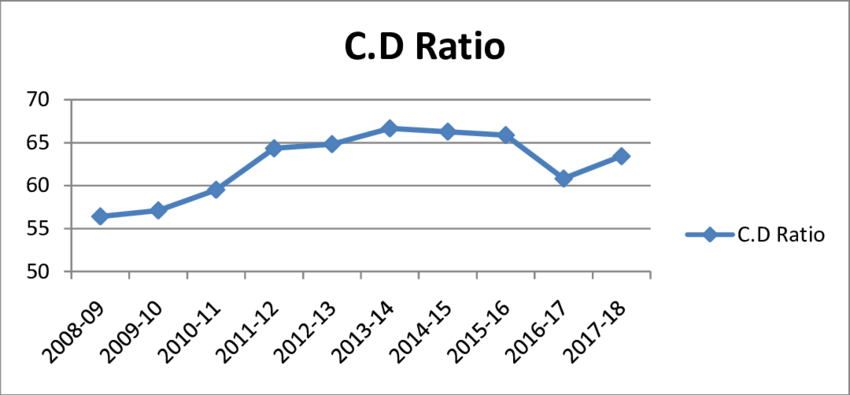
"RBI Worried About High CD Ratio in Banks"
- The Reserve Bank of India has instructed banks to narrow the difference between credit and deposit growth and lower their CD ratio.
- The CD ratio is a measure of a bank's loans compared to its total deposits.
- The RBI's Financial Stability Report shows that the CD ratio has been increasing since September 2021, reaching a high of 78.8% in December 2023.
- Private sector banks make up over 75% of banks with CD ratios exceeding 75%.
Key Reasons for high CD ratio
Increased credit growth
- Retail credit is on the rise, including vehicle loans and personal loans.
- Bank lending to the retail sector grew at a CAGR of 25.2% from April 2022 to March 2024.
- More loans are being given to businesses and MSMEs.
Decreased deposit growth
- Banks are facing tough competition among themselves.
- Customers are moving from saving to investing, putting funds into capital markets.
- This shift is causing a slowdown in deposit growth.
Impact of High CD Ratio
Bank may face:
- NIM is a metric that shows the net profit a bank earns from its investments and loans.
- Liquidity risk refers to the possibility that a bank may not have enough funds to meet its payment obligations on time.
- Credit risk is the risk that borrowers may not be able to fulfill their contractual obligations to repay loans.
"India-China Border Talks"
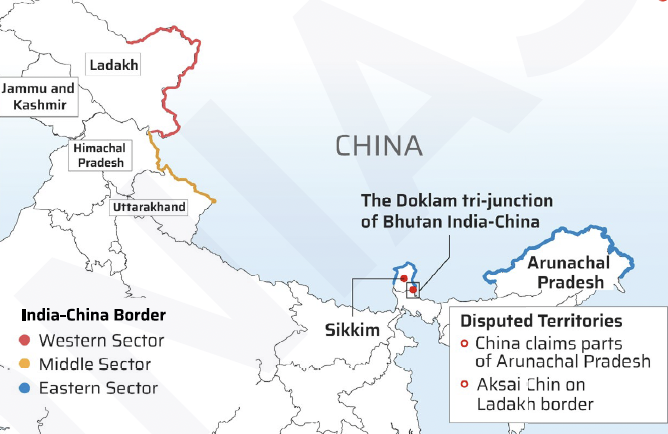
- Foreign Ministers of India and China agree that prolonging the military standoff along the Line of Actual Control (LAC) is not beneficial for either side.
- Emphasis is placed on the need for early dispute resolution to restore border peace and tranquillity.
Key Developments in Meeting
- India stresses the importance of redoubling efforts to achieve complete disengagement from remaining areas in Eastern Ladakh.
- The Eastern Ladakh standoff began in 2020 after a violent clash between troops in the Pangong lake area.
- Both countries agree that the Working Mechanism on Consultation and Coordination on India-China Border Affairs (WMCC) should hold an early meeting.
India-China Border Dispute Overview
- India's 3,488-km border with China is not clearly demarcated, and there is no mutually agreed LAC along certain stretches.
- The border is divided into three sectors: Western sector (Ladakh), Middle sector (Uttarakhand and Himachal Pradesh), and Eastern sector (Arunachal Pradesh and Sikkim).
- India and China have differing views on the border lines in each sector, leading to ongoing disputes.
Way Forward for India-China Relations
- The principles of mutual respect, mutual sensitivity, and mutual interest will guide bilateral ties between India and China.
"UK Elects New PM"
- The UK and India both have a Parliamentary system of democracy.
- In the UK, Parliament is considered supreme.
- In India, Parliamentary sovereignty is subject to Constitutional Supremacy.
- This means that in the UK, Parliament has the ultimate authority, while in India, the Constitution holds the highest power and can limit Parliamentary actions.
Comparison of dimensions of democracy in India and the UK
| Specification | India | UK |
|---|---|---|
| Eligible Voters for election in Lower House |
|
|
| Voting process | The process of voting is conducted using an Electronic Voting Machine (EVM) | Postal ballots allow individuals to vote by mail instead of in person |
| Office of Prime Minister (PM) |
|
|
| Oath by elected Members |
|
|
SEBI's New Guidelines for CRAs
- These guidelines aim to improve the Ease of Doing Business for CRAs and safeguard investor interests.
Key Guidelines for CRAs
- Communication of Ratings: CRAs must inform companies of their ratings within one working day of the rating committee meeting.
- Appeal Process: Companies have the right to request a review or appeal of the rating decision within three working days of the rating committee meeting.
- Public Disclosure: CRAs are required to publish a press release on their website and notify the stock exchange/debenture trustee within seven working days of the rating committee meeting.
- Record Keeping: CRAs must maintain records of these disclosures for a period of 10 years.
Overview of Credit Rating in India
- Credit ratings reflect a CRA's assessment of the likelihood of timely debt repayment and the risk of default on interest and principal payments.
- SEBI (Credit Rating Agencies) Regulations, 1999 defines CRAs as corporate bodies involved in rating securities listed or to be listed on SEBI-recognized stock exchanges.
- There are 7 CRAs registered with SEBI in India, including CRISIL, CARE, ICRA, Acuité, Brickwork Rating, India Ratings (Ind-Ra), and Infomerics Valuation And Rating Pvt. Ltd.
Comparison between CRA and Credit Bureau
- CRAs provide opinions on future debt repayments by borrowers, while credit bureaus offer information on past debt repayments by borrowers.
ASUSE Results: 2021-22 and 2022-23
- ASUSE was conducted by the National Sample Survey Office under the Ministry of Statistics and Programme Implementation.
- The survey covered unincorporated non-agricultural establishments such as proprietorship, partnership, Self-Help Groups, cooperatives, societies, and trusts.
About Unincorporated Enterprise
- Unincorporated enterprises are producer units that are not legally separate from their owners.
- The assets used in these enterprises belong to the owners, not the enterprises themselves.
- These enterprises cannot engage in transactions or contractual relationships with other economic units or incur liabilities on their own behalf.
Key Highlights of ASUSE Survey (2022-23)
- The number of establishments in the sector grew by 5.88% to 6.50 crore, with 55% in rural areas.
- Uttar Pradesh, West Bengal, and Maharashtra have the highest number of establishments.
- Gross Value Added increased by 9.83%.
- Women entrepreneurs led 54% of proprietary establishments in the Manufacturing sector.
- Digitization increased by 7.2% for entrepreneurial purposes.
- Credit availability improved with an increase in outstanding loan per establishment to Rs. 50,138.
Significance of Unincorporated Enterprises
- Unincorporated enterprises make a significant contribution to GDP and employment generation, with 11 crore workers employed in 2022-23.
- They are an integral part of the supply chain, supporting the incorporated sector as suppliers and service providers.
Challenges Faced by Unincorporated Enterprises
- Challenges include lack of access to formal credit and registrations.
- Minimum regulatory oversight leaves them vulnerable to economic shocks and policy changes.