
Daily Current Affairs UPSC 25 June 2024
Welcome to our daily current affairs blog post for UPSC aspirants! In today's edition, we will be discussing the most significant events and news updates that took place on 25th June 2024. Staying updated with current affairs is crucial for UPSC preparation, as it not only helps you stay informed but also enhances your understanding of various subjects. So, let's dive into the important happenings of the day and explore their potential impact on the upcoming UPSC examinations.

Renaming of States
- Kerala Assembly passed a resolution to change the state's name to 'Keralam'.
- The process for renaming states can be initiated by either the Parliament or State Legislature.
- Renaming is governed by Article 3 of the Constitution.
- The Article empowers Parliament to change the name of any state through a law.
- A bill can be introduced in Parliament on the recommendation of the President.
- The bill is then sent to the Legislature of the state for their input.
- The bill must be passed by a simple majority in each house.
- Once the President gives assent, the change in the state's name is recorded in the First and Fourth Schedule of the Constitution.
International Hydrographic Organisation (IHO)
- IHO celebrates World Hydrography Day annually on June 21 to raise awareness about hydrography.
- Hydrography is the science that measures and describes physical features of oceans, seas, coastal areas, lakes, and rivers.
- IHO is an intergovernmental organization that ensures all world's navigable waters are surveyed and charted.
- It coordinates activities of national hydrographic offices.
- IHO Secretariat has been hosted by Principality of Monaco since its establishment in 1921.
- IHO has 100 Member States including India.
- Indian Naval Hydrographic Department under Indian Navy is responsible for hydrographic surveys and nautical charting in India.
Scheme for Partial Reimbursement of Exploration Expenses for Holders of Exploration License
- Ministry of Mines has introduced a Scheme for Partial Reimbursement of Exploration Expenses for Exploration License holders.
- The objective of the scheme is to provide partial reimbursement of exploration expenses from the National Mineral Exploration Trust (NMET).
- NMET was established in 2015 under the Mines and Minerals (Development and Regulation) Act, 1957 to accelerate mineral exploration in the country.
- Eligibility for the scheme is limited to Exploration License holders granted under section 10BA of the MMDR Act.
- The provision of Exploration License was introduced through an amendment in the MMDR Act in 2023.
Front Running
- A Mutual Fund was recently accused of engaging in Front-Running.
- Front-Running involves using non-public information to trade securities before a large order is placed.
- This practice is illegal in India and undermines confidence in financial markets.
- The Securities and Exchange Board of India amended regulations in 2022 to address front running by Mutual Funds.
Central Civil Services (Leave) (Amendment) Rules, 2024
- The Ministry of Personnel Public Grievances and Pensions has notified the Central Civil Services (Leave) Rules, 2024.
- Key amendments include granting maternity leave of 180 days to surrogate or commissioning mothers with less than two surviving children who are Government servants.
- Commissioning mother refers to the intending mother of a child born through surrogacy.
- Central employee commissioning fathers with less than two living children will now be entitled to 15 days of paternity leave within six months of the child's birth.
- Previously, there were no rules in place to grant maternity or paternity leave for surrogacy.
World Craft City (WCC)
- Srinagar has been designated as a 'World Craft City' by the World Crafts Council.
- This recognition will support the handloom and handicraft industry, promote tourism, enhance infrastructure, and attract more investment and funding.
- The World Crafts Council was established in 1964 to empower artisans and preserve craft heritage worldwide.
- The World Crafts Council- International launched the World Craft Cities initiative in 2014.
- The initiative aims to create a network of craft cities globally, promoting the principles of the creative economy.
- It acknowledges the important role of local authorities, craftspeople, and communities in cultural, economic, and social development on a global scale.
Oath of Members of Parliament
- Newly elected Members of Parliament in the 18th Lok Sabha have begun taking their oaths.
- Taking an oath is necessary for MPs to participate in debates and voting in Parliament.
- Constitutional provisions regarding oaths are outlined in Article 99 and Article 104.
- Oaths must be subscribed before the President or a person appointed by him, as per Article 99.
- The forms of oath are provided in the Third Schedule.
- Article 104 imposes a penalty on members who sit in the House without taking the oath.
- There is an exception to this rule where an individual can become a minister without being elected to Parliament and can participate in proceedings without voting.
- Oaths can be taken in English or any of the 22 Scheduled languages.
Javelin anti-tank Weapon System
- India and the US discussed the possibility of producing American javelin missiles in India.
- The Javelin anti-tank Weapon System is considered the world's top single man-portable medium-range anti-tank weapon system.
- The missile automatically guides itself to the target after launch, following a fire-and-forget principle.
- This feature allows the gunner to take cover and avoid counter fire.
- The Javelin missile can be safely fired from inside buildings or bunkers.
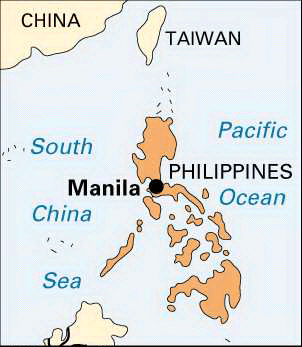
Philippines (Capital: Manila)
- Philippines Ambassador praises BrahMos missiles for providing credible defense.
Political features of the Philippines
- Island country in Southeast Asia located in the western Pacific Ocean
- Surrounded by water bodies such as the Philippine Sea, Celebes Sea, Sulu Sea, and South China Sea.
Geographical features of the Philippines
- Highest Point: Mount Apo.
- Major Rivers: Cagayan River, Mindanao River, Agusan River, etc.
- Climate: Tropical and monsoonal climate in the country.
"The Cost of Inaction: Global Impact of Children and Youth Not Learning"
- The report was a joint effort by UNESCO, OECD, and the Commonwealth Secretariat to analyze the economic and societal impact of educational deficiencies.
Key Findings
- The report found that out-of-school children and educational gaps cost the global economy $10,000 billion annually.
- Despite efforts over the years, around 250 million children and young people globally are still out of school.
- 57% of the world's children lack basic skill levels, highlighting a significant educational gap.
- Secondary education was found to reduce the risk of early marriage and childbirth for girls.
- Early school leavers, especially females, were linked to a 59% increase in early pregnancies.
- A 10% reduction in early school leavers or those without basic skills could boost annual GDP growth by 1 to 2% points.
Recommendations
- The report recommended improving school infrastructure, including single-sex water and sanitation facilities and reducing class sizes.
- It highlighted the success of initiatives like constructing toilets in India, which decreased dropout rates for both girls and boys.
- Promoting health and mental well-being through comprehensive sex education was also recommended.
- The report suggested promoting vocational education and training that addresses gender barriers and meets labor market needs.
Key Initiatives to Address Educational Deficiencies
Global:
- Education was declared a universal human right in 1948, and SDG 4 aims to ensure quality education for all.
India:
- Initiatives like the Right to Education Act 2009, Samagra Shiksha Programme 2018, and the National Education Policy 2020 are key efforts to improve education.
- Other initiatives in India include PM Schools for Rising India (PM SHRI) 2022 and the PMPOSHAN Scheme (formerly known as the Mid-Day Meal Scheme).
"Deadly Tamil Nadu Illicit Liquor Tragedy"
- Deaths have been linked to methanol poisoning from illicitly produced Hooch/Spurious liquor. Hooch is a term used for low-quality alcohol that may contain methanol along with ethanol.
Methanol (CH3OH)
- Also known as wood alcohol or spirit, traditionally produced from wood.
- Modern method involves syngas derived from biomass or other sources.
- Characteristics include being colorless, volatile, and mixable with water.
- Used as a solvent in paints, varnishes, and for making formaldehyde
- Ingestion can cause blindness and even death.
Regulatory Framework
- Food Safety and Standards Regulations set limits on methanol in liquors.
- Hazardous Chemical Rules regulate methanol and are included in Schedule 1.
- Some states have banned the sale of alcoholic drinks containing methanol.
Way forward
- Need for strong central legislation to regulate methanol supply chain
- Tightening laws such as the Poisons Act to prevent methanol poisoning
Ethanol (C2H5OH)
- Obtained commercially through fermentation of sugars.
- Used as a solvent and in the preparation of carbon compounds.
- Also used as a renewable fuel.
- Ingestion affects the central nervous system, judgment, and inhibitions
"India's First Underground Coal Gasification Pilot Project Launched in Jharkhand"
- This initiative aims to transform the coal industry by utilizing in-situ coal gasification.
About Coal Gasification
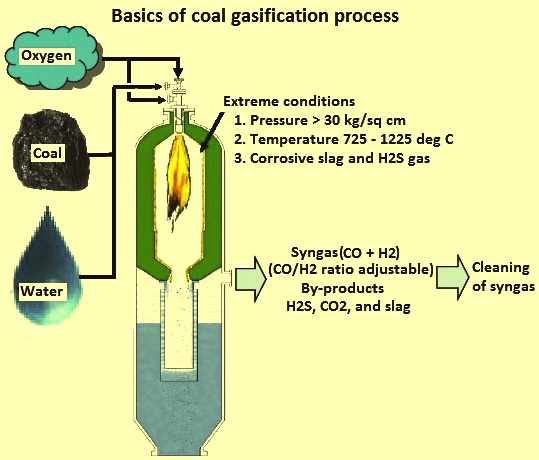
- Coal gasification is a process that converts underground coal into valuable gases like methane, hydrogen, carbon monoxide (CO), and carbon dioxide (CO2).
- During the gasification process, coal is partially oxidized under controlled conditions to produce a liquid fuel called syngas.
- Syngas, a mixture of CO and hydrogen, can be used for power generation and producing gaseous fuels like methane.
Advantages of Coal Gasification
- Provides access to coal resources that are economically unviable through traditional mining methods.
- Enables sustainable and efficient use of India's vast coal reserves, which are the third largest in the world.
- Reduces India's dependence on imported fuel like crude oil and natural gas.
Associated Concerns
- Lack of technology for converting India's low-grade, high ash content coal into syngas.
- Generation of waste, black water, and the need for costly systems for CO2 removal.
- Production of more CO2 compared to conventional coal-powered thermal power plants.
Initiatives Taken
- The National Coal Gasification Mission aims for 100 million tons of coal gasification by 2030.
- 100% Foreign Direct Investment (FDI) allowed in coal mining.
- Viability Gap Funding scheme to promote Coal/Lignite Gasification Projects.
"UN's Global Principles Combat Online Misinformation"
Impact of Digital Platforms on Misinformation and Disinformation Crisis
- Technologies like artificial intelligence contribute to the creation of misinformation at unprecedented levels.
- Misinformation and disinformation are identified as top risks in the Global Risk Report 2024.
- Opaque algorithms create information bubbles and reinforce prejudices, leading to issues like racism and misogyny.
- Health-related misinformation leads to misinterpretation of scientific knowledge, opinion polarization, and escalating fear and panic.
United Nations Global Principles for Information Integrity
- Set of five principles aimed at addressing the harm caused by false information on digital platforms.
- Provides a framework for multi-stakeholder action to promote information integrity.
Recommendations for Stakeholders
- Technology Companies: Integrate safety and privacy into design and delivery, evaluate business models, and modernize content.
- AI Actors (Government and Private Sector): Conduct safe, secure, and trustworthy audits, respect intellectual property rights.
- News Media: Ensure information integrity, transparency, and responsible advertising.
- State and Political Actors: Promote transparency, political participation, capacity building, and access to information.
Five Principles
- Trust and integrity in society.
- Empowering the public.
- Providing healthy incentives.
- Supporting independent, free, and pluralistic media.
- Promoting transparency and research efforts.
"Pakistani Delegation to Inspect HEPs under IWT"
- Delegation arrived to inspect Kishenganga (330MW) and Ratle (850 MW) HEP under IWT.
- Kishanganga HEP diverts water from Kishenganga River to Jhelum River basin in J&K.
- Ratle HEP situated on Chenab River in Kishtwar district, J&K.
About Indus Waters Treaty (IWT)
- Signed in 1960 between India and Pakistan with World Bank as signatory.
- Allocates Western Rivers to Pakistan and Eastern Rivers to India.
- India allowed to construct hydroelectric power facilities on tributaries of Jhelum and Chenab rivers with restrictions.
- Disagreement between countries related to design features of Kishenganga and Ratle HEPs.
- World Bank provides 3 Step Dispute Resolution Mechanism.
Issues with IWT
- Lack of collaboration and mutual trust between countries.
- No regular data sharing as planned in treaty.
- Limited to conflict-resolution mechanism instead of strengthening interaction, trust, and cooperation.
"Ministry of Mines Launches Fourth Tranche Auction"
- 21 critical mineral blocks will be auctioned, containing minerals such as Graphite, Glauconite, Phosphorite, Potash, Nickel, Phosphate, and Rare Earth Elements (REE).
About Critical Minerals
- Critical minerals are essential for modern technologies and are at risk of supply chain disruptions due to limited global production and geopolitical factors.
- In 2023, the Ministry of Mines identified 30 strategically important Critical Minerals, including Antimony, Beryllium, Bismuth, Copper, and Gallium.
Significance of Critical Minerals
- Economic growth: Cobalt, nickel, and lithium are crucial for industries like telecommunications and electric vehicle manufacturing.
- Clean energy: REE are vital for green technologies such as semiconductors, solar panels, and wind turbines.
- National Security and Defense: Cobalt is used in military technologies like smart bombs, aircraft, and precision-guided missiles.
Concerns Associated with Critical Minerals
- Concentration of extraction or processing in a few geographical locations can lead to supply chain vulnerabilities.
- For example, the Lithium triangle consists of Argentina, Chile, and Bolivia.
- India relies on imports for its silver, cobalt needs, mainly sourced from China.
Initiatives for Critical Minerals
- India-Australia Critical Minerals Investment Partnership.
- India has joined the Minerals Security Partnership to catalyze public and private investment in critical mineral supply chains globally.
- Khanij Bidesh India Ltd. (KABIL) is mandated to identify and acquire overseas mineral assets of critical and strategic nature like lithium and cobalt.