
Daily Current Affairs UPSC 15 and 16 August 2024
Welcome to our daily current affairs blog post for UPSC aspirants! In today's edition, we will be discussing the most significant events and news updates that took place on 15th and 16th August 2024. Staying updated with current affairs is crucial for UPSC preparation, as it not only helps you stay informed but also enhances your understanding of various subjects. So, let's dive into the important happenings of the day and explore their potential impact on the upcoming UPSC examinations.

Extremophile
- A recent study found that microwave ovens contain diverse microbial communities and extremophiles.
- Extremophiles are organisms that can survive in extreme conditions such as high pressure, temperature, radiation, and salinity, with Archaea being an example of extremophiles thriving in harsh environments.
- These organisms produce unique enzymes called "extremozymes" that allow them to function in challenging environments.
- Extremophiles play a vital role in supporting plant growth and crop productivity in regions with harsh conditions.
- Extremophiles have applications in various industries including biotechnology, biodegradation, bioremediation, biorefinery, pharmaceuticals, food, agriculture, cosmetics, and textiles.
Gallantry awards
- The President has approved 103 Gallantry awards for Armed Forces and Central Armed Police Forces personnel on Independence Day 2024.
- The order of precedence for Gallantry Awards is Param Vir Chakra, Ashoka Chakra, Mahavir Chakra, Kirti Chakra, Vir Chakra, and Shaurya Chakra.
- Gallantry Awards are announced twice a year, on Republic Day and Independence Day.
- Wartime Gallantry Awards like Param Vir Chakra, Maha Vir Chakra, and Vir Chakra were established in 1950.
- Ashoka Chakra Class-I, Class-II, and Class-III were created in 1952 and later renamed Ashoka Chakra, Kirti Chakra, and Shaurya Chakra in 1967.
- These awards are given for acts of bravery during peacetime.
Prokaryotes
- Scientists have discovered that Prokaryotes are highly adaptable to climate change and could become dominant in marine environments.
- Prokaryotes are microscopic single-celled organisms like bacteria and blue-green algae that lack a defined nucleus and membrane-bound organelles.
- They have a single chromosome, unlike Eukaryotes which include plants, animals, and fungi.
- Eukaryotes have a distinct nucleus and membrane-bound organelles, and can be unicellular or multicellular with multiple chromosomes.
- Plant and animal cells are different types of eukaryotic cells, with plant cells having cell walls, plastids, and a large central vacuole that are not present in animal cells.
Biosurfactants
- Researchers have found that biosurfactants can be made using environmentally friendly materials from agricultural and industrial waste.
- Surfactants are substances that can lower the surface tension of a liquid, making it easier to spread and wet surfaces. For example, detergents are surfactants.
- Biosurfactants are active compounds produced by microbes that reduce surface and interfacial tension. They are made by bacteria, yeasts, and fungi.
- Microbial surfactants have advantages over synthetic ones, such as being less toxic and more easily broken down by natural processes. They also remain effective in extreme pH and salinity conditions.
Amrit Bharat Station Scheme
- Dahisar and Kandivali in Mumbai have recently been included in the Amrit Bharat Station Scheme.
- The Amrit Bharat Station Scheme, led by the Ministry of Railways, aims to enhance and modernize railway stations for passengers.
- The scheme plans to upgrade a total of 1275 stations with initiatives such as improved accessibility, free Wi-Fi, and promoting 'One Station One Product'.
- The long-term vision of the scheme includes creating Master Plans for stations to enable seamless multi-modal connectivity and promote Transit Oriented Development.
Gross environment product Index
- Uttarakhand is the first state in India to introduce the Gross Environment Product Index (GEPI).
- GEPI is a new way to measure the environmental impact of human activities.
- The four pillars of GEPI are air, soil, trees, and water.
- The formula for calculating the GEPI index includes factors such as air quality, water quality, soil health, and forest cover. GEP index = (Air- GEP index + Water- GEP index + Soil-GEPindex + Forest-GEP index)
- GEPI helps to evaluate the effects of human activities on the environment and natural resources.
- It also measures the contributions of natural ecosystems to the economy and overall well-being.
Californium
- Authorities in Patna seized a package believed to contain Californium.
- Californium is a synthetic radioactive element with an atomic number of 98.
- It was discovered in 1950 by Stanley Thompson, Kenneth Street, and others, and named after the University of California.
- Californium is highly radioactive and very expensive.
- It has various applications such as in portable metal detectors, identifying gold and silver ore, and assisting in starting up nuclear reactors.
- However, it also poses threats such as damaging genetic makeup and being hazardous to health due to its radioactivity.
Dengue
- Indigenous tetravalent dengue vaccine, DengiAll, is moving forward to phase-3 clinical trials.
- The trial will be conducted in collaboration with the Indian Council of Medical Research and Panacea Biotec.
- Dengue, also known as Break-Bone Fever, is a viral infection transmitted by infected female Aedes mosquitoes.
- Dengue is commonly found in tropical and sub-tropical climates, particularly in urban and semi-urban areas.
- Severe cases of dengue can lead to conditions such as dengue hemorrhagic fever and dengue shock syndrome in adults.
- Currently, there is no antiviral treatment or licensed vaccine available for dengue in India.
Sri Aurobindo Ghose
- The Prime Minister honored Sri Aurobindo on his birthday.
About Aurobindo Ghose (15 August 1872 – 5 December 1950)
- Aurobindo Ghose was born in Kolkata, West Bengal on August 15, 1872.
- He was an Indian nationalist, poet, philosopher, and yogi.
His Contributions:
- He helped establish the youth club Anushilan Samiti.
- He was arrested in connection with the Alipore Bomb Case in 1908.
- He contributed to journals such as Jugantar, Bande Mataram, and Karmayogi.
- He founded the Sri Aurobindo Ashram in Pondicherry in 1926.
- He focused on spiritual nationalism and developed the Integral Yoga system.
- Some of his notable books include The Life Divine, Savitri, Essay on the Gita, The Synthesis of Yoga, Defense of Indian Culture, among others.
Values:
Strength, devotion to one's spiritual beliefs and country, willingness to give up something valuable, and other similar qualities.
India's Wetlands Gain Ramsar Status
| Wetland | Specifications |
|---|---|
| Nanjarayan Bird Sanctuary (Tamil Nadu) |
|
| Kazhuveli Bird Sanctuary (Tamil Nadu) |
|
| Tawa Reservoir (Madhya Pradesh) |
|
About Wetland
- A wetland is a piece of land that is filled with water.
- Wetlands must meet at least one of nine criteria, such as supporting a large number of water birds or conserving biological diversity.
- Currently, India has a total of 85 Ramsar Sites, with Tamil Nadu having the highest number of these designated sites.
"Minister Launches AI Pest Surveillance System"
- NPSS will offer regular pest management advisories and promote Integrated Pest Management.
- It falls under the Directorate of Plant Protection, Quarantine & Storage (Ministry of Agriculture).
Need for NPSS
- To reduce farmers' reliance on pesticide retailers and address pesticide overuse.
- Pest attacks can lead to up to 20% losses in food production.
AI and Agriculture
- AI can be utilized to tackle food scarcity, climate change, low yield, etc.
Applications of AI in Agriculture
- Diagnostic: Identifying water stress, pest infestation, and diseases.
- Prescriptive: Analyzing soil health and prescribing fertilizer.
- Advisory: Providing weather advisories and irrigation scheduling.
- Predictive: Predicting yield, forecasting pest attacks, and issuing early warnings.
Challenges in AI Adoption in Indian Context
- Policy issues: Inadequate data governance, rights enforcement, regulations, etc.
- Farmers' attitude: Resistance to change, risk-aversion, lack of trust in technology.
- Marginalization and digital divide: Lack of digital infrastructure hindering smallholders from using advanced technologies.
- High initial investment: Acting as a barrier for small-scale farmers.
Way Forward
- Continued investment in research and infrastructure.
- Providing financial support and subsidies to Research Institutes for developing region-specific AI models and applications.
Initiatives for Promoting AI in Agriculture
- Kisan e-Mitra: AI-powered chatbot assisting farmers on PM Kisan Samman Nidhi scheme.
- AI for Agriculture Innovation (AI4AI) initiative by the World Economic Forum.
- 'Saagu-Baagu' initiative under AI4AI to promote innovation in agriculture in Telangana.
- AI-based analytics for crop health monitoring using satellite datasets for rice and wheat crops.
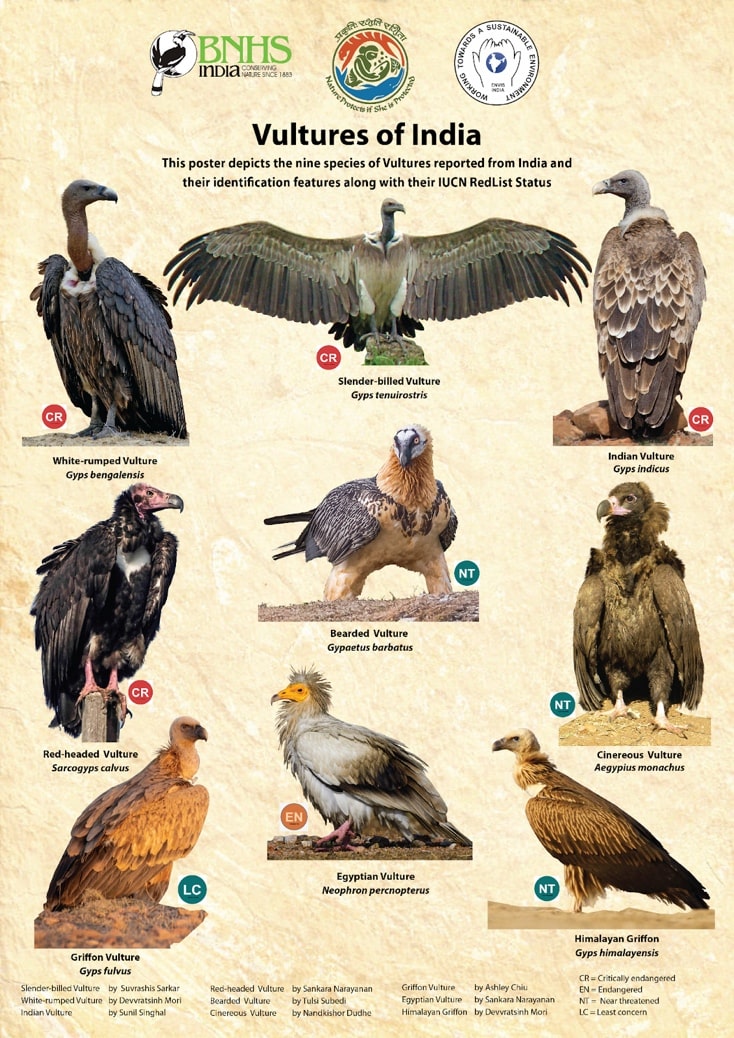
"Vulture Decline and Premature Deaths"
A recent study suggests that approximately 500,000 people may have died prematurely in India between 2000 and 2005 as a result of the functional extinction of vultures.
Impact of Vulture Decline in India
- Keystone Species: Vultures play a crucial role in cleaning up disease-ridden carcasses and reducing populations of other scavengers, such as feral dogs and pathogens.
- Human Health Crisis: The decline in vulture population has led to an increase in human mortality by over 4% due to a negative shock to sanitation, resulting in increased pathogens.
- Economic Costs: The public health crisis caused by the decline in vulture population has resulted in nearly $70 billion in annual monetary damage.
Vultures in India
- Characteristics: Vultures are large carrion-eating birds mainly found in the tropics and subtropics, with 9 species found in India, including 3 migratory species.
- Conservation Status: Vultures are protected under Schedule (1) of the Wildlife Protection Act 1972.
- Threats: Vultures in India face threats such as loss of natural habitats due to human activities, food scarcity, exposure to the drug diclofenac, and electrocution.
Vulture Conservation Initiatives
- Ban on Veterinary Use of Diclofenac: In 2006, the use of diclofenac, ketoprofen, and aceclofenac in veterinary practices was banned to protect vultures.
- Action Plan for Vulture Conservation: India has implemented a five-year action plan for vulture conservation from 2020 to 2025.
- Conservation Centers: Vulture conservation breeding centers have been established in places like Pinjore, Haryana, and vulture restaurants have been set up in locations like Koderma and Raigad.
"Bio-Economy: The Future of Industry"
- The Minister emphasized the significance of the Bio-Economy sector during the 4th edition of Global Bio-India, which is a strategic initiative led by the Department of Biotechnology and BIRAC.
About Bio-Economy
- Bio-Economy involves the knowledge-based production and utilization of biological resources in a sustainable manner across various economic sectors such as Bioindustrial, Biopharma, and Bioagriculture.
- The Bio-Economy sector has experienced significant growth, increasing from $10 billion in 2014 to over $130 billion in 2024, with a projected target of $300 billion by 2030. India currently ranks 12th globally in bio-manufacturing.
Significance of Bio-Economy
- Decreases dependence on fossil fuels, lowers greenhouse gas emissions, and supports sustainability efforts.
- Encourages a circular economy by reducing waste and maximizing resource efficiency, such as converting agricultural waste into biogas.
- Plays a significant role in India's economy, accounting for 4% of GDP and providing employment for over 2 million individuals.
- Progress in bio-based technologies can improve agricultural productivity, increase pest resistance, and enhance food security.
Challenges Faced by Bio-Economy Sector
- Challenges in the Bio-Economy sector include uncertain regulatory structures, lack of uniform industry standards, limited research centers, and insufficient R&D funding.
- Ethical challenges related to Responsible Research and Innovation, such as genetic modification, also pose obstacles.
Initiatives and Policies to Support Bio-Economy
- BIRAC plays a vital role in fostering biotech innovation in India through industry-focused schemes like the Biotechnology Ignition Grant Scheme and BioNEST.
- Policy measures such as the National Biofuel Policy 2018 and the National Biopharma Mission aim to boost the Bio-Economy sector.
- The Biological Research Regulatory Approval Portal (BioRRAP) has been launched as a single gateway for regulatory approval for biological research, streamlining the process for researchers and industry players.
Monkeypox Outbreak Declared PHEIC by WHO
- The decision to declare a global Public Health Emergency of International Concern (PHEIC) was made based on recommendations from the International Health Regulations (IHR) Emergency Committee.
- This declaration was made due to an outbreak of Mpox in the Democratic Republic of Congo (DRC) and cases outside of Africa, marking the second time in two years that Mpox has been declared a global PHEIC.
About Mpox
- Monkeypox is a viral illness caused by the monkeypox virus, which is a type of Orthopoxvirus.
- It was first found in humans in 1970 in the Democratic Republic of the Congo.
- The virus spreads through close contact and typically results in symptoms similar to the flu and skin lesions filled with pus.
- Monkeypox is most commonly seen in central and western Africa and primarily affects gay, bisexual, and other individuals.
- Vaccines and treatments developed for smallpox have been approved for use in some countries and can also be used for monkeypox in certain situations.
About PHEIC
- According to the International Health Regulations (IHR) of 2005, a public health emergency of international concern (PHEIC) is defined by certain criteria.
- The IHR of 2005 is a legally binding agreement that involves 196 countries worldwide, including all Member States of the World Health Organization (WHO).
- A PHEIC is the highest level of alert that WHO can issue under the IHR.
- Since 2009, WHO has declared seven international public health emergencies, such as the H1N1 influenza pandemic, polio outbreak, Ebola outbreaks in West Africa and Congo, Zika epidemic, COVID-19, and Mpox.
"ISRO Launches EOS-08 Earth Observation Satellite"
- The SSLV-D3/EOS-08 mission successfully launched a satellite into orbit from the Satish Dhawan Space Centre in Sriharikota.
- The mission's goal is to operate in a circular Low Earth Orbit at an altitude of 475 km with an inclination of 37.4°, and it is expected to have a mission life of 1 year.
- The SR-0 DEMOSAT, developed by Space Kidz India, was also included in the payload for this mission.
Objectives of EOS-08 mission:
- Designing and developing a microsatellite: The main goal of the mission is to create a small satellite for specific purposes.
- Creating payload instruments compatible with the microsatellite bus: Developing instruments that can be used with the microsatellite.
- Incorporating new technologies required for future operational satellites: Implementing cutting-edge technologies that will be useful for future satellite missions.
Payloads of EOS-08 Mission:
- Electro Optical Infrared Payload (EOIR) payload: This payload is used to capture images in specific infrared bands for various applications such as disaster monitoring and environmental monitoring.
- Global Navigation Satellite System-Reflectometry (GNSS-R) payload: This payload utilizes remote sensing to measure ocean winds, soil moisture, and other environmental factors.
- SiC UV Dosimeter: This instrument is designed to monitor UV irradiance at specific locations to ensure astronaut safety during missions.
About Earth observatory satellites (EOS):
- EOS are satellites specifically designed for Earth observation from space.
- Earth observation involves collecting data on natural and artificial activities on Earth, including various systems and processes.
- These satellites are used for applications such as early warning systems and environmental impact monitoring.
About Small Satellite Launch Vehicle (SSLV)-D3:
- SSLV-D3 is the third developmental flight of the SSLV program.
- The SSLV is capable of launching small satellites into specific orbits using a combination of solid and liquid fuel stages.
- The benefits of SSLV include low cost, flexibility in accommodating multiple satellites, and minimal infrastructure requirements for launch.