
Daily Current Affairs UPSC 21 September 2024
Welcome to our daily current affairs blog post for UPSC aspirants! In today's edition, we will be discussing the most significant events and news updates that took place on 21th September 2024. Staying updated with current affairs is crucial for UPSC preparation, as it not only helps you stay informed but also enhances your understanding of various subjects. So, let's dive into the important happenings of the day and explore their potential impact on the upcoming UPSC examinations.

Witness Protection Scheme (WPS), 2018
- The Supreme Court emphasized the importance of witnesses as crucial to the justice system and expressed concerns about the implementation of the Witness Protection Scheme (WPS) in 2018.
- The WPS was approved by the Supreme Court in 2018 and is applicable in all States and Union Territories.
- The objective of the WPS is to protect witnesses by assessing threats and implementing protection measures such as changing identities and relocating witnesses.
- Witnesses are categorized into three groups based on the level of threat they face: Category A for threats to life, Category B for threats to safety, reputation, or property, and Category C for moderate threats.
- The WPS includes the establishment of a State Witness Protection Fund managed by the Department or Ministry of Home under the State or Union Territory Government.
Facial Recognition Technology (FRT)
- The government has implemented the FRT two factor authentication process for distributing Take Home Ration (THR) as a trial run.
- THR is a component of the Integrated Child Development Scheme (ICDS).
- The two factor authentication process involves capturing and verifying the beneficiary's photo, as well as sending a one-time password to their phones.
- FRT, or Facial Recognition Technology, is an AI system that uses complex algorithms to identify or verify a person based on images or video data.
- FRT creates a virtual facial map by analyzing key features of the face and their distances from each other.
- FRT can be used for two main purposes: 1:1 verification, which matches a person's facial map to a specific photograph, and 1:n identification, which compares a person's face against an entire database.
Credit Default Swaps
- SEBI has permitted mutual funds to trade Credit Default Swaps (CDS) in order to enhance liquidity in the corporate bond market.
- A CDS is a type of financial derivative that enables investors to exchange or mitigate their credit risk with another investor.
- CDS function as insurance agreements that safeguard investors in the event of a bond issuer failing to make their scheduled payments.
- Premium payments are made to maintain CDS, similar to how insurance contracts operate in the bond market.
Vivad Se Vishwas Scheme 2024
- The Finance ministry has announced the Direct Tax Vivad Se Vishwas Scheme, 2024 (VSV 2.0) to resolve income tax disputes currently under appeal.
- The aim of VSV 2.0 is to simplify taxes, improve taxpayer services, reduce litigation, and enhance government revenue.
- Taxpayers can settle appeals, writ petitions, and special leave petitions pending in the Supreme Court, high courts, and appellate tribunals before July 22, 2024 by paying the full tax amount and waiving any interest and penalties.
- The scheme is open to both taxpayers and tax authorities involved in the disputes.
Square Kilometer Array
- The Square Kilometer Array (SKA), the world's largest radio telescope currently under construction, has conducted its initial observations and is now partially operational.
- The SKA project aims to build the largest radio telescope in the world, with a collecting area of over one square kilometer.
- SKA will be made up of a global observatory with two large telescopes located in South Africa and Australia.
- The objectives of the SKA telescopes include understanding the origins of the Universe, detecting gravitational waves, and studying the evolution of galaxies, dark matter, and cosmic magnetism.
- India became an Associate Member of the SKA Organization in 2012 and has actively participated in the pre-construction phase of the SKA telescopes.
Food Import Rejection Alert (FIRA)
- The FIRA online portal was launched by the government during the 2nd edition of the Global Food Regulators Summit 2024.
- The portal was developed by FSSAI and is hosted by the Food Safety Standards Authority of India in New Delhi.
- FIRA generates alerts on food consignments rejected by India due to poor safety standards, notifying the public and food safety authorities.
- It has an online interactive interface for rapid dissemination of information, ensuring enhanced traceability and transparency.
- The portal provides a database for tracking rejected food products, strengthening the risk management system, and preventing health risks arising from rejected food.
Criticality
- The third PHWR unit at the Rajasthan Atomic Power Project has achieved criticality at Rawatbhata.
- Two PHWR units at the Kakrapar Atomic Power Station in Gujarat have also achieved criticality.
- Criticality is when a reactor releases enough neutrons in each fission event to sustain a chain reaction.
- When a reactor is critical, it is in the ideal operating condition for energy production, with power neither increasing nor decreasing.
Sustainable Aviation Fuel (SAF)
- India and Brazil have agreed to work together on the production and use of Sustainable Aviation Fuels (SAF).
- SAF is currently the most developed and effective way to reduce carbon emissions in the aviation industry.
- This liquid fuel is used in commercial aviation and can lower CO2 emissions by up to 80%.
- SAF has fewer impurities like sulphur, leading to a significant decrease in sulphur dioxide and particulate matter emissions.
- It can be made from various sources such as waste oil, green waste, and non-food crops, as well as through a synthetic process that captures carbon from the air.
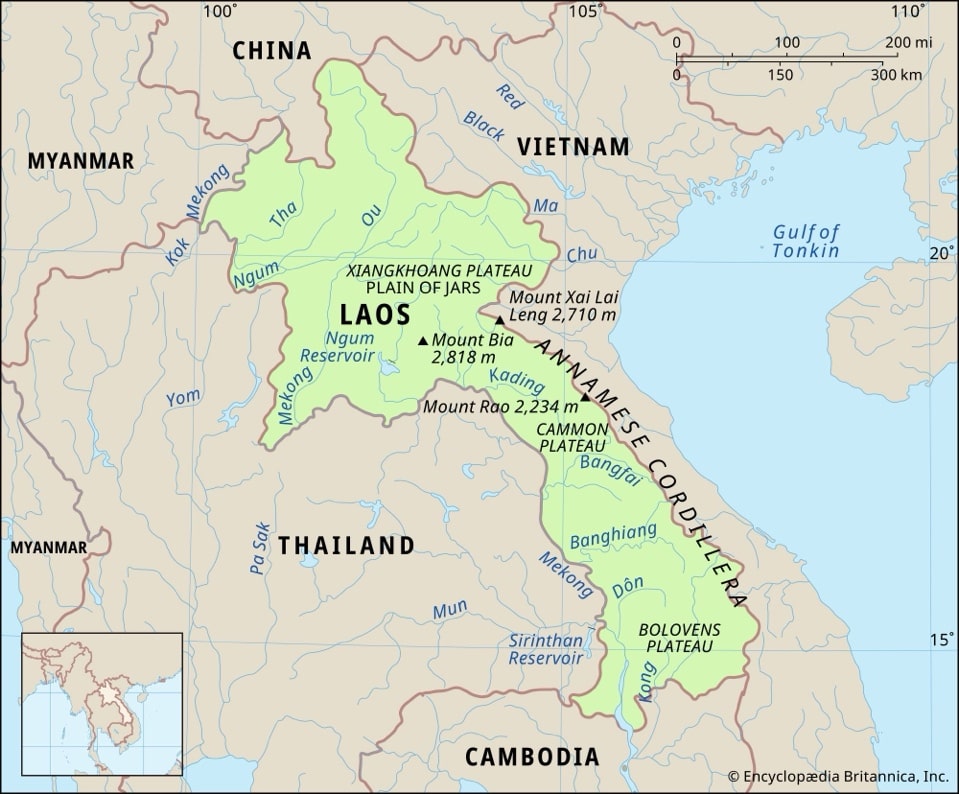
Lao PDR (People’s Democratic Republic) (Capital: Vientiane)
- India’s Minister for Commerce and Industry co-chaired the 21st ASEAN-India Economic Ministers meet in Lao PDR
- Political Features of Laos
- Location: Only landlocked country in Southeast Asia and a member of ASEAN
- Part of Golden Triangle, known for opium growing
- Bordering Countries: China, Vietnam, Cambodia, Thailand, and Myanmar
- Geographical Features of Laos
- Plateaus: Xiangkhiang, Bolovens, and Khammouan
- Mountain Ranges: Annamite Range, Luang Prabang Range
- Highest Peak: Phu Bia
- Major Rivers: Mekong (bordering Myanmar and Thailand)
Celebrating a Century of ICAR-NISA
ICAR-NISA was originally founded in 1924 as the Indian Institute of Natural Resins and Gums in Ranchi, Jharkhand. In 2022, it was renamed ICAR-NISA and now operates under the Ministry of Agriculture and Farmers' Welfare.
Secondary Agriculture
- Secondary agriculture involves adding value to primary agricultural products and engaging in other agriculture-related activities such as beekeeping, poultry farming, and agricultural tourism.
- It encompasses all activities that transform agricultural produce, residues, and by-products into high-value commodities for various uses including pharmaceutical, industrial, medicinal, and specific food purposes.
- Secondary agriculture covers both food and non-food processing, making it a comprehensive term for value-added agricultural practices.
- Example: Extracting vitamins from grains and oil from rice bran, creating jaggery from sugarcane, setting up a small-scale unit for producing jams, pickles, and other products.
Growth Potential:
- There is a growing desire among consumers for products that offer added value, such as ready-to-eat meals and functional foods.
- There is a need to utilize alternative renewable resources from agriculture and biology.
- There are significant amounts of agricultural byproducts available.
Significance of Secondary Agriculture
- Utilizing crop residues and agricultural waste in an environmentally sustainable way, rather than burning or dumping them, is important.
- Activities like beekeeping and lac culture can provide farmers with better economic returns.
- Adding value to products can increase shelf life and overall productivity.
- Promoting agriculture, rural, and cottage industries, as well as the use of technology, can help support sustainable practices.
Challenges of Secondary Agriculture
- Industries that are creating valuable products from agricultural by-products such as Active Pharmaceutical Ingredients are still in the early stages of development.
- The small size of land holdings in India is making it challenging to collect crop residue.
- There is a lack of research in developing appropriate technology for processing agricultural waste.
- Farmers are not well-informed about how to properly process agricultural waste.
"PM MITRA Park Opens in Maharashtra"
- The Maharashtra Industrial Development Corporation (MIDC) is in charge of developing it as the State Implementation Agency.
- It is part of the PM MITRA Park Scheme, which includes a total of 7 parks.
- Other states involved in the scheme are Tamil Nadu, Telangana, Gujarat, Karnataka, Madhya Pradesh, and Uttar Pradesh.
About PM MITRA Park Scheme
- In 2021, the Ministry of Textiles announced the creation of MITRA parks.
- The concept is based on the 5F vision: Farm to Fibre to Factory to Fashion to Foreign.
- The goal is to establish modern industrial infrastructure for the textile industry's entire value chain.
- The project will be implemented from 2021-22 to 2027-28 by a Special Purpose Vehicle owned by the Centre and State Government.
- Eligibility for MITRA parks includes having at least 1000 acres of contiguous and encumbrance-free land, as well as adherence to State Textile and industrial policies.
- MITRA parks can be either Greenfield (newly developed) or Brownfield (existing) sites.
Benefits of PM MITRA Parks Scheme
- Reducing logistics costs/Enhancing Competitiveness: The scheme aims to create an integrated value chain from spinning to garment manufacturing at one location, which can help reduce logistics costs and enhance competitiveness in the textile industry.
- Employment Generation: Each park is expected to create 1 lakh jobs directly and 2 lakh jobs indirectly, providing a significant boost to employment opportunities in the sector.
- Achieving SDG Target: The scheme aligns with Sustainable Development Goal 9, which focuses on building resilient infrastructure, promoting sustainable industrialization, and fostering innovation in the textile industry.
Other initiatives for textiles Industry
- Scheme for Capacity Building in Textile Sector (SAMARTH): This initiative addresses the skilled manpower requirement across the textile sector, helping to improve the overall workforce in the industry.
- Amended Technology Up-gradation Fund Scheme (ATUFS): This scheme provides credit linked Capital Investment Subsidy (CIS) to units for the purchase of benchmarked machinery in different segments of the textile sector, promoting technological advancement.
- National Technical Textiles Mission: This mission focuses on promoting technical textiles in the industry, encouraging innovation and diversification in the sector.
- Production Linked Incentive (PLI) Scheme for Textiles: This scheme provides incentives for increased production in the textile industry, aiming to boost manufacturing and exports in the sector.
"Union Cabinet Approves Venus Orbiter Mission"
- The Venus Orbiter Mission (VOM) will be carried out by the Department of Space, with the goal of placing a scientific spacecraft in orbit around Venus.
- ISRO will handle the spacecraft's development and launch, with the mission set to take place in March 2028.
- The total budget for the mission is Rs. 1,236 Crore, with Rs. 824 Crore allocated for the spacecraft itself.
Significance of VOM
- Aims to study Venusian surface, subsurface, atmospheric processes, and the Sun's influence on Venus.
- Helps understand the evolution of Venus and Earth.
- Prepares India for future planetary missions with larger payloads and optimal orbit insertion approaches.
- Offers employment opportunities and technology spin-offs to other sectors of the economy.
About Venus
- Venus is Earth's closest planetary neighbor and is often called Earth's twin due to its similar size and shape.
- Venus has a thick atmosphere that traps heat, creating a hot environment.
- The planet is covered in toxic clouds of sulfuric acid.
- Phosphine, a potential indicator of microbial life, has been detected in Venus' clouds.
- Venus and Uranus are the only planets that rotate from east to west, while others rotate west to east.
Missions to Venus
| Mission (Year) | Highlights |
|---|---|
| Past Missions | |
| Mariner 2 (1962, USA) | The initial spacecraft to reach Venus did not find a magnetic field. |
| Venera 7 (1970, Soviet Union) | The first soft landing on Venus was a success. |
| Magellan (1990, USA) | Venus' surface was mapped using radar for the first time on a near-global scale. |
| Akatsuki (2015, Japan) | Research is being conducted on the atmosphere of Venus. |
| Future Missions | |
| DAVINCI Venus Flyby and Probe (2029, NASA) | NASA's upcoming mission to Venus, focusing on atmospheric studies. |
| VERITAS Orbiter (2031, NASA) | A mission to map Venus' surface in high resolution. |
| EnVision Orbiter (2031, ESA) | ESA's Venus Orbiter, scheduled for 2031, focusing on surface studies. |
Bombay HC strikes down IT Rules amendment mandating FCU establishment
Verdict in the Kunal Kamra vs Union of India Case.
Background:
- The 2023 amendment to the IT Rules allowed the Government to identify and remove fake news related to its business on social media platforms through the FCU.
- Intermediaries were required to take down flagged fake news or face legal action and lose their safe harbor protection.
- The Supreme Court in 2023 halted the establishment of the FCU in the Press Information Bureau as notified by the Centre.
Key Observations by the HC:
Rules are considered unconstitutional or beyond the powers of the IT Act, 2000
- Violate Principles of Natural Justice and Fundamental Rights
- Article 14: Equality before Law.
- Article 19 (1) (a): Freedom of Speech and Expression.
- Article 19 (1) (g): Freedom to practice any profession.
- Article 21: Right to Life and Personal Liberty.
- Rules are vague and do not clearly define fake or misleading news.
- The absence of a "right to the truth" means the State is not responsible for providing citizens with only accurate information determined by the FCU.
- Rules fail to satisfy the test of proportionality.
About Test of Proportionality:
- The restriction of a fundamental right must meet certain criteria:
- Legitimacy: Determines if the law serves a legitimate government purpose.
- Suitability: Ensures that the law effectively achieves its objective.
- Necessity: Considers if the law is necessary or if there are less restrictive options available.
- Balancing: Considers the benefits of the law against the potential infringement of rights.
"Joining the International Big Cat Alliance"
India, along with Nicaragua, Eswatini, and Somalia, became a founding member of the IBCA by signing and ratifying the Framework Agreement.
About the IBCA Initiative
- In 2023, India launched the International Big Cat Alliance (IBCA) to celebrate 50 years of Project Tiger.
- The goal of IBCA is to enhance global cooperation for the conservation of seven big cat species and their habitats.
- India is home to all big cat species except Puma and Jaguar.
- IBCA includes 95 big cat range countries, non-range countries interested in conservation, and various conservation partners and scientific organizations.
- All UN member countries are eligible to join IBCA.
- Nine international organizations have agreed to be partner organizations of IBCA.
- IBCA will receive Rs. 150 crores in funding over five years from 2023-24 to 2027-28.
- The headquarters of IBCA is located in India.
Significance of Protecting Big Cats
- Keystone species help protect the delicate balance of biodiversity in their ecosystem by preserving predators.
- Apex predators play a crucial role in maintaining ecosystem health by controlling herbivore populations through hunting.
- Protecting these species can also benefit the economy by creating jobs and boosting ecotourism.
Conservation Status of Big Cats in India
- In India, tigers are endangered, lions, cheetahs, snow leopards, and leopards are vulnerable, jaguars are near threatened, and pumas are least concern.
- All five big cats in India are listed in Schedule 1 and 4 of the Wildlife Protection Act, 1972, and CITES Appendix.
Work-Life Balance Concerns in India
The International Labour Organization (ILO) has identified India as one of the most overworked countries worldwide.
Key findings
- India ranks second after Bhutan for the percentage of employed individuals working 49 or more hours per week, with 51% of workers falling into this category.
- Pacific Island nations like Vanuatu, Kiribati, and Micronesia have significantly lower average working hours per week compared to India, with averages ranging from 24.7 to 30.4 hours.
- The average working hours per week in India are approximately 46.7 hours.
Factors Contributing to Work-Life Imbalance in India
- Remote work due to technological advancements and the Covid-19 pandemic has led to indefinite working hours for many individuals.
- Gender bias in family responsibilities has resulted in only 32% of women in India reporting that they are able to maintain a work-life balance, according to a study by IIM-A.
- The industry's focus on counting hours rather than measuring productivity has contributed to the lack of work-life balance.
- The informal economy in India has led to an uneven distribution of work hours among individuals.
Impacts of Long Working Hours in India
- Long working hours have been linked to negative health outcomes such as an increased risk of stroke, stress, and impacts on mental well-being.
- Enterprises in India experience negative externalities from long working hours, including lower productivity levels and higher rates of absenteeism.
- Social impacts of long working hours in India include less engagement in community and civic life.
Steps to Achieve Work-Life Balance in India
- Implementing limits on working hours, such as a 40-hour workweek as seen in countries like Iceland, Spain, and the UK, can help promote work-life balance.
- Introducing a "Right to Disconnect" policy, as seen in countries like France and Australia, can allow individuals to refuse work-related contact outside of working hours.
Legal Provisions Related to Working Hours in India
- The ILO's Hours of Work (Industry) Convention, 1919, sets a limit of 8 hours per day and 48 hours per week for persons employed.
- The Indian Factories Act, 1948, prohibits adult workers from working more than 48 hours in any week.
- The Weekly Holidays Act, 1942, ensures that employed individuals in India are granted weekly holidays.