
Daily Current Affairs UPSC 17 July 2024
Welcome to our daily current affairs blog post for UPSC aspirants! In today's edition, we will be discussing the most significant events and news updates that took place on 17th July 2024. Staying updated with current affairs is crucial for UPSC preparation, as it not only helps you stay informed but also enhances your understanding of various subjects. So, let's dive into the important happenings of the day and explore their potential impact on the upcoming UPSC examinations.

Money Bill
- The Supreme Court has agreed to hear petitions challenging the Union Government's use of the Money Bill route to pass certain bills in Parliament.
- A Money Bill is defined under Article 110 of the Indian Constitution and includes provisions related to taxes, borrowing of money, or government guarantees.
- The Speaker of the Lok Sabha has the final decision on whether a bill qualifies as a Money Bill.
- According to Article 109, Money Bills can only be introduced in the Lok Sabha.
Asmita Project
- Ministry of Education launched the Asmita Project and two other initiatives to promote multilingualism in education.
- These initiatives are in line with the New Education Policy, 2020.
- The Asmita Project aims to provide high-quality study materials in native languages, with 22,000 books to be produced in 22 scheduled languages over 5 years.
- The University Grants Commission (UGC) and Bharatiya Bhasha Samiti (BBS) are the implementing agencies for the Asmita Project.
- Bahubhasha Shabdkosh is a comprehensive multilingual dictionary repository.
- The Real-time Translation Architecture will enhance translation using cutting-edge technology.
CEPI
- The first health research-related Pre-clinical Network Facility in Asia has been opened in Faridabad, Haryana under CEPI.
- A Genetically Defined Human Associated Microbial Culture Collection Facility has also been inaugurated.
- CEPI was launched in 2017 by Norway and India, along with the Bill & Melinda Gates Foundation and the World Economic Forum.
- The aim of CEPI is to speed up the development of vaccines for emerging infectious diseases and ensure fair access to these vaccines.
- CEPI is headquartered in Oslo, Norway.
Indian Council of Agricultural Research
- The 96th Foundation and Technology Day of Indian Council of Agricultural Research (ICAR) was recently celebrated.
- ICAR was established in 1929 as a registered society under the Societies Registration Act, 1860, based on the report of the Royal Commission on Agriculture.
- The objective of ICAR is to coordinate, guide, and manage research and education in agriculture, horticulture, fisheries, and animal sciences in India.
- ICAR is an autonomous organization under the Department of Agricultural Research and Education, Union Ministry of Agriculture and Farmers Welfare.
- The headquarters of ICAR is located in New Delhi.
- The Union Minister of Agriculture serves as the ex-officio President of the ICAR Society.
Inverse ETF
- SEBI is considering adding a new asset class for investors that includes long-short equity funds and inverse ETFs.
- Inverse ETFs, also known as Short ETFs or Bear ETFs, are constructed using derivatives to profit from a decline in the value of an underlying benchmark.
- ETFs are marketable securities that track an index, commodity, bonds, or a basket of assets like an Index Fund.
- Inverse ETFs specifically gain from a drop in the value of an underlying benchmark.
- These types of ETFs are typically only intended for short holding periods.
Role of Climate Change on Length of Earth Day
- Recent research shows that the melting of polar ice caps is causing the Earth's rotation to slow down, resulting in longer days.
- Climate change is causing glaciers and polar ice sheets to melt faster, leading to a rise in sea levels and mass transport from the poles to the equator.
- This mass transport is increasing the Earth's oblateness and lengthening the day since 1900.
- The implications of these findings include challenges for precise timekeeping and space navigation due to the changing length of Earth's day.
Chagos Islands
- India has promised to support Mauritius in its territorial dispute with the UK over the Chagos islands.
- The Chagos islands consist of 58 small, low-lying islands in the Indian Ocean, including key islands like Salomon Islands, Diego Garcia, and Nelsons Island.
- Diego Garcia is home to a US naval support facility and is strategically located about 1,600 km south of the Indian subcontinent.
- The Chagos islands are currently controlled by the UK as the British Indian Ocean Territory.
- In 2019, the International Court of Justice (ICJ) advised the UK to unconditionally withdraw from the islands.
R21/Matrix-M
- Ivory Coast is the first country to administer the new R21/Matrix-M malaria vaccine to children under 2 years old.
- Malaria is a dangerous disease caused by a parasite transmitted to humans by certain mosquitoes.
- The R21/Matrix-M vaccine is the second malaria vaccine recommended by the WHO, following the RTS,S/AS01 vaccine.
- Developed by the University of Oxford with technology from Novavax, the vaccine targets the initial form of the malaria parasite entering the human body.
- The Serum Institute of India is responsible for manufacturing and scaling the production of the vaccine.
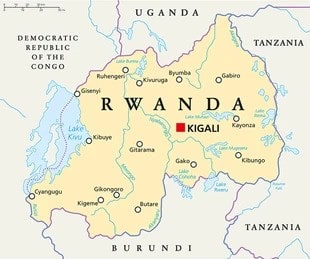
Rwanda (Capital: Kigali)
Rwanda's current President secures victory for a fourth term
- Political Boundaries
- Located in east-central Africa, south of the Equator.
- Borders with Uganda, Tanzania, Burundi, and Democratic Republic of Congo.
- Geographical features
- Known as 'The Land of a Thousand Hills'.
- Highest point: Mount Karisimbi in Virunga Range.
- Major Lakes: Lake Kivu, Muhazi Lake, etc.
- Major Rivers: Akagera, Akanyaru, Mukungwa (in Nile Basin) and Rubyiro, Ruhwa, Rusizi (in Congo Basin).
"Karnataka State Bill Boosts Local Employment"
- The Karnataka Cabinet has approved a bill that requires 50% reservation for locals in management jobs and 75% in non-management positions in various industries and establishments.
- Other states like Haryana and Andhra Pradesh have also implemented laws to provide reservation for locals in the private sector.
- The Haryana law was deemed unconstitutional by the Punjab and Haryana High Court because it was found to violate fundamental rights and constitutional morality principles.
Why States are Pushing for Local Reservation
- The private sector is the largest source of job opportunities, making it a key player in promoting social justice through reservation policies.
- Some believe that job opportunities in a particular state should be prioritized for residents of that state.
- The private sector receives benefits from the government, such as tax breaks and low-interest loans, so it can be encouraged to implement affirmative action policies.
Concerns Raised
- Impact on business operations: The difficulty in finding skilled workers may make it harder for businesses to operate effectively, potentially leading them to consider relocating to areas with a more skilled workforce.
- Fueling regionalism: The preference for hiring locals can contribute to a sense of exclusion for non-local workers, potentially leading to tensions and conflicts in the workplace.
- Violation of constitutional rights: By discriminating against non-local workers, these practices go against the principles of equality and freedom to work as guaranteed by the Indian Constitution.
"Bihar Bridge Collapse Crisis"
- The collapse of 14 bridges in Bihar highlights the inadequate state of public infrastructure in India.
- There have been multiple instances of fatalities across the country due to the failure of public infrastructure, such as the canopy collapse at Delhi Airport.
- These incidents underscore the urgent need for investment and maintenance in public infrastructure to ensure the safety of citizens.
Factors contributing to the poor state of public infrastructure:
- L1 method of contract bidding: Projects are awarded to the lowest bidder without considering quality or expertise.
- Administrative inefficiency: Sub-standard materials, failure to follow design protocols, poor quality control, and corruption.
- Lack of adequate funding: Actual infrastructure investment falls short of the required percentage of GDP.
- Poor safety audit: Infrastructure projects declared safe have collapsed after safety audits.
- Other factors: Widening gap between demand and supply, geographical reasons like floods.
Measures required to improve public infrastructure:
- Benchmarking capacity and utilization of infrastructure services.
- Mandatory implementation of Quality cum Cost Based Selection for contracts.
- Regular safety audits by independent auditors.
Key initiatives by the government to promote public infrastructure:
- National Infrastructure Investment Fund.
- National Infrastructure Pipeline with a significant investment over the next few years.
- Establishment of India Infrastructure Finance Company Limited.
- Providing Viability Gap Funding.
- Promoting new models of Public-Private Partnership like the Hybrid Annuity Model.
"Government of India Revamps NITI Aayog"
- The Aayog's term, excluding the CEO, aligns with the term of the Union Government, so it needed to be reconstituted after the new government was formed in June of this year.
About National Institution for Transforming India (NITI) Aayog
- Established in 2015 through a decision made by the Union Cabinet, this government think-tank replaced the former Planning Commission.
Composition of NITI Aayog
- Chairperson: Prime Minister of India.
- Governing Council includes PM, CMs of all States and UTs, Lt. Governors of other UTs, Ex-Officio Members, Vice Chairperson, Full-Time Members, and Special Invitees.
- Regional Councils address specific issues impacting multiple states or regions
- CEO appointed by the PM for a fixed tenure.
Twin Mandate of NITI Aayog
- Oversee adoption and monitoring of SDGs.
- Promote competitive and cooperative federalism among States and UTs.
Role of NITI Aayog in India's Development Agenda
- Cooperative federalism involves all states working together towards a national development agenda as a team.
- Competitive federalism promotes healthy competition among states through transparent rankings, such as the Aspirational District Programme and Sustainable Development Goals India Index.
- Regional and sector-wise interventions are implemented, such as the NITI Forum for North East and Project SATH-E for transforming human capital in education.
"Celebrating 15 Years of CSC SPV"
- CSC SPV, the organization responsible for managing the CSC scheme, marked its 15th anniversary.
About CSC SPV
- CSC SPV was established by the Ministry of Electronics & IT under the Companies Act, 1956.
- It provides a centralized collaborative framework for delivery of services to citizens through CSCs.
- Vision is to develop CSCs as a reliable and ubiquitous IT-enabled network of citizen service points.
About Common Service Centres (CSCs)
- CSCs are one of the three pillars of the National e-Governance Plan (NeGP) approved in 2006.
- They serve as front-end delivery points for Government, private, and social sector services to rural citizens of India.
- Services offered include G2C, B2C, financial services, and more.
Significance of CSCs
- CSCs bridge the digital divide and provide access to online services in remote areas.
- They generate employment through training programs and promote entrepreneurship.
- Other benefits include financial inclusion, rural business support, and e-Commerce integration.
CSC 2.0 Scheme
- Launched in 2015 with the objective of setting up at least 1 CSC in each of the 2.5 lakh Gram Panchayats across the country.
- Aims to consolidate service delivery through a universal technology platform.
- Key features include standardization of services and encouraging more women as Village-level Entrepreneurs.
"India's Successful Review by HRC"
- The Human Rights Committee (HRC) recently reviewed India's implementation of the International Covenant on Civil and Political Rights (ICCPR).
- The HRC is made up of 18 independent experts who oversee the implementation of the ICCPR.
- The HRC is a human rights treaty body within the United Nations.
- The committee experts praised India's Women's Reservation Act 2023, which aims to reserve one-third of seats for women in various legislative bodies.
About ICCPR
- The ICCPR is a multilateral treaty adopted by the UN General Assembly in 1966 and enforced from 1976.
- It covers various human rights such as freedom of movement, equality before the law, fair trial, freedom of thought, conscience, religion, opinion, expression, and peaceful assembly.
- The ICCPR is part of the International Bill of Human Rights, which also includes the UDHR and ICESCR.
- There are 174 State Parties to the ICCPR.
- India became a State Party to the ICCPR in 1979.
Other Human Rights Covenants
- The Genocide Convention was established in 1948 to prevent and punish the crime of genocide.
- The ICERD was created in 1965 to eliminate all forms of racial discrimination.
- CEDAW was adopted in 1979 to address and eliminate all forms of discrimination against women.
Driving Towards Net-Zero: India's e-Mobility R&D Roadmap
- The Principal Scientific Adviser to the Government of India has launched a report that identifies future cutting-edge technological requirements in four important areas: Energy Storage Cells, EV Aggregates, Materials and Recycling, and Charging and Refueling.
Challenges in India's Electric Vehicle Sector
- India's electric vehicle sector heavily relies on lithium imports from other countries due to the unavailability of a hardware manufacturing base.
- A large percentage of used batteries are either processed by unorganized industries or end up in landfills and garbage dumps.
- Currently, there are only 2000 charging stations in India, according to the NITI Aayog Report in 2021.
Proposed R&D Roadmap
- Energy Storage Cell: The roadmap includes accelerating the process of finding more lithium reserves, implementing established extraction technologies, and utilizing existing supply chain strategies in Li-battery/cell production.
- EV Aggregates: Emphasis is placed on Hybrid Energy Storage Systems (HESS) that combine different energy storage technologies such as batteries and supercapacitors.
- Material and Recycling: The roadmap includes conducting economic analysis of the recycling value chain and implementing methods for monitoring and reporting environmental impact.
- Charging and Refueling: The roadmap includes developing proper road infrastructure for transmitting pads underneath the road, designing scalable systems for dynamic wireless charging technology, and creating adaptive charging techniques for different power ranges of EVs and battery chemistries.