
Daily Current Affairs UPSC 17 October 2024
Welcome to our daily current affairs blog post for UPSC aspirants! In today's edition, we will be discussing the most significant events and news updates that took place on 17th October 2024. Staying updated with current affairs is crucial for UPSC preparation, as it not only helps you stay informed but also enhances your understanding of various subjects. So, let's dive into the important happenings of the day and explore their potential impact on the upcoming UPSC examinations.

Multi-Track Diplomacy
- The first ASEAN-India Track 1 Cyber Policy Dialogue took place in Singapore.
- Track 1 Diplomacy involves official communication between governments, conducted by diplomats and other official authorities.
- Track 1.5 Diplomacy involves government representatives and non-governmental experts engaging in less formal dialogue.
- Track 2 Diplomacy is an unofficial channel for dialogue between non-governmental experts without direct government involvement.
- The 1993 Oslo Accords originated from unofficial Track 2 discussions before moving into official Track 1 negotiations.
SARTHI
- National Institute of Food Technology Entrepreneurship and Management, Kundli (NIFTEM-K) has introduced the Solar Assisted Reefer Transportation with Hybrid Controls and Intelligence (SARTHI) System.
- The main goal of SARTHI is to reduce post-harvest losses in perishable food transportation.
- SARTHI containers have dual compartments to store fruits and vegetables at optimal temperatures and humidity levels.
- The system combines Internet of Things (IoT) technology with real-time monitoring.
- Sensors in the containers measure temperature, humidity, ethylene, and CO2 levels, sending data to a mobile app for quality assessment.
- These features allow transporters to make informed decisions and potentially reroute produce to closer markets if spoilage is detected.
Five Eye Alliance
- The United Kingdom, as part of the Five Eye Alliance, has offered assistance to Canada during a recent diplomatic issue with India.
- The Five Eye Alliance is a network of intelligence-sharing between over 20 agencies from five English-speaking countries: Australia, Canada, New Zealand, the United Kingdom, and the United States.
- The alliance focuses on both surveillance and signals intelligence (SIGINT) activities.
Karakoram Wildlife Sanctuary
- The Standing Committee of the National Board for Wildlife (NBWL) has approved the construction of roads through the Karakoram Wildlife Sanctuary (KWS).
- The KWS is located in the easternmost parts of the Karakoram range in Ladakh, bounded by the international boundaries with China and Pakistan.
- The sanctuary is mostly semi-arid with a cold desert and heavy glaciation, and is home to wildlife such as snow leopards, Eurasian lynx, Himalayan wolves, and Tibetan antelope.
- The rivers Nubra and Shyok flow through the sanctuary.
World Energy Outlook 2024
- The International Energy Agency published its main report, the World Energy Outlook 2024.
- Geopolitical tensions and fragmentation pose significant risks to energy security.
- Approximately 20% of the world's oil and LNG supplies pass through the Strait of Hormuz in the Middle East.
- Clean energy is being integrated into the energy system rapidly, with over 560 GW of new renewables capacity added in 2023.
- It is projected that over half of the world's electricity will come from low-emission sources by 2030.
Hellfire Missile
- India and the US have agreed on a deal for India to purchase 170 AGM-114R Hellfire missiles.
- The AGM-114R Hellfire missile is a short-range Air to Ground Missile with a range of approximately 7-11 km.
- It is a precision strike missile that is guided by Semi-Active Laser (SAL) technology.
- The missile is capable of neutralizing a wide range of targets such as air defense systems, patrol boats, armored vehicles, and enemy combatants with its multipurpose warhead.
- It can be launched from various platforms including aircraft and Unmanned Aerial Vehicles.
Samarth (Scheme for Capacity Building in Textiles Sector)
- The government has extended the Samarth Scheme for two more years with a budget of Rs. 495 Crore to train 3 lakh individuals in textile-related skills.
- The Samarth Scheme is under the Ministry of Textiles and aims to support the textile industry in creating jobs in various sectors excluding Spinning and Weaving.
- The program is focused on providing demand-driven and placement-oriented skilling opportunities.
- So far, the scheme has trained 3.27 lakh candidates, with 79.5% of them being employed.
- There is a strong focus on women's employment, with 88.3% of the trained individuals being women.
Hand-in-Hand (HIH) Initiative
- The 2024 Hand-in-Hand Investment Forum was opened by the Food and Agriculture Organization (FAO).
- The HIH Initiative was launched in 2019 by FAO to support the implementation of nationally led programs aimed at transforming agrifood systems to eradicate poverty, end hunger and malnutrition, and reduce inequalities.
- The initiative utilizes advanced geospatial modeling, analytics, and partnership-building to achieve its goals.
- Areas of intervention include developing value chains for priority commodities and building agro-industries.
- The initiative has 72 member countries, with India not being a member.
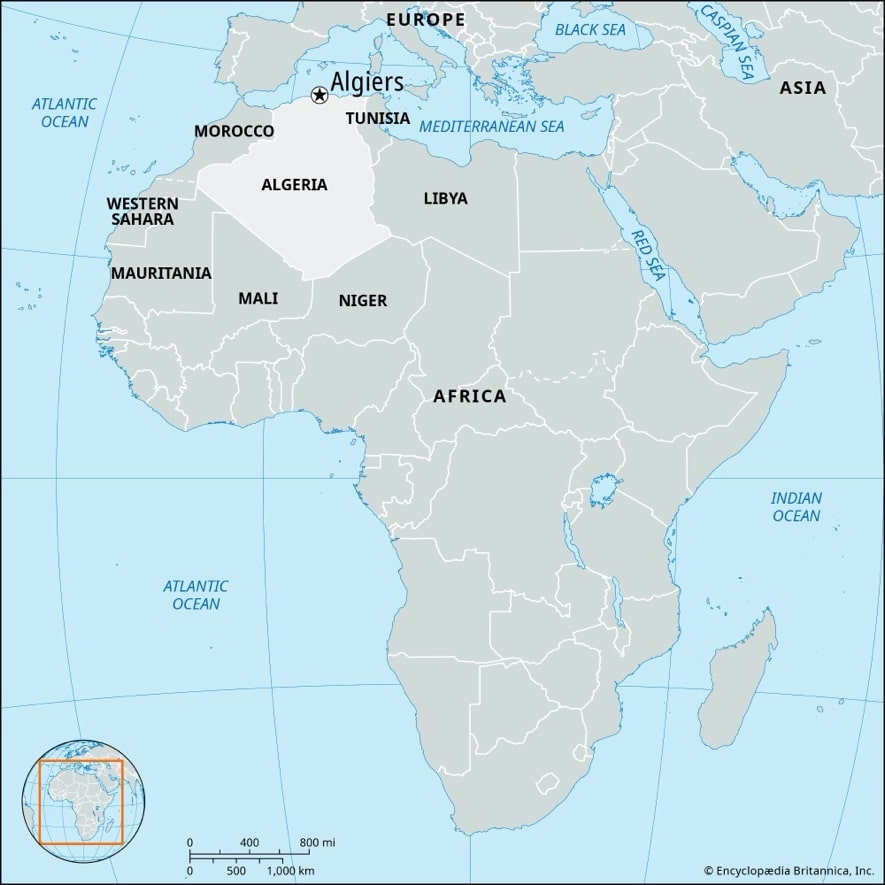
Algeria (Capital: Algiers)
The President of India recently traveled to Algeria for a visit.
Political Features:
- Algeria is a country in North Africa located in the Maghreb region.
- The Maghreb region includes the Atlas Mountains and the coastal plain of Morocco, Algeria, Tunisia, and Libya.
- Algeria is bordered by Tunisia and Libya to the east, Niger, Mali, and Mauritania to the south, Morocco and Western Sahara to the west, and the Mediterranean Sea to the north.
Geographical Features:
- Key rivers in Algeria include the Chelif River and Djedi River.
- The highest point in Algeria is Mount Tahat.
- Algeria has a Mediterranean climate, characterized by warm, dry summers and mild, rainy winters.
"JUNO Begins Neutrino Data Collection"
JUNO will assist in unraveling the mysteries surrounding Neutrinos, including their source and how they interact with other particles.
What are Neutrinos?
- Neutrino is a tiny particle with a mass that is significantly smaller than other elementary particles.
- The three types of neutrinos are Electron, Muon, and Tauon neutrino.
- Neutrinos can switch between different types while they are in motion, a phenomenon known as neutrino oscillation.
Key Characteristics:
- It has a spin of 1/2 and a neutral charge.
- It moves at nearly the speed of light in straight paths from its origin.
- It seldom interacts with other matter, earning it the nickname "ghost particle."
- They are the most plentiful particles with mass in the universe.
- Their only interactions are through gravity and the weak force.
JUNO’s contribution in studying Neutrinos and its significance
- Neutrinos from the sun could be observed in real-time to study solar processes.
- Neutrinos from radioactive decay in the Earth could help understand mantle convection and tectonic plate movement.
- The telescope may offer insights into violent astrophysical events such as exploding stars and gamma-ray bursts.
- The Juno Mission, launched by NASA in 2011, was intended to observe Jupiter.
Key Neutrino Observatories
- The India-based Neutrino Observatory (INO) is financially supported by the Department of Atomic Energy (DAE) and the Department of Science and Technology (DST).
- The location of the INO is in the Bodi West hills of Theni District in Tamil Nadu.
- The IceCube Neutrino Observatory is a unique detector located in the South Pole ice, designed to observe the cosmos from deep within.
- China's TRIDENT (Tropical Deep-sea Neutrino Telescope) and the US's DUNE (Deep Underground Neutrino Experiment) are other neutrino observatories around the world.
Legal Battle: Meta Faces State Lawsuits Over Teen Social Media Addiction
Meta, along with other social media platforms like SnapChat, have also been blamed for encouraging increased social media use among teenagers.
Factors Driving Social Media Usage Among Teens
- Social media addiction algorithms: Studies show that these algorithms are designed to exploit the habit loop in the human brain, driving users to engage in behavior to receive rewards or fulfill needs.
- Rise in access to mobile devices: Increased availability of mobile devices and digital technology, along with changes in family structure like the rise of nuclear families, contribute to the growing use of social media among teens.
- Lack of parental time: Many parents are unable to spend quality time with their children due to work-related responsibilities, leading teens to seek connection and entertainment through social media.
Risks and Concerns of Social Media Addiction
- Mental health issues: Exposure to cyberbullying on social media can increase the risk of mental health conditions such as anxiety and depression among teens.
- Reduced outdoor activities: Studies show that children aged 9-13 spend over 3 hours a day on social media, leading to a decrease in physical activity and outdoor play.
- Other risks: Exposure to cyberstalking, promotion of sedentary lifestyles, and other negative impacts on overall well-being.
Measures to Address Social Media Addiction
- Establishing a minimum age for social media use to protect younger users from potential harm.
- Implementing technology-based tools and applications that encourage productive and responsible use of social media platforms.
Initiatives to Combat Social Media Addiction
- Age restrictions by social media platforms like Meta, which sets a minimum age of 13 for users on Facebook and Instagram.
- Digital De-Addiction (D-DAD) centers in Kerala provide free counseling to children up to 18 years old struggling with digital addiction.
- Guidelines issued by the Central Board of Secondary Education (CBSE) in 2017 to schools on promoting safe and secure internet use among students.
"Supreme Court's Doubts on Gram Nyayalayas"
- The Supreme Court has expressed doubts about the practicality of establishing Gram Nyayalayas, as required by the Gram Nyayalayas Act of 2008.
- Gram Nyayalayas are meant to guarantee that all citizens have access to justice, regardless of any social, economic, or other barriers they may face.
Concerns raised by the Supreme Court regarding Gram Nyayalayas:
- Mandatory Establishment: The Supreme Court questioned whether it is mandatory for States/UTs to establish Gram Nyayalayas as per the Gram Nyayalayas Act of 2008, as the Act states that governments "may" constitute these village courts.
- Resource Crunch: State governments are already facing limited resources for regular courts, making it challenging for them to fund additional Gram Nyayalayas.
- Rising Burden: There is a concern that establishing Gram Nyayalayas may end up burdening high courts with appeals and writ petitions.
Key Features of Gram Nyayalayas:
- Seat: Gram Nyayalayas are established at the intermediate level Panchayat or a group of contiguous Panchayats.
- Jurisdiction: They have both civil and criminal jurisdiction and operate as mobile courts.
- Dispute Process: Disputes are preferably settled through conciliation, with social workers potentially being appointed as Conciliators.
- Evidence Act: Gram Nyayalayas are not bound by the Indian Evidence Act, 1872, but by the Principles of Natural Justice.
Implementation Status of Gram Nyayalayas:
- Initial Target: The initial target was around 2,500 Gram Nyayalayas, but fewer than 500 have been established, with only 314 currently operational in India.
- Progress: States like Maharashtra, Madhya Pradesh, and Rajasthan have shown progress in establishing Gram Nyayalayas, while major states like Uttar Pradesh and Bihar have seen limited or no implementation.
Initiative to Support Gram Nyayalayas:
- Gram Nyayalayas scheme: Under this Centrally Sponsored Scheme, the Union Government provides financial assistance to States to set up Gram Nyayalayas.
Supreme Court Concerned About Stubble Burning in Punjab & Haryana
- The Supreme Court has reprimanded states for failing to address the issue of stubble burning by farmers, which leads to deteriorating air quality in the Delhi-National Capital Region (Delhi-NCR).
- The Court highlighted that states have not taken necessary steps to enforce the directions given by the Commission for Air Quality Management (CAQM) in NCR in 2021 to curb stubble burning.
Understanding Stubble Burning
- Stubble burning refers to the practice of setting fire to the leftover stubble or Parali, which is the lowest portion of rice crop after harvest.
- It is commonly done between September and November to clear paddy residue quickly before planting wheat, especially in fields where combine harvesters are used.
- Factors contributing to stubble burning include the short time available between rice harvesting and sowing of wheat, making it a cost-effective method to clean fields after the harvesting season.
Impacts of Stubble Burning
- Stubble burning is a major source of air pollutants such as PM10, PM2.5, NOx, etc., leading to significant human health issues.
- It releases greenhouse gases, contributing to global warming and climate change.
- The loss of nutrients in crop leftovers to the atmosphere has adverse effects on soil fertility.
Stubble Management Strategies
- Incorporating stubble into the soil can improve soil fertility, productivity, and replenish soil nutrients.
- Utilizing agricultural leftovers for animal feed and generating nutrient-rich compost can be beneficial.
- Production of Bran Oil, Bioethanol, and Biogas from stubble can provide alternative uses for the leftover crop residue.
Initiatives to Prevent Stubble Burning
- The Commission on Air Quality Management (CAQM) in NCR and Adjoining Areas is a statutory body established under the CAQM in the NCR and Adjoining Areas Act 2021 to address air quality issues.
- The Graded Response Action Plan (GRAP) serves as an emergency response mechanism to combat air pollution in the Delhi-NCR region, triggered when the Air Quality Index (AQI) reaches "poor" levels.
- Other initiatives include making Crop Residue Management (CRM) machinery more affordable to encourage farmers to adopt alternative practices to stubble burning.
"Agriculture and Conservation Report by IUCN"
The main report from IUCN thoroughly examines the intricate connection between agriculture and conservation.
Impact of Agriculture on Biodiversity
Negative Impacts:
- Agriculture poses a direct threat to 34% of species evaluated on the IUCN Red List.
- Direct threats from agriculture involve turning natural habitats into croplands, pasturelands, plantations, and irrigation areas.
- Indirect impacts of agriculture include introducing invasive alien species, nutrient loading, soil erosion, agrochemical use, and contributing to climate change.
Positive Impact:
- Agriculture serves as a habitat for about 17% of species on the IUCN Red List.
Impact of Biodiversity on Agriculture
Positive Impact:
- Ecosystems help agriculture by providing services in two main ways:
- Provisioning services, such as producing biomass and genetic materials
- Regulating and maintenance services, like climate regulation, sediment retention, nutrient cycling, water flow regulation, and pollination
Negative Impact:
- Ecosystem disservices like crop predation can harm agriculture.
Recommendations for aligning agriculture with conservation
- Agriculture Sustainability: Protect areas and species that cannot coexist with agriculture without compromising food security or economic output.
- Maintain ecosystem services for agriculture by preserving natural climate, soil, and water conditions.
- Align agricultural and economic policies with conservation efforts, as only a small percentage of agricultural subsidies are green subsidies.
- Reform food policy to reduce food wastage and promote dietary changes that reduce meat consumption.
"Delhi High Court Allows Posthumous Use of Cryopreserved Semen"
The Delhi High Court has approved the use of the frozen sperm of a deceased son for surrogacy by a 60-year-old couple.
Highlights of Judgement
- Indian law allows for posthumous reproduction with the consent of the egg or sperm owner.
- Posthumous Reproduction involves conceiving a child using ART after the death of one or both biological parents.
- Deceased person's cryopreserved gametes are used in the process.
- The court determined that semen or ovum samples are considered 'property' as part of an individual's biological material and can be inherited by legal heirs.
Assisted Reproductive Technology (ART) Overview
- ART includes various techniques to achieve pregnancy by handling sperm or oocytes outside the body and transferring them into a woman's reproductive system.
- Techniques like In-Vitro Fertilization, Surrogacy, Gamete Cryopreservation, and Gamete Intra-Fallopian Transfer (GIFT) fall under ART.
Regulation of ART in India
- The ART (Regulation) Act, 2021 focuses on regulating and supervising ART clinics and banks to prevent misuse and ensure safe and ethical practices.
- The Surrogacy (Regulation) Act, 2021 prohibits commercial surrogacy and only allows altruistic surrogacy.