
Daily Current Affairs UPSC 18, 19 and 20 August 2024
Welcome to our daily current affairs blog post for UPSC aspirants! In today's edition, we will be discussing the most significant events and news updates that took place on 18th, 19th and 20th August 2024. Staying updated with current affairs is crucial for UPSC preparation, as it not only helps you stay informed but also enhances your understanding of various subjects. So, let's dive into the important happenings of the day and explore their potential impact on the upcoming UPSC examinations.

Rapid Innovation and Start-up Expansion (RISE) Accelerator
- Atal Innovation Mission and CSIRO Australia are seeking applications from start-ups and MSMEs for the Climate Smart Agritech cohort of the India-Australia RISE Accelerator.
- The RISE Accelerator program was launched in 2023 to help businesses looking to expand internationally between India and Australia.
- The platform has been crucial in assisting start-ups and MSMEs in validating, adapting, and testing their technologies for new markets.
- The focus themes of the program include Climate Smart Agriculture, Clean Energy, Circular Economy and Waste Management, and Climate Smart Mobility.
Foot and Mouth Disease (FMD)
- The Union Minister of Fisheries, Animal Husbandry & Dairying recently assessed progress towards the goal of achieving a FMD-free India by 2030.
- FMD is a highly contagious viral disease that affects cloven-hoofed animals like cattle, buffaloes, sheep, goats, and pigs.
- The disease does not impact horses, dogs, or cats.
- FMD is caused by an Aphthovirus from the Picornaviridae family and symptoms include fever and blisters on various parts of the body.
- The disease can lead to reduced milk yield, growth rate, infertility, and trade restrictions on animal products.
- Steps taken to combat FMD include the implementation of the National Animal Disease Control Programme to eradicate FMD and Brucellosis.
Directorate General of Quality Assurance (DGQA)
- DRDO has transferred the AHSP of 'Nipun' munition to DGQA.
- 'Nipun' is a Soft Target Munition created by the Armament Research & Development Establishment.
- DGQA is an Inter-Service Organisation under the Department of Defence Production in the Ministry of Defence.
- DGQA is responsible for quality assurance of defense stores and equipment, whether imported or domestically produced.
- It conducts quality checks for the Army, Navy (excluding Naval Armaments), and common user items for the Air Force sourced from various sectors like Private Sector, Public Sector Undertakings, and Ordnance Factories.
Zoopharmacognosy
- A recent case of Zoopharmacognosy in Sumatran orangutans was highlighted by scientists.
- Zoopharmacognosy is the process by which wild animals use medicinal plants for treating diseases and protecting themselves from parasites.
- Examples of Zoopharmacognosy include dogs chewing grass to get rid of stomach infections, pregnant lemurs nibbling on tamarind leaves to aid milk production, and pregnant elephants eating leaves from plants of the Boraginaceae family to induce delivery.
Purandar Figs
- APEDA helped export India's first ready-to-drink fig juice, made from Purandar Figs, to Poland.
- Purandar Figs were awarded the GI Tag in 2016.
- The fig is grown in various villages in Purandar Taluka in Pune district.
- Maharashtra has the largest area, 2242 hectares, dedicated to fig cultivation.
- Purandar Figs are bell-shaped, larger in size, and have a unique violet skin color that sets them apart from other varieties.
Microplastic contamination in Food
- The Food Safety and Standards Authority of India (FSSAI) has launched a new project to address the issue of microplastic contamination in food.
- The project, titled "Micro-and Nano-Plastics as Emerging Food Contaminants: Establishing Validated Methodologies and Understanding Prevalence in Different Food Matrices," aims to develop standard protocols for micro-plastic analysis and generate data on consumer exposure levels.
- Microplastics are small plastic pieces less than five millimeters long, while nanoplastics are particles less than 100 nm (1 μm) in size.
- These contaminants can lead to health problems such as endocrine disruption, weight gain, insulin resistance, decreased reproductive health, and cancer.
AI Guardrails
- Recent media reports have highlighted the absence of guardrails in Elon Musk's xAI's new AI models, Grok-2 and Grok-2 mini.
- AI guardrails are structures and tools put in place to guarantee that AI systems adhere to ethical, legal, and technical standards.
- They serve to prevent AI from causing harm, exhibiting bias, or being exploited for malicious purposes.
- AI guardrails play a crucial role in AI governance, ensuring the responsible development, deployment, and utilization of AI technologies.
Liquid water on Mars
- A new study titled "Liquid water in the Martian mid-crust" indicates that Mars may have significant amounts of liquid water deep within its rocky outer crust.
- The liquid water layer is situated at a depth of 10 to 20 km in the Martian crust.
- Data collected from NASA's Mars Insight Lander was utilized in this study.
- This discovery marks the first time that scientists have found evidence of liquid water on Mars.
- Understanding the water cycle on Mars could provide insights into the planet's climate, surface features, and interior evolution.
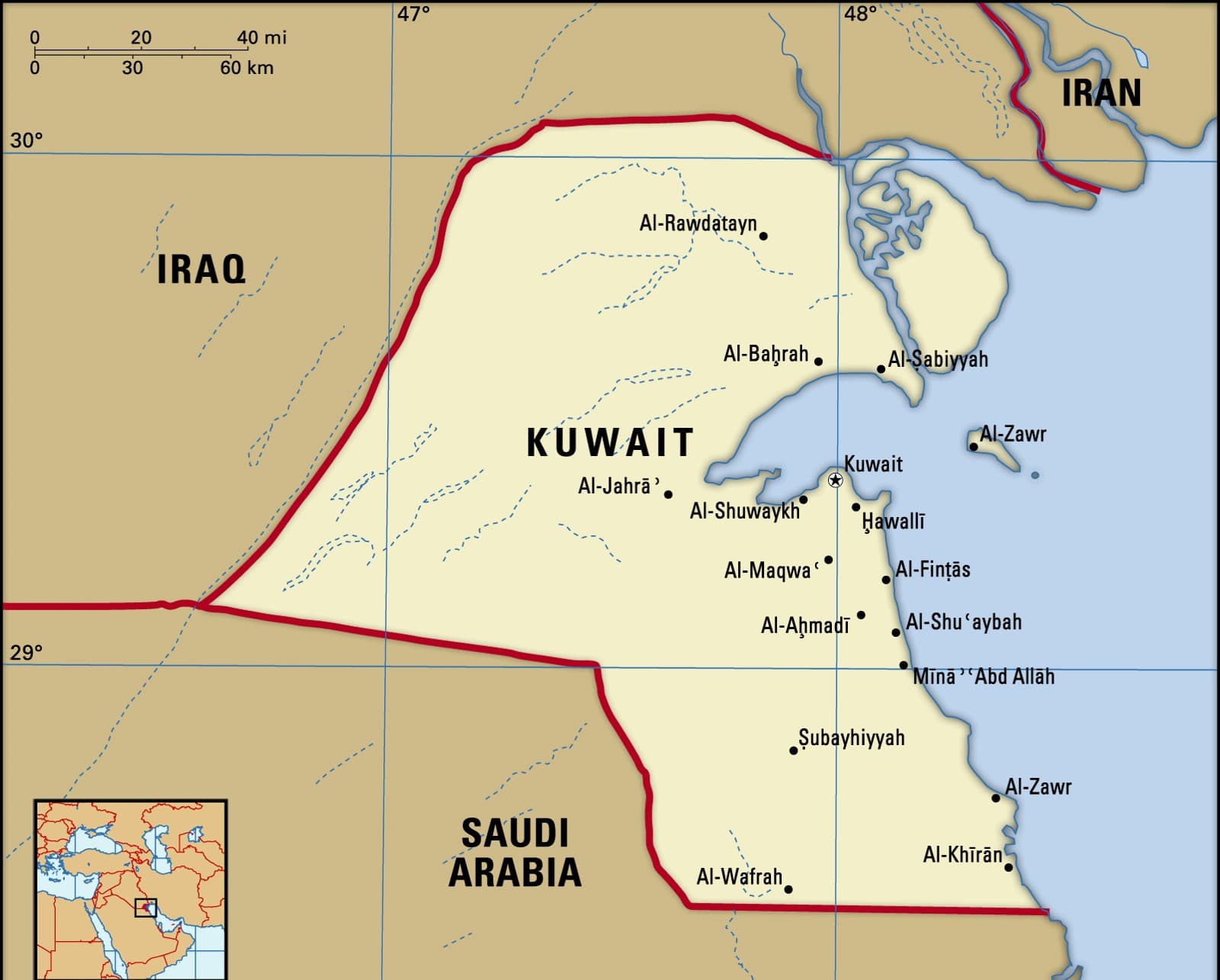
Kuwait (Capital: Kuwait City)
The Indian External Affairs Minister contacted the Prime Minister of Kuwait to talk about the relationship between the two countries.
Political Features
- Location: Situated in the Arabian Peninsula at the northwest corner of the Persian Gulf
- Bordering Nations: Iraq to the north and west, Saudi Arabia to the south and west
- Maritime border with Iran to the east
- Member of Gulf Cooperation Council, Arab League, Organisation of Islamic Cooperation, and OPEC
Geographical Features
- Climate: Hyper arid desert climate with highly variable and extreme conditions
- Topography: Predominantly desert with Al-Jahrā oasis at the western end of Kuwait Bay
- Rivers: Wadi al Batin, Khor Bubiyan, Khor al Sabiyah
- Holds 6% of the world's proven oil reserves
"India Hosts VOGSS Summit"
- VOGSS aims to unite Global South countries to discuss various issues based on the philosophy of ‘Vasudhaiva Kutumbakam’.
- Global South includes developing, less developed, or underdeveloped countries, separated from the Global North by the Brandt line.
- India hosted the 1st and 2nd VOGSS in January and November 2023.
Key Highlights of 3rd VOGSS
- Theme: "An Empowered Global South for a Sustainable Future”.
- Virtual Meet: 123 countries participated (China & Pakistan not invited).
- Global Development Compact (GDC): India proposed GDC to address debt concerns and focus on trade, sustainable growth, and technology sharing.
- India to launch special funds for trade promotion and capacity building.
Challenges Faced by Global South
- Obsolete global governance and financial institutions.
- Technology divides between North and South.
- Terrorism, extremism, and separatism as serious threats.
India’s Advocacy For Global South
- Social Impact Fund: India to contribute $25 million for Digital Public Infrastructure in Global South.
- Global South Young Diplomat Forum: Launched for education and capacity building.
- Induction of African Union into G20 during India’s Presidency.
- Vision of Aarogya Maitri: India’s mission for health security, including Jan Aushadhi Kendras in African and Pacific Island countries.
Cancellation of lateral entry advertisement requested by Union Minister
- An advertisement has been issued for positions of joint secretaries, directors, and deputy secretaries in various central ministries.
- So far, 63 appointments have been made through lateral entry, with 35 of them coming from the private sector.
About lateral entries
- The concept involves bringing in individuals from non-traditional government backgrounds to take on mid and senior-level roles in government departments.
- The initiative was officially implemented in 2018 based on the suggestion of NITI Aayog's three-year Action Agenda.
- The idea was supported by the Second Administrative Reforms Commission, which was formed in 2005.
Arguments in Favor of Lateral Entry
- Brings domain expertise to address complex governance challenges.
- Helps augment manpower as there is a shortage of IAS officers in central ministries.
- Widens talent pool for appointments, similar to successful practices in RBI.
Arguments Against Lateral Entry
- Difficult to ensure accountability due to short tenures.
- Lack of field experience may be a drawback.
- Could deter existing talent and raise concerns about reservation policies.
Other Reforms to Strengthen Bureaucracy
- Deputation to Private Sector to bring in domain expertise and competition.
- Institutionalize goal setting and tracking for each department.
- Implement new appraisal mechanisms like the government's "360 degree" performance appraisal.
- Establish public administration universities for aspiring and serving civil servants.
"Indian Americans' Impact on US Society"
Even though they make up just 1.5% of the U.S. population, the Indian diaspora has made significant contributions to the country.
Contributions of Indian Diaspora in the USA
- Economic Impact: Indian diaspora members hold top positions in Fortune 500 companies, such as Satya Nadella and Shantanu Narayen.
- Cultural Influence: Indian festivals like Diwali and Holi are widely celebrated in the USA, and Indian chefs like Vikas Khanna have gained popularity. Wellness practices with Indian roots, like those promoted by Deepak Chopra, have also made an impact.
- Innovation, Research, and Development: Indian Americans have contributed significantly to scientific publications in the US, with famous personalities like Har Gobind Khorana and Abhijit Banerjee making notable contributions.
- Government and Public Services: Indian Americans like Kamala Harris and Bobby Jindal have held prominent positions in the US government.
Benefits of Indian Diaspora for India
- Economic: The Indian diaspora in the US contributes significantly to remittances and foreign direct investment in India.
- Brain Gain: Indian entrepreneurs who have leveraged US higher education have played a key role in the success of Indian startups.
- Political: Indian diaspora members have been involved in diplomacy, lobbying efforts, and representation in global institutions.
- Cultural Diplomacy & Soft Power: Indian cultural practices like yoga and Ayurveda have gained popularity in the US, contributing to India's soft power.
- Indo-US Scientific Collaboration: Collaborative initiatives between India and the US in the field of science and technology have been successful.
Initiatives for Diaspora Engagement by India
- Know India Programme (KIP): A program by the Ministry of External Affairs to engage with the Indian diaspora.
- Pravasi Bharatiya Divas: A celebration held once every two years on 9th January to honor the Indian diaspora.
- Indian Community Welfare Fund (ICWF): A fund aimed at providing welfare services to Indian nationals abroad.
"Banni Grassland Restoration Study"
Analysis of Soil Characteristics: The study examined various nutrients and micronutrients in the soil of Banni grassland using satellite data, with a focus on ecological value as the primary criterion.
Findings of the Study:
- Categorization of Restoration Zones: The study classified the restoration zones in Banni grassland into five categories, with 36% being highly suitable, 28% suitable, 27% moderately suitable, 7% marginally suitable, and 2% not suitable for restoration.
- Restoration Strategies: The highly suitable and suitable zones can be easily restored with adequate water sources, while the marginally suitable and not suitable zones can be managed through terracing, fertilization, and protection from water erosion and salt intrusion.
About Banni Grassland:
- Description: Banni grassland in Kutch, Gujarat is Asia's largest tropical grassland, spanning over 2,600 sq. km and emerging from the sea due to tectonic activities.
- Flora and Fauna: The grassland is home to various species such as Banni buffalo, Kankrej Cattle, Asiatic wild ass, Camel, and horse, and is culturally significant for ethnic semi-nomadic communities like Maldharis and Jats.
- Ecosystem Services: The grassland provides ecosystem services like carbon storage, climate mitigation, and pollination, and is known for strange dancing light phenomena called Chir Batti or Ghost lights.
Threats to Banni Grasslands:
- Livestock Grazing: Excessive pressure from livestock grazing is a major threat to the grassland.
- Soil Salinity: Increased soil salinity has led to the invasion of Prosopis juliflora, a problematic plant species.
- Water Scarcity and Climate Change: Aridity, water scarcity, climate change, and desertification are also significant threats to the grassland.
Steps for Grassland Restoration in India:
- Land Degradation Neutrality Commitment: India has committed to restoring 26 million hectares of degraded land by 2030.
- Cheetah Introduction Project: The introduction of cheetahs in India aims to restore open forest and savannah grassland habitats.
- Declaration of Protected Areas: The establishment of protected areas like national parks and wildlife reserves is crucial for conservation efforts.
- Banni Grassland Restoration Project: The Banni Grassland Restoration Project of 2019 focuses on restoring and conserving the unique ecosystem of the Banni grassland in Gujarat.
"Permafrost Melting: Toxic Mercury Release"
- Researchers studied samples from the top three meters of permafrost in the Yukon River.
- Comparison with satellite data revealed significant mercury release during riverbank erosion.
About Permafrost
- Permafrost is frozen ground that remains at or below 0°C for at least two consecutive years.
- It consists of a mix of soil, rocks, and sand held together by ice.
- Common in high mountain regions and Earth's higher latitudes like the Arctic and Antarctica.
- Despite being frozen, permafrost regions are not always covered in snow.
Impacts of Melting Permafrost
- Thawing permafrost leads to the release of greenhouse gases like carbon dioxide and methane.
- Ancient bacteria and viruses are released, posing health risks to humans and animals.
- Over 5 million people in the Arctic region are directly threatened by potential mercury release.
- Melting permafrost contributes to sea level rise, increased erosion, and risks of landslides.
About Mercury
- Mercury is a naturally occurring metal found in air, water, and soil.
- It is the only metal that is liquid at room temperature.
- Exposure to even small amounts of mercury can cause serious health issues.
- Natural sources include volcanoes, geothermal springs, oceans, etc.
- Anthropogenic sources include burning coal, gold mining, industrial uses, etc.
- Health hazards of mercury exposure include impacts on the nervous, digestive, and immune systems.
- Mercury poisoning can lead to diseases like Minamata disease, which affects the nervous system.
"RBI's Framework for SROs in Financial Markets"
- The framework recognizes the need for industry standards for self-regulation as the number and size of Regulated Entities grow.
- Instead of burdening regulators like RBI and SEBI, the framework encourages self-regulation among industry members.
- SROs can play a key role in developing, promoting, and enforcing industry standards and best practices to enhance self-regulation in financial markets.
About Self-Regulatory Organisations (SROs) framework
Eligibility for SROs
- SROs must be set up as a not-for-profit company registered under Section 8 of the Companies Act, 2013.
- The applicant must have a minimum net-worth of INR 10 crore.
Responsibilities of SROs
- SROs are required to inform the RBI about sector developments regularly, carry out tasks assigned by RBI, and submit an Annual Report to the RBI.
About Regulated Entities (REs)
- REs are financial institutions and organizations that operate within specific regulations set by regulatory authorities.
- The role of REs includes maintaining financial stability, ensuring compliance with regulations, conducting due diligence, and implementing measures to prevent financial crimes like money laundering and fraud.
- Examples of REs include Insurance Repositories under IRDA and Scheduled commercial banks under RBI.