
Daily Current Affairs UPSC 04 July 2024
Welcome to our daily current affairs blog post for UPSC aspirants! In today's edition, we will be discussing the most significant events and news updates that took place on 4th July 2024. Staying updated with current affairs is crucial for UPSC preparation, as it not only helps you stay informed but also enhances your understanding of various subjects. So, let's dive into the important happenings of the day and explore their potential impact on the upcoming UPSC examinations.

Speedy Trial
- The Supreme Court has confirmed that the right to a speedy trial is a constitutional right under Article 21, regardless of the seriousness of the crime.
- This means that defendants should be tried for their alleged crimes within a reasonable time frame.
- In the case of Kartar Singh Vs State of Punjab (1994), the Supreme Court established the right to a speedy trial as a fundamental right.
- Another important case related to this issue is Abdul Rehman Antulay vs RS Nayak.
- The new Bharatiya Nagarik Suraksha Sanhita (BNSS) has replaced the Criminal Procedure Code (CrPC) and aims to address delays in the justice system.
Zika Virus
- The Union Health Ministry has issued an advisory to state governments in response to Zika virus cases reported in Maharashtra to prevent its spread.
- Zika virus is primarily transmitted by the bite of an infected mosquito Aedes aegypti, which bites during the day and also transmits dengue.
- While Zika virus is non-fatal, it is associated with microcephaly in babies born to affected pregnant women and can trigger other health concerns such as Guillain-Barré syndrome, neuropathy, and myelitis.
- Currently, there is no vaccine available to prevent Zika virus or medicine to treat it.
Agricultural and Processed Food Products Export Development Authority (APEDA)
- New Zealand has refused India's request for a certification trademark similar to a geographical indication tag for basmati rice because it is also grown outside of India.
- Australia had previously rejected a similar request on the same grounds.
- APEDA was established under the Agricultural and Processed Food Products Export Development Authority Act, 1985.
- APEDA promotes exports and handles GI registration for Indian products abroad, including filing certification trademark applications.
- APEDA also serves as the Secretariat to the National Accreditation Board, overseeing the accreditation of Certification Bodies for organic exports under the National Programme for Organic Production.
Pachathuruthu Project
- The Chief Minister of Kerala believes that the Pachathuruthu initiative will play a crucial role in helping the state achieve its ambitious Net Zero Carbon target.
- The Pachathuruthu project aims to create man-made mini-forests by planting a variety of indigenous plants in barren lands.
- This initiative will help protect natural forest biodiversity and aid in carbon sequestration, as well as mitigate the impact of urban heat islands.
- The projects under the Pachathuruthu initiative are planned by mobilizing the masses through participatory campaigns and with the coordination and leadership of Local Self-Government Institutions.
Air pollution
- A study on air pollution in India published in Lancet Planetary Health found that approximately 33,000 annual deaths in 10 cities can be attributed to PM 2.5 pollution.
- Deaths are higher in cities like Delhi, Varanasi, and Kolkata due to higher average exposure to pollution, possibly influenced by the nature of pollution sources and population density.
- WHO guidelines recommend that 24-hour average exposure to PM 2.5 should not exceed 15 μg/m3.
- Indian air quality standards allow for a higher level of PM 2.5, with a limit of 60 μg/m3 over a 24-hour period.
WHO tobacco cessation guideline
- WHO has published its first clinical treatment guideline for helping adults quit tobacco use.
- The guideline aims to assist over 750 million tobacco users who struggle to quit.
- More than 60% of the world's 1.25 billion tobacco users want to quit, but 70% lack access to effective cessation services.
- Reasons for lack of access include inefficient health systems and lack of resources.
- The guideline recommends a combination of medication and behavioral interventions for tobacco cessation.
Cabinet Committees
- The Union government has formed eight Cabinet committees to assist in decision-making in specific areas.
- Cabinet committees are established under the Transaction of Business Rules, 1961.
- The committee system allows the cabinet to focus on key areas such as appointments, accommodation, economic affairs, parliamentary affairs, political affairs, security, investment and growth, and skill, employment, and livelihood.
- These committees help streamline the decision-making process and ensure that important issues are addressed effectively.
National Medical Commission(NMC)
- The National Medical Commission (NMC) has a new Chairperson who has been appointed.
- The NMC is a statutory body created by the National Medical Commission Act, 2019.
- The aim of the NMC is to enhance access to high-quality and cost-effective medical education.
- The functions of the NMC include establishing policies for overseeing medical institutions, researchers, and professionals, as well as ensuring coordination among various Autonomous Boards.
Metal-organic frameworks (MOFs)
- Scientists studied how MOFs are able to be flexible by analyzing the mechanisms within their crystals.
- The flexibility of MOFs is linked to significant structural changes caused by both soft and hard vibrations within the crystal.
- MOFs are a type of crystalline material that can absorb gases like carbon dioxide, store them, and act as filters for purifying crude oil due to their nanopores.
- Despite their useful properties, MOFs have limited stability and mechanical weakness which have prevented them from being used more widely.
Apatani Tribe
- ZSI researchers discovered a new species of horned frog in Talle Wildlife Sanctuary in Arunachal Pradesh.
- The new species is named after the Apatani community in the region.
- The Apatani tribe is found in Ziro valley and is known for their traditional village council called bulyañ.
- The region of the tribe has been included in UNESCO's Tentative List as a living Cultural Landscape.
- The major festivals of the Apatani tribe are Dree and Myok.
- Key dances of the tribe include Daminda and Pree dance.
"Restoring Education to State List"
- Education is currently under the concurrent list of Schedule 7 of the Constitution, allowing both the Centre and States to enact laws.
Background of Education Listing
- Under the Government of India Act of 1935, education was under the Provincial Legislative List.
- After independence, education was on the State list of the seventh schedule.
- The 42nd Constitutional Amendment (1976) moved education to the Concurrent list based on the Swaran Singh Committee's recommendation.
- No explicit reason was given for the change.
- Benefits of Education in Concurrent List
- Allows for the development of all-India policies on education.
- Addresses issues of lack of professionalism and corruption in state-run universities.
Reasons for Demand to Shift Education to State List
- One size fits all approach is not feasible for a diverse country like India.
- States spend 76% of the budgeted expenditure on education, making them more responsible for education.
- Allows for tailoring of syllabus according to the requirements of each state.
International Practices
- In the U.S., state and local governments set educational standards, while the federal government focuses on financial aid policies.
- In Canada, education is managed by the provinces.
- In Germany, legislative powers for education reside with states.
- In South Africa, national departments set policies with provinces implementing them to address local educational needs.
"NITI Aayog's Sampoornata Abhiyan Launch"
- The campaign aims to achieve full coverage of 6 key indicators in Aspirational Districts and 6 key indicators in Aspirational Blocks within a 3-month timeframe.
Aspirational Districts and Blocks Programs
- The Aspirational Districts Programme focuses on improving development indicators in specific districts, while the Aspirational Blocks Programme targets key indicators at the block level.
Key indicators in Aspirational Districts
- These indicators include the distribution of Soil Health Cards, availability of electricity in secondary schools, and the percentage of fully immunized children, among others.
Key indicators in Aspirational Blocks
- These indicators involve screening for Diabetes and hypertension, the percentage of Self Help Groups (SHGs) receiving a Revolving Fund, and other important metrics at the block level.
| Aspirational Districts Programme | Aspirational Blocks Programme |
|---|---|
| Established in 2018 by NITI Aayog | Started in 2023 by NITI Aayog |
| Goal is to rapidly and efficiently improve 112 districts nationwide | Goal is to provide essential government services in 500 Blocks (329 Districts) nationwide |
| Concentrates on five key areas: Health & Nutrition, Education, Agriculture & Water Resources, Financial Inclusion & Skill Development, and Infrastructure. | Concentrates on five main areas: Health & Nutrition, Education, Agriculture and Allied Services, Basic Infrastructure, Social Development |
| Success is evaluation based on 81 development indicators | Development is evaluated based on 40 indicators |
"Aditya-L1's Successful Halo Orbit"
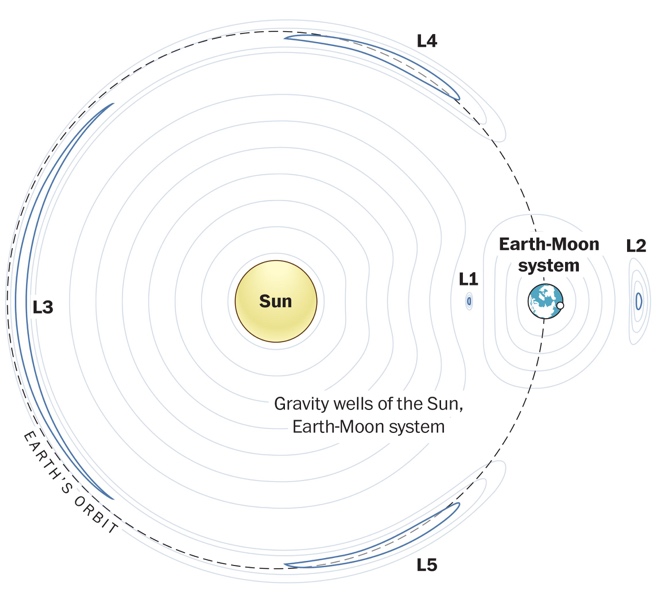
- Aditya-L1 was placed in its halo orbit around the Langrange L1 point in early 2024 and took 178 days to complete one revolution.
- At Lagrange points, the gravitational forces of two large bodies balance out the centripetal force needed for a smaller object to orbit with them.
- There are five Lagrange points in a two-body gravitational system, labeled as L1, L2, L3, L4, and L5.
What are halo orbits?
- Halo orbits are three-dimensional orbits that result from the gravitational pull of two planetary bodies and centrifugal force on a spacecraft.
- These orbits exist in any 3-body system, such as the Earth-Moon orbiting satellite system.
- They are mainly associated with Lagrange points L1, L2, or L3.
Benefits of placing Aditya-L1 in Halo Orbit
- Placing Aditya-L1 in a halo orbit ensures a mission lifetime of 5 years.
- It helps in reducing fuel consumption by minimizing stationkeeping maneuvers.
- The orbit ensures an unobstructed view of the sun for the mission.
About Aditya-L1 Mission (2023)
- The Aditya-L1 mission is the first Indian space mission to study the Sun.
- The objectives of the mission include studying the Sun's corona, solar emissions, solar winds and flares, and Coronal Mass Ejections (CMEs), as well as carrying out round-the-clock imaging of the Sun.
- The mission carries 7 payloads, including the Visible Emission Line Coronagraph (VELC) and Solar Ultraviolet Imaging Telescope (SUIT).
"Bretton Woods Conference Turns 80"
- The Bretton Woods Conference, also known as the United Nations Monetary and Financial Conference, took place in 1944 in Bretton Woods, New Hampshire.
About Bretton Woods Conference
- Purpose: The conference aimed to establish new rules for the international monetary system after World War II.
- Delegates from 44 nations participated in the conference.
Key Outcomes:
- Creation of the Bretton Woods Institutions: The International Monetary Fund (IMF) and the International Bank for Reconstruction and Development (IBRD), now known as the World Bank (WB).
- Fixed exchange rate regime: Member countries fixed their currency in terms of gold or the US dollar.
- Transition to floating exchange rates after the dollar exchange crises of 1971 and 1973.
- Promotion of Free Trade to ensure international prosperity and peace.
Comparison of Brtteon Woods Institutions
IMF and World Bank Comparison
| Sphere | IMF | World Bank |
|---|---|---|
| Mandate | - Supports worldwide economic and financial stability - Offers financial assistance to countries facing balance of payments issues - Provides short- and medium-term loans to aid in economic recovery |
- Supports countries in implementing reforms or projects to promote long-term economic development and poverty reduction - Provides technical and financial assistance to help countries achieve their goals - Examples of projects include building schools and other infrastructure to improve quality of life |
| Membership and Headquarters | - There are 190 countries in total - The headquarters of both organizations are located in Washington, D.C., USA. |
- India is a member of 189 countries, including both the IMF and the World Bank Group - India is not a member of the WB International Centre for Settlement of Investment Disputes - Countries must first join the IMF in order to be eligible to join the World Bank Group |
"National Indicators for Extreme Poverty"
- The government is developing a national indicator to measure extreme poverty as part of the National Indicator Framework (NIF) 2024.
- NIF tracks India's progress on Sustainable Development Goals (SDGs) which aim to eradicate extreme poverty by 2030.
Need for a National Indicator
- Lack of updated official poverty line based on reports from committees like Suresh Tendulkar, D T Lakdawala, and C Rangarajan.
- Varying global indicators from organizations like the IMF and World Bank make it difficult to accurately measure poverty.
- Reliable poverty estimates are crucial for policymaking and tracking progress on anti-poverty programs.
Measurement of Poverty in India
- Official poverty line based on consumption expenditure with surveys conducted every five years by the National Sample Survey Office.
- NITI Aayog has introduced the National Multidimensional Poverty Index (NMPI) which shows a reduction in poverty from 2015-16 to 2019-21.
Calculation of Poverty by Suresh Tendulkar Committee
- Poverty line set at a monthly expenditure of Rs 1,000 or less in cities and Rs 816 or less in villages.
- Rangarajan Committee raised the income limits for poverty to Rs. 32 in rural India and Rs. 47 in urban India.
"GPAI Ministerial Council Convenes in New Delhi"
- The meeting led to an agreement on a commitment to the future vision of the Global Partnership on Artificial Intelligence (GPAI) and the strengthening of synergies to utilize human-centric and trustworthy AI for the benefit of all.
- GPAI is an integrated partnership that brings together OECD members and GPAI countries, with 29 member countries including India.
- The aim of GPAI is to bridge the gap between theory and practice on AI by supporting cutting-edge research and applied activities on AI-related priorities.
- India will be the lead chair of GPAI in 2024, showcasing its leadership in the global AI discourse.
Key Takeaways from the Meeting
- The meeting recognized the potential of artificial intelligence (AI) in shaping the future of societies and economies.
- It acknowledged the emerging risks and challenges posed by AI systems, such as disinformation and harmful biases leading to discrimination.
- There is a commitment to ensuring a safe, secure, trustworthy, and human-centric AI through an inclusive, multi-stakeholder approach.
- Serbia was elected as the Lead Chair of GPAI for 2024-25 by GPAI members.
Related News
- The World Intellectual Property Organization (WIPO) released the "WIPO Patent Landscape Report on Generative AI."
- India has emerged as the fifth biggest location for GenAI invention, filing 1,350 GenAI patents with the highest growth rate (56% per year) over the period 2014-2023.
- China leads the ranking in GenAI patents, followed by the US.