
Daily Current Affairs UPSC 29 and 30 September 2024
Welcome to our daily current affairs blog post for UPSC aspirants! In today's edition, we will be discussing the most significant events and news updates that took place on 29th and 30th September 2024. Staying updated with current affairs is crucial for UPSC preparation, as it not only helps you stay informed but also enhances your understanding of various subjects. So, let's dive into the important happenings of the day and explore their potential impact on the upcoming UPSC examinations.

International Court of Justice (ICJ)
- The ICJ has ordered Israel to immediately provide basic food supplies to the Palestinian population in Gaza.
- The ICJ is the main judicial body of the UN, created in 1945 under the UN Charter and replacing the Permanent Court of International Justice.
- The ICJ is located in the Peace Palace in Hague, Netherlands.
- The ICJ is composed of 15 judges who are elected by the UN General Assembly and Security Council for 9-year terms.
- Candidates for the ICJ must receive a majority of votes in both bodies to be elected.
- The main functions of the ICJ are to settle legal disputes according to international law and to give advisory opinions.
Stem Cell
- A woman with Type 1 diabetes received treatment using cells taken from her own body through a reprogrammed stem cell transplant.
- Stem cells are undifferentiated cells with the ability to renew themselves.
- Stem cells can be sourced from embryos or adult tissues.
- There are three types of stem cells based on their potency: totipotent, pluripotent, and multi-potent.
- Totipotent cells can differentiate into all cell types in an organism, while pluripotent cells can differentiate into most tissues but not all, and multi-potent cells have a limited range of tissues they can differentiate into.
National Industrial Corridor Development Programme (NICDP)
- The Prime Minister officially opened the Bidkin Industrial Area, which is part of the NICDP and the Delhi-Mumbai Industrial Corridor.
- The NICDP was initiated with the launch of the DMIC and is focused on making India a top manufacturing and investment hub with a strong transportation network.
- The goal of the NICDP is to create jobs, boost economic growth, and improve overall socio-economic development in the country.
Paryatan Mitra And Paryatan Didi Initiative
- The Ministry of Tourism introduced Paryatan Mitra & Paryatan Didi as a national responsible tourism program.
- The initiative aims to enhance the experience for tourists by connecting them with local "tourist-friendly" individuals who serve as ambassadors and storytellers for their destination.
- The program provides tourism training and awareness to all individuals who interact with tourists in a destination.
- There is a focus on training women and youth to create new tourism products and experiences such as food tours and craft tours.
Marburg Virus Disease (MVD)
- An outbreak of Marburg Viral Disease in Rwanda has resulted in the deaths of multiple individuals.
- Marburg Viral Disease (MVD) is a rare and highly contagious viral hemorrhagic fever that affects both humans and primates, with a high mortality rate.
- Marburg and Ebola viruses belong to the same Filoviridae family and have similar clinical presentations, despite being caused by different viruses.
- The disease spreads through human-to-human transmission and from bats to humans.
- Marburg Virus was first identified in 1967 in Marburg and Frankfurt, Germany, as well as in Belgrade, Serbia.
- MVD is most commonly found in Sub-Saharan Africa and currently has no antiviral treatment or vaccine available.
Poumai Naga tribe
- The Poumai Naga tribe in Purul village, Senapati District, Manipur, has prohibited hunting and killing of wild animals and birds in their area.
- The Poumai Naga tribe is one of the oldest and largest Naga tribes in Manipur, known for their pottery and salt production.
- They are located in both Manipur and Nagaland and their language is Poula.
Revamped Pharmaceutical Technology Upgradation Assistance Scheme (RPTUAS)
- The Department of Pharmaceuticals has made changes to the Pharmaceutical Technology Upgradation Assistance Scheme (RPTUAS).
- The incentive for pharmaceutical companies has been increased to Rs 2 crore from Rs 1 crore.
- A new category, "production equipment," has been added to the list of eligible expenses for subsidy calculation.
- The objective of RPTUAS is to support the pharmaceutical industry in upgrading to Revised Schedule-M and WHO's good manufacturing practices standards.
- More flexible financing options have been introduced, with subsidies now being provided on a reimbursement basis.
Santhal Revolt
- Jharkhand High Court has ordered the formation of a fact-finding committee to investigate infiltration in the 'Santhal Parganas', which were established after the Santhal Revolt.
- The Santhal Revolt, which took place from 1855-56, was one of the earliest uprisings against British colonial rule.
- The revolt was a response to the Permanent Settlement in 1793, which resulted in the displacement of Santhals from Birbhum and Manbhum regions (now part of Bengal) and their subsequent exploitation by Zamindars and the British.
- The Santhals referred to the outsiders as Dikus and were led by four brothers - Sidho, Kanho, Chand, and Bhairav Murmu - who employed Guerilla Warfare tactics.
- Hul Diwas is celebrated in Jharkhand to honor the martyrs of the Santhal Revolt.
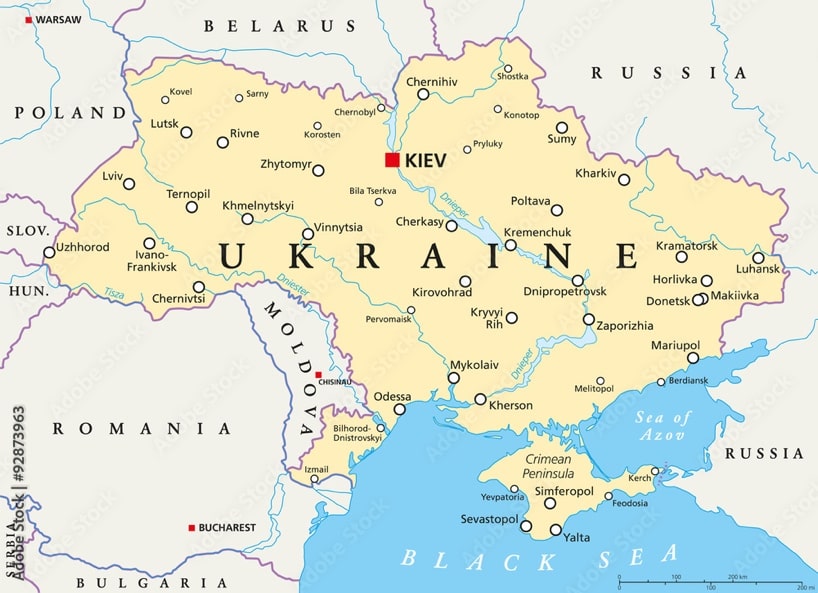
Ukraine (Capital: Kyiv)
- Russian missiles targeted Ukraine's Snake Island in the Black Sea
- Political Features:
- Location: Eastern Europe, second largest country in Europe after Russia
- Bordering Countries: Belarus, Russia, Moldova, Romania, Hungary, Slovakia, Poland
- Sea of Azov and Black Sea to the south
- Geographical Features:
- Mountain Ranges: Carpathians, Crimean Mountains
- Highest Point: Mount Hoverla
- Climate: Temperate
- Major Rivers: Dnieper, Danube, Dniester
"India's rightful place on the UNSC: Bhutan"
- The US, France, and the UK have expressed their support for India's permanent membership in the UNSC.
- Making changes to the UNSC would involve modifying the UN Charter.
- Any amendments to the Charter would need to be approved by a two-thirds majority vote in the General Assembly and ratified by two-thirds of all UN Members, including the permanent members of the UNSC.
About UNSC
- The UNSC was created in 1945 as part of the UN and is responsible for maintaining global peace and security.
- The UNSC consists of 15 members, as shown in the infographic.
- The UNSC has the authority to make decisions that member countries must follow according to the UN Charter.
Factors supporting India’s Permanent Membership
- Head of Developing Nations, such as those in the Global South
- Swift expansion of economy (ranked as the 5th largest globally)
- India holds the title of being the most populous country on Earth
- Among the top contributors to the United Nations Peacekeeping Forces
Hurdles in India’s Permanent Candidature
- China is the only permanent member of the UNSC that has not supported India's bid for a permanent seat on the council.
- Groups like Uniting for Consensus and the Coffee Club are against expanding the number of permanent seats on the UNSC.
- The current permanent members of the council are acting in their own self-interest by opposing the addition of new permanent seats.
United Nations Security Council

Karnataka Government Revokes CBI's 'General Consent'
- Several other states, including West Bengal, Punjab, and Tamil Nadu, have also revoked their general consent in the past.
- In 2018, West Bengal withdrew its general consent, a decision that was supported by the Supreme Court in the State of West Bengal v. Union of India case in 2024.
Consent to the CBI
- According to section 6 of the DSPE Act, 1946, the CBI is required to get permission from the state government before conducting an investigation in that state.
- The NIA, on the other hand, operates under The NIA Act, 2008, and has the authority to investigate crimes nationwide without needing state government consent.
Type of Consent
- General Consent: The CBI does not need to get permission each time it goes to a state for an investigation or case, except in certain situations.
- Exceptions to General Consent: The CBI must seek permission if the case is ordered by a higher court, if it is registered in a different state or union territory, or if it was registered before consent was withdrawn.
- Case-specific Consent: In every case, the CBI must request permission from the state government.
About CBI
- Establishment of CBI: Established in 1963 based on the recommendation of the Santhanam Committee on Prevention of Corruption (1962-64)
- Legal Status: CBI is a non-statutory and non-constitutional body governed by the Delhi Special Police Establishment (DSPE) Act, 1946
- Ministry Oversight: CBI operates under the Ministry of Personnel, Pension & Public Grievances
- Types of Cases Investigated: CBI investigates cases related to anti-corruption, economic offences, and sensational crimes with inter-state or all-India ramifications.
"CERN Marks 70th Anniversary"
- CERN, known by its French acronym, is an international scientific organization created for collaborative research in high-energy particle physics.
About CERN
- Founded in 1954 as the first joint venture in Europe post-World War II.
- Situated near Geneva, Switzerland.
- Comprised of 23 Member States and 10 Associate Member States, including India.
- Core principle is to focus on scientific research and not military purposes.
Key Achievements:
- The Z Boson and W Boson Particles were crucial in advancing our knowledge of the weak force.
- The World Wide Web was created by Tim Berners-Lee at CERN in 1989.
- Anti-Matter research has been facilitated by the use of the Antiproton.
- The Decelerator has helped in studying the origins of the universe.
- The Higgs Boson Particle, also called the God Particle, was found at the Large Hadron Collider (LHC) at CERN.
- The Higgs boson is linked to the Higgs field, which provides mass to particles like electrons.
- CERN's LHC is the biggest particle accelerator globally, where protons or lead ions collide at near-light speeds.
India’s contributions
- Indian physicists from institutions such as Tata Institute of Fundamental Research (TIFR) participate in CERN experiments like the L3 experiment and LHC.
- The Department of Atomic Energy collaborates with CERN on Novel Accelerator Technologies (NAT).
- India runs two Tier-2 centers for the Worldwide LHC Computing Grid (WLCG).
"Union Cabinet Approves NCoE for AVGC-XR"
- The establishment of a National Center of Excellence (NCoE) for Animation, Visual Effects, Gaming, Comics, and Extended Reality (AVGC-XR) is in line with the 2022-23 budget plans, which included the formation of an AVGC task force.
- The NCoE aims to enhance the creative economy in India by focusing on AVGC-XR industries.
Features of NCoE
- The organization will be established as a Section 8 Company according to the Companies Act, 2013.
- Tentatively called the Indian Institute for Immersive Creators (IIIC).
- Its main purpose will be to serve as an incubation center to support and develop startups in the AVGC-XR industry.
Benefits
- The animation industry in India is experiencing exponential growth, with a 25% growth rate and an estimated value of ₹46 billion by 2023 according to the FICCI-EY Report 2023.
- India is a hub for various immersive technologies such as Virtual Reality (VR), Augmented Reality (AR), Mixed Reality (MR), and 3D modeling.
- The focus on creating indigenous intellectual property (IP) in the digital creative economy will benefit both domestic and global markets.
- The growth of the industry is expected to create 500,000 jobs, with a strong emphasis on education, skilling, industry development, and innovation.
- The development of the animation industry in India will enhance the country's soft power globally and attract foreign investment.
About Creative Economy
- The concept of creative industries is constantly changing and involves using creative assets to drive economic growth and development.
- Creative industries are built on knowledge-based economic activities and involve the creation, production, and distribution of goods and services using creativity and intellectual capital.
- In India, the creative industries are worth $30 billion and employ around 8% of the country's working population.
"Swift Trials and Tough Bail Rules: SC's Stance on PMLA"
In the case of V. Senthil Balaji vs. The Deputy Director, the Supreme Court granted bail to the accused who was facing charges of money laundering under the Prevention of Money Laundering Act (PMLA), 2002.
SC Observations
- The need for quick resolution of trials in cases under laws like PMLA, UAPA, and NDPS Act with strict bail conditions.
- Section 45 of PMLA does not allow the state to detain an accused for an extended period.
- Bail should not be used as a form of punishment.
- Strict bail conditions do not prevent Constitutional Courts from granting bail based on violations of the Constitution.
- Prolonged incarceration without conviction may violate rights under Article 21 and could lead to a claim for compensation.
About PMLA, 2002
- Take action to stop money-laundering and allow for the seizure of assets obtained through or used in money-laundering activities.
- According to Section 45, an accused person can be granted bail only if certain conditions are met.
- There must be initial evidence that the accused did not commit the crime and is not likely to commit any crimes while out on bail.
"Draft Guidelines for Passive Euthanasia Released by Ministry of Health"
The title is "Instructions for Removing Life Support from Patients with Terminal Illness" (Passive Euthanasia).
Key highlights
Conditions for Withdrawing Life Sustaining Treatments (LST):
- Brainstem death as per Transplantation of Human Organs Act, 1994.
- Patient not expected to benefit from aggressive therapeutic interventions.
- Patient or surrogate has documented informed refusal to LST.
- The Primary Medical Board (PMB) and Secondary Medical Board (SMB) must have established constitutions.
- Decisions to forego life-sustaining treatment (LST) should be reached through consensus among PMB members, with SMB validating the decision.
- Hospitals should form a Clinical Ethics Committee to handle audits, oversight, and conflict resolution.
About Euthanasia
- Deliberately ending a person's life to alleviate suffering from a painful and incurable disease or disorder is known as euthanasia.
- Passive euthanasia involves intentionally allowing a patient to die by withholding artificial life support, such as a ventilator or feeding tube, and is permitted in countries like Norway.
- In the Common Cause vs. Union of India & Anr. (2018) case, the Supreme Court of India recognized the right to die with dignity as a fundamental right under Article 21 and upheld the legal validity of passive euthanasia.
- Active euthanasia is the intentional act of killing a terminally ill patient at their voluntary request through direct intervention by a doctor, and is allowed in countries like Belgium but illegal in India.