
Daily Current Affairs UPSC 10 and 11 November 2024
Welcome to our daily current affairs blog post for UPSC aspirants! In today's edition, we will be discussing the most significant events and news updates that took place on 10th and 11th November 2024. Staying updated with current affairs is crucial for UPSC preparation, as it not only helps you stay informed but also enhances your understanding of various subjects. So, let's dive into the important happenings of the day and explore their potential impact on the upcoming UPSC examinations.

Eurasian Otter
First Sighting in Pune, Maharashtra
- A Eurasian Otter was sighted for the first time in Pune, Maharashtra.
About Eurasian Otter (Lutra lutra)
- Species in India: One of the three otter species found in India, alongside:
- Smooth-coated Otter
- Small-clawed Otter
- Global Distribution: Found in Europe, Asia, and Africa.
- Indian Habitat: Confined mainly to:
- Himalayan foothills
- Parts of Northeast India
- Western Ghats
Characteristics
- Behavior: Solitary and nocturnal creatures.
- Ecological Role:
- Apex predators in river ecosystems.
- Regulate fish populations and maintain ecological balance.
Conservation Status
- IUCN Status: Near Threatened.
Threats
- Habitat pollution from pesticides and oil spills.
- Destruction of riverbanks.
Biotechnology Research and Innovation Council (BRIC
Formation
- Established by the Department of Biotechnology (DBT), Ministry of Science and Technology.
- Formed by merging 14 Autonomous Institutions (AIs).
- It was completed one year since its inception.
Objectives
- Promote cutting-edge research aligned with national priorities.
- Foster innovation and cross-institutional collaboration.
- Develop indigenous technologies and capabilities.
Governance and Role
- Centralized governance mechanism through intra-mural core grants.
- Acts as a unifying platform for scientists and researchers from various institutions.
Salad Bar Extremism
Emerging Trend
- Reports suggest a rise in "Salad Bar Extremism" in some Western countries.
About Salad Bar Extremism
- A form of extremism driven by a mix of beliefs and views rather than a coherent ideology.
- Alternate Names: Composite extremism or mixed, unstable, or unclear (MUU) extremism.
Key Features
- Combines multiple extremist agendas.
- May form alliances across ideological lines based on shared interests.
- Examples include misogynistic, anti-minority, or anti-Semitic ideologies.
Recent Examples
- Edmonton city hall shooting, Canada (2024).
- Texas mall attack (2021).
Cairo Call to Action
The World Urban Forum (WUF) concluded its 12th edition in Cairo, Egypt, adopting a 10-point "Cairo Call to Action."
About WUF
- Established in 2001 by the United Nations.
- A global platform to discuss sustainable urbanization.
Key Highlights of the Cairo Call to Action
- Addressing the Global Housing Crisis: Focuses on creating inclusive urban spaces and improving urban planning for better outcomes.
- Achieving Global Goals Locally: Encourages local action to meet global targets and amplifies the role of local actors.
- Building Alliances: Promotes collaboration to enhance the impact of local initiatives.
- Unlocking Finance for Equity: Ensures funding for cities and communities while emphasizing fairness and justice.
- Leveraging Grassroots Data: Stresses the use of local and community data for better decision-making.
- Culture and Heritage for Sustainability: Highlights the role of cultural assets in sustainable development.
QS World University Rankings
The QS World University Rankings: Asia (2025) evaluated 984 institutions across 25 countries in Asia.
About QS Rankings
- Published by Quacquarelli Symonds (QS).
- Provides insights and solutions for higher education globally.
Key Indicators Used for Ranking
- Academic and Employer Reputation.
- Faculty-Student Ratio.
- International Research Network.
India’s Performance in 2025 Rankings
- Top Performers
- IIT Delhi ranked 44th.
- IIT Bombay ranked 48th.
- Overall Representation
- 46 Indian institutions included (318% rise from 2015).
- 2 institutions in the top 50 and 7 in the top 100.
Exercise AUSTRAHIND
The 3rd edition of the joint military exercise AUSTRAHIND commenced in Pune, India.
About the Exercise
- Conducted annually, alternates between India and Australia.
- Aims to enhance interoperability for joint sub-conventional operations.
Key Features
- Focus Areas: Semi-urban operations in semi-desert terrain under Chapter VII of the UN mandate.
- Phased Structure:
- Phase 1: Combat conditioning and tactical training.
- Phase 2: Validation phase to test and finalize strategies.
EV-as-a-Service Programme
- The Union Minister of Power, Housing & Urban Affairs launched the 'EV as a Service' Programme by Convergence Energy Services Limited (CESL), a subsidiary of Energy Efficiency Services Limited.
- Background: Linked to the PM E-DRIVE Scheme to accelerate India's transition to electric mobility.
- Key Feature: Subscription-based model for accessing electric vehicles, avoiding high initial purchase costs.
About EV-as-a-Service Programme:
- Deployment: Aim to introduce 5,000 electric cars in government departments over two years.
- Environmental Goal: Supports India’s target of achieving net zero emissions by 2070.
Thrombotic Thrombocytopenic Purpura
- Discovery: Study identified a link between the CoronaVac COVID-19 vaccine and TTP, a rare blood disorder.
About TTP
- A condition causing thrombi (blood clots) in small blood vessels, affecting blood flow to vital organs like the brain, kidneys, and heart.
- Causes:
- Lack of the ADAMTS13 enzyme, which regulates blood clotting.
- Can be inherited or acquired.
- Symptoms:
- Thrombocytopenia: Low platelet count.
- Purpura: Purple bruises under the skin.
- Hemolytic Anemia: Abnormal destruction of red blood cells.
Maulana Abul Kalam Azad (1888 - 1958)
National Education Day
- Date: Celebrated annually on November 11 since 2008, honoring his contributions to education and nation-building.
About Maulana Abul Kalam Azad
- Birthplace: Mecca, Saudi Arabia.
- Role: Renowned educationist and polyglot; first Education Minister of independent India (1947–1958).
Key Contributions
- Indian National Congress Leadership:
- President in 1923 (Delhi session) and 1940 (Ramgarh session).
- Khilafat Movement: Headed All-India Khilafat Committee (1920–1924).
- Freedom Struggle: Active in Dandi March (1930) and Quit India Movement (1942).
- Constitution-Making: Member of the Constituent Assembly representing the United Provinces.
- Institution Builder: Instrumental in founding institutions like the Indian Council for Cultural Relations (ICCR) and University Grants Commission (UGC).
Legacy
- Recognition: Posthumously awarded Bharat Ratna in 1992.
- Core Values: Known for patriotism, integrity, and tolerance.
First successful clinical demonstration of RNA editing in humans conducted
- Wave Life Sciences' Achievement
- U.S.-based biotechnology company successfully used RNA editing to treat alpha-1 antitrypsin deficiency (AATD).
- AATD is a genetic disorder where protein α-1 antitrypsin accumulates, causing damage to the liver and lungs.
About RNA Editing
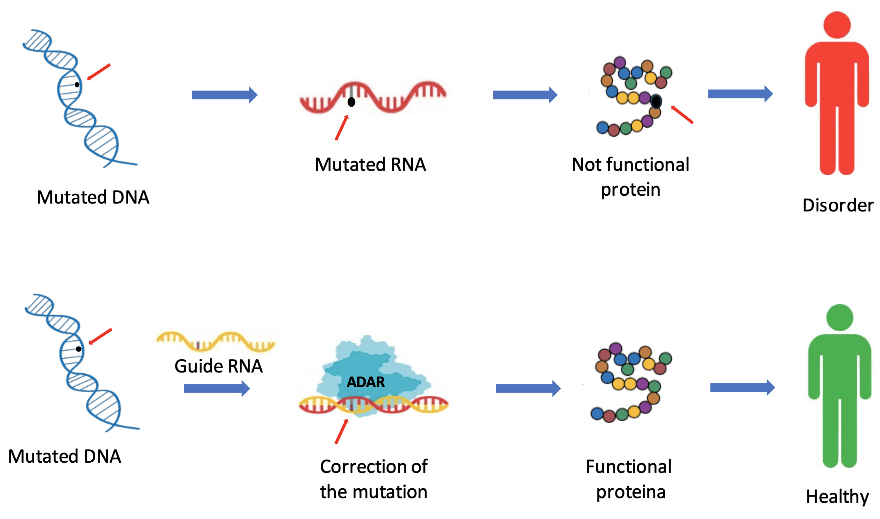
- RNA editing is a genetic modification process involving insertion, deletion, or substitution in RNA sequences.
- Technique Used: ADAR with gRNA
- ADAR (Adenosine Deaminase Acting on RNA): Enzyme used to edit RNA by converting adenosine to inosine.
- gRNA (guide RNA): Small RNA molecules that guide editing by pairing with specific mRNA regions.
The Process of RNA Editing:
- RNA Building Blocks
- Four components: Adenine (A), Guanine (G), Uracil (U), Cytosine (C).
- ADAR modifies adenosine (A) in mRNA to inosine (I), mimicking guanosine (G).
- Mechanism
- Inosine replaces adenosine, triggering a cellular response to correct mismatches.
- This restores the function of mRNA, enabling the production of normal proteins.
Challenges in RNA Editing
- Lack of Specificity: ADARs may cause unintended changes in mRNA due to low gRNA accuracy, increasing side-effect risks.
- Transient and Developing Nature:
- RNA editing effects are temporary, requiring repeated treatments for sustained benefits.
- The field is still in its early stages of development.
RNA Editing vs. DNA Editing
- Nature of Changes
- RNA editing: Temporary and reversible, making it safer and more flexible.
- DNA editing: Permanent and irreversible, with potential for lasting errors.
- Immune and Allergic Risks
- RNA editing: Lower risk due to reliance on ADAR enzymes, naturally present in humans.
- DNA editing: Higher risk as it uses bacterial-derived proteins for cutting functions.
Lead exposure causes $6 trillion in economic losses from premature cardiovascular disease (CVD) mortality: Study
Economic Impact:
- Lead exposure contributes to $6 trillion in economic losses annually due to premature cardiovascular disease (CVD) mortality.
- Highlighted in Lancet Public Health study titled ‘Removing lead from the global economy’.
About Lead (Pb)
- Characteristics:
- Soft metal with low melting point, corrosion resistance, and poor heat conductivity.
- Non-reactive with water, highly malleable, dense, and ductile.
- Occurrence:
- Found in ores with zinc, silver, and copper.
- Naturally occurring toxic metal in Earth’s crust.
- Uses: Batteries (automobile and inverters), ammunition, metal products (e.g., pipes), etc.
- Sources of Pollution: Lead poisoning primarily arises from smelting units and paints.
Impact of Lead Pollution
On Humans
- Cognitive Impairment: Reduces IQ points in children; neurodevelopmental effects begin in the womb.
- Health Effects:
- Increases risk of heart disease, kidney failure, and premature death.
- Causes 5.5 million premature deaths annually from CVD.
On Plants
- Growth Reduction:
- Soil lead concentration increase from 0 to 1000 ppm reduces wheat seed germination from 98% to 50%.
- Reduces biomass generation by 44%.
On Birds
- Physiological and Behavioral Effects:
- Leads to anemia, brain damage, and impaired mobility (difficulty flying, landing, and walking).
- Increases mortality rates.
Initiatives to Control Lead Poisoning
- Global Efforts:
- Global Alliance to Eliminate Lead Paint: Led by WHO and UNEP.
- WHO guidelines on managing lead exposure.
- Policy Actions: Banning the use of leaded petrol.
Recommendations for Lead Elimination
- Global Political Action: States should fund initiatives proportionally to the amount of lead they mine and export.
- Taxation: Implement increasing taxes on lead to shift demand to substitutes.
- Waste Management: Classify lead as toxic waste requiring safe disposal instead of recycling, which causes emissions.
Supreme Court upholds accessibility for PwDs as a Human and Fundamental Right
Key Judgment and Context
- Case: Rajive Raturi vs. UoI & Ors.
- Bench: Three-Judge bench of the Supreme Court.
- Key Ruling: Declared that PwDs' right to access environments, services, and opportunities is both a human right and a fundamental right.
- Basis: Judgment relied on a report by the Centre for Disability Studies (CDS), NALSAR University of Law, advocating the social model of disability.
Social Model of Disability
- Focus: Social change to achieve inclusion and equality for PwDs.
- Key Principle: Removal of social and structural barriers that hinder full participation of PwDs.
Issues Highlighted in CDS NALSAR Report
- Accessibility Barriers: Gaps in accessibility in courts, prisons, schools, public transport, etc.
- Intersectionality and Compounded Discrimination: Overlapping challenges of caste, gender, and other factors with disabilities exacerbate marginalization.
- Inconsistent Legal Framework:
- RPwD Act, 2016: Mandates strict compliance with accessibility standards.
- RPwD Rules, 2017: Introduced Rule 15, allowing only self-regulation, which contradicts the mandatory nature of the Act.
Key Highlights of the Supreme Court Judgment
- Rule 15(1) of RPwD Rules Declared Ultra Vires: The rule undermined the mandatory accessibility standards outlined in the RPwD Act, 2016.
- Principles of Accessibility:
- Universal Design: Enabling access for all, irrespective of disabilities.
- Comprehensive Inclusion: Catering to diverse disabilities.
- Assistive Technology Integration: Leveraging technology to enhance accessibility.
- Stakeholder Consultation: Ensuring inputs from affected individuals and groups.
- Two-Pronged Approach:
- Retrofitting existing institutions and systems to improve accessibility.
- Ensuring future infrastructure and initiatives are fully accessible.
Accessibility Initiatives for PwDs
- Rights-Based Approach:
- RPwD Act, 2016: Enacts principles of the UN Convention on the Rights of Persons with Disabilities.
- Article 9 of UN Convention: Establishes the obligation to provide accessible environments.
- Accessible India Campaign (Sugamya Bharat Abhiyan): A government initiative to promote nationwide accessibility in infrastructure and services.
Notable Judicial Precedents
- State of Himachal Pradesh v. Umed Ram Sharma (1986): Affirmed that the right to accessibility is integral to the Right to Life (Article 21).
- Disabled Rights Group v. Union of India (2017): Directed authorities to reserve seats in educational institutions for PwDs.
'Participatory Approaches in AI Development and Governance' Paper released by IIT-Madras
The paper highlights the importance of participatory approaches in enhancing the fairness and effectiveness of AI systems.
About Participative AI (PAI)
- Involves a broader range of stakeholders, beyond technology developers, in the creation and governance of AI systems.
- Core Principles: Derived from participatory governance frameworks.
- Need for Participative AI: Rapid advancements in AI and its deployment by public and private entities (e.g., Facial Recognition in law enforcement) demand inclusive approaches to minimize risks and improve outcomes.
Benefits of Participative AI
- Counter Top-Down Decision-Making: Reduces implementation conflicts by addressing unilateral actions.
- Promotes Inclusion and Fairness: Mitigates biases and discriminatory outcomes in AI systems deployed in diverse communities.
- Facilitates Feedback Loops: Aids in identifying technical issues and assessing post-deployment impacts.
- Builds Trustworthiness: Reduces false positives/negatives, fostering user confidence and wider adoption.
Challenges with Participative AI
- Co-optation: Risk of dominant actors influencing AI development for personal agendas.
- Limited Non-Expert Participation: Current models primarily involve experts like bureaucrats and select industry representatives, sidelining broader stakeholders.
- Participatory Washing: Superficial involvement of stakeholders for compliance rather than genuine engagement.
- Transparency Paradox: Sharing algorithm details may expose vulnerabilities to malicious actors.
Examples of Participatory Governance in India and Abroad
- Land Acquisition Act, 2013: Mandates Social Impact Assessment involving affected communities.
- Forest Rights Act, 2006: Empowers Gram Sabhas as statutory institutions for democratic decision-making.
- Nagoya Protocol: Ensures equitable sharing of benefits arising from genetic resource utilization.
‘The State of Food and Agriculture 2024’ report released by FAO
- Report Title: The State of Food and Agriculture 2024 released by the Food and Agriculture Organization (FAO).
- Focus: Highlights the need for value-driven transformation in agrifood systems and examines the global hidden costs associated with these systems.
- Hidden Costs Defined:
- External costs (negative externalities) or economic losses caused by market or policy failures in agrifood systems.
- Hidden costs encompass the entire journey of food, from production to consumption.
Key Findings
- Global Hidden Costs:
- Industrial and diversified agrifood systems account for the highest global hidden costs (~$5.9 trillion in 2020 PPP terms).
- Health-related hidden costs, particularly from non-communicable diseases, dominate.
- Unhealthy diets (e.g., low whole-grain intake, excessive sodium consumption) contribute ~70% of all hidden costs.
- Other Costs:
- Social Costs: Resulting from undernourishment and poverty.
- Environmental Costs: Include greenhouse gas emissions and ecological degradation.
- India-Specific Findings:
- India ranks 3rd globally in hidden costs (~$1.3 trillion annually), following China and the USA.
- The major contributor in India is unhealthy dietary patterns.
Recommendations for Transforming Agrifood Value Chains
- For Industrial Agrifood Systems (Long value chains, high urbanization):
- Develop dietary guidelines based on agrifood systems.
- Implement mandatory nutrient labeling and certifications.
- Conduct public awareness campaigns.
- For Traditional Agrifood Systems (Short value chains, low urbanization):
- Combine productivity-focused interventions with measures addressing environmental and dietary sustainability to reduce ecological footprints.
India’s Efforts to Reform Agrifood Systems
- Promoting Sustainable Farming: Initiatives like Paramparagat Krishi Vikas Yojana (PKVY), Per Drop More Crop (PDMC), and the National Bamboo Mission (NBM).
- Enhancing Agricultural Infrastructure: Programs such as the Agriculture Infrastructure Fund (AIF) and the Agricultural Marketing Infrastructure (AMI) scheme.
- Improving Farmers’ Welfare: Schemes like Pradhan Mantri Kisan Samman Nidhi (PM-KISAN) and the formation of Farmer Producer Organizations (FPOs).
Concerns raised with declining fertility rates in some states
- State-Specific Concerns:
- Chief Ministers of Andhra Pradesh and Tamil Nadu have expressed concerns about declining fertility rates and their impact on population growth.
- Both states report significantly low Total Fertility Rates (TFR), which may have long-term implications for their socio-economic structure.
Fertility Rate in India: An Overview
1. Key Findings of NFHS-5 (2019-21):
- National Decline in TFR: India's TFR has reduced to 2.0, below the replacement level of 2.1, necessary to sustain population size.
- Regional Variations:
- Southern states like Tamil Nadu (TFR: 1.4) and Andhra Pradesh (TFR: 1.5) show sharp declines.
- Northern states like Uttar Pradesh (TFR: 2.7) and Bihar (TFR: 3.0) maintain higher fertility rates.
2. Replacement Level Fertility:
- Indicates the number of children required per woman to replace the current population across generations.
Factors Contributing to Declining Fertility Rates
1. Family Planning Initiatives:
- Increased adoption of family planning policies.
- Rise in family planning demand among married women from 66% (2015-16) to 76% (2019-21).
2. Educational and Economic Empowerment of Women:
- Higher education levels and workforce participation among women.
- Increased opportunity costs of having more children.
3. Rising Cost of Living:
- Financial concerns, including housing and living expenses, discourage larger families.
Concerns with Declining Fertility Rates
1. Ageing Societies:
- Economic and Social Strains: Higher government spending required for pensions and healthcare services.
- Old Age Dependency: Increased burden on younger generations for the care of an ageing population.
2. Political Challenges:
- Potential reduction in political representation of low-growth states after the 2026 parliamentary seat review.
3. Labour Shortages:
- Decline in working-age population can lead to economic slowdowns.
- Example: Japan faces significant labour shortages due to persistently low fertility rates.