
Daily Current Affairs UPSC 27 September 2024
Welcome to our daily current affairs blog post for UPSC aspirants! In today's edition, we will be discussing the most significant events and news updates that took place on 27th September 2024. Staying updated with current affairs is crucial for UPSC preparation, as it not only helps you stay informed but also enhances your understanding of various subjects. So, let's dive into the important happenings of the day and explore their potential impact on the upcoming UPSC examinations.

Bharat 6G Alliance
- The Union Minister of Communications recently met with the Bharat 6G Alliance to enhance India's domestic 6G ecosystem.
- The Bharat 6G Alliance is a collaboration of Indian industry, academia, research institutions, and standards organizations supported by the government.
- The goal of the alliance is to position India as a key global provider of cost-effective 5G, 6G, and future telecommunications solutions by 2030.
- The focus areas of the alliance include developing 5G Advanced/6G intellectual property and patents in India, creating Indian 5G Advanced/6G products, and encouraging Indian participation in international telecommunications standards organizations.
Eturnagaram Wildlife Sanctuary
- A rare weather event caused significant damage to thousands of trees in Eturnagaram Wildlife Sanctuary.
- Eturnagaram Wildlife Sanctuary, established in 1953, is one of the oldest sanctuaries in Warangal, Telangana.
- The sanctuary is surrounded by Laknavaram Lake and is divided into two parts by the Dayyam Vagu River.
- The sanctuary is home to a variety of fauna including Indian Gaur, Giant Squirrels, Sloth Bears, Indian Bison, Black Bucks, Chinkaras, and Tigers.
- Some of the finest teak wood can be found in the sanctuary.
- Eturnagaram Wildlife Sanctuary hosts the sammakka Sarakka Jathra, one of Asia's largest tribal events, which takes place once every two years.
National Career Service (NCS)
- The Ministry of Labour & Employment (MoL&E) and Amazon have signed a 2-year MoU to utilize the NCS portal to enhance job opportunities.
- The NCS Portal was launched in 2015 and is managed by MoL&E to connect job seekers with employment opportunities in various sectors.
- The portal provides a variety of employment services such as counseling and skill development.
- In the current year, the NCS portal reached a milestone by listing 2 million active vacancies in a single day.
Intercontinental Ballistic missile (ICBM)
- China recently conducted its first test firing of an ICBM into the Pacific Ocean in decades.
- ICBMs were first used by the United States in 1959 and are considered a strategic defensive weapon due to their powerful nature.
- These missiles can travel over 5,500 kilometers and follow a free-falling trajectory towards their targets after being powered by rockets.
- Ballistic missiles have the capability to carry either nuclear or conventional warheads.
- Agni-V, the longest missile in the Agni series, is an ICBM with a range of over 5,000 km.
Kasturirangan Committee
- The Karnataka government did not agree with the recommendations of the High Level Working Group on Western Ghats in 2013, led by Dr. K. Kasturirangan.
- The Kasturirangan Committee suggested that 37% of the Western Ghats area should be designated as eco-sensitive, which would impact various projects and activities.
- The Environment Ministry then released a draft notification in 2014 identifying biologically and culturally diverse areas as Eco-sensitive Areas.
- The report proposed a ban on mining, quarrying, red category industries, and thermal power projects in the Western Ghats.
- The earlier Western Ghats Ecology Expert Panel, chaired by Prof. Madhav Gadgil in 2011, recommended that 75% of the Western Ghats should be declared environmentally sensitive, but this was met with controversy and led to the formation of the Kasturirangan committee.
Jitiya or Jivitputrika festival
- Bihar experienced a disaster during the Jivitputrika festival.
- The Jitiya or Jivitputrika festival is a Hindu festival mainly observed in Bihar, Uttar Pradesh, Jharkhand, and Nepal.
- Mothers fast during this festival to pray for the well-being, long life, and prosperity of their children.
- The festival lasts for 3 days, with the first day known as nahayekhaye.
- The festival is based on Hindu mythology, specifically the story of King Jimutavahana, who sacrificed for the welfare of others and is honored during this time.
EU deforestation regulation (EUDR)
- Despite objections from India, Brazil, Indonesia, and the US, the EU will proceed with the implementation of its EUDR starting on December 30, 2024.
- The EUDR, which came into effect in 2023, is designed to combat global forest degradation and deforestation, protect biodiversity, and reduce greenhouse gas emissions. It places new responsibilities on companies that import, export, or sell certain products in the EU.
- The regulation stipulates that commodities entering or leaving the EU market must not originate from land that has been deforested or degraded after December 31, 2020.
- Covered commodities include cattle, cocoa, coffee, palm oil, soy, timber, and rubber, as well as products derived from these commodities such as beef, furniture, and chocolate.
GlobE Network
- India has been chosen to be part of the steering committee of the GlobE (Global Operational Network of Anti-Corruption Law Enforcement Authorities) network.
- The GlobE Network was established in 2021 during the UN General Assembly Special Session against Corruption (UNGASS) and is an initiative launched under the G20 framework.
- The objective of the GlobE Network is for operational law enforcement authorities with an anti-corruption mandate to collaborate in addressing transnational corruption cases.
- The network is governed by its members and supported by the UNODC as its secretariat, with 121 member countries and 219 law enforcement authorities.
- In India, the Ministry of Home Affairs serves as the Central Authority for the GlobE Network, with the CBI and ED representing the country as member authorities.
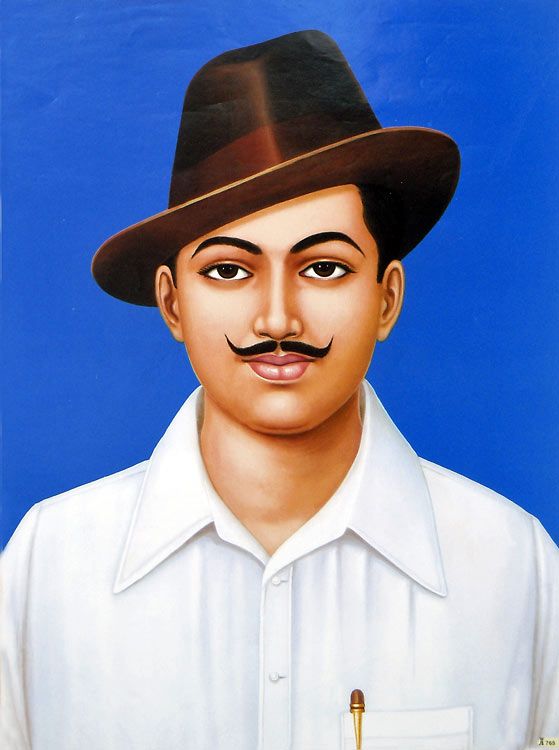
Shaheed Bhagat Singh
- Birth anniversary of Shaheed Bhagat Singh celebrated
- Background of Shaheed Bhagat Singh
- Born in Lyallpur, western Punjab, India (now in Pakistan)
- Influenced by revolutionary socialism, Marxism, and communism ideals
- Contributions of Shaheed Bhagat Singh
- Founded Naujawan Bharat Sabha in 1926
- Changed name of Hindustan Republican Association to Hindustan Socialist Republican Association in 1928
- Bombed Central Legislative Assembly in Delhi in 1929 with Batukeshwar Dutt to oppose Public Safety Bill and Trade Dispute Bill
- Wrote works like "Why I Am an Atheist: An Autobiographical Discourse" and "The Jail Notebook"
- Values upheld by Shaheed Bhagat Singh
- Patriotism
- Courage
- Strength of conviction
"Half a Century of Indian Microfinance"
- SEWA Bank, India's inaugural Microfinance Institution, was established in 1974 as a cooperative bank.
- The Grameen Bank, founded by Nobel Laureate Muhammad Yunus in Bangladesh in 1976, is credited with laying the groundwork for modern MFIs.
- The Reserve Bank of India (RBI) serves as the regulatory authority for MFIs operating within the country.
- The Malegam Committee, formed by the RBI in 2010, proposed a comprehensive framework for regulating Non-Banking Financial Companies (NBFC) - MFIs.
About Microfinance Services
- It provides financial services such as small loans to underserved and low-income individuals who do not have access to traditional banking.
- The services offered also include savings accounts, money transfers, micro insurance, and more.
Significance of Microfinance Sector
- A powerful tool for promoting financial inclusion and driving socio-economic transformation.
- Empowering women through the formation of Self Help Groups.
- Contributing to poverty reduction and fostering overall rural development.
Challenges in Microfinance Sector
- MFIs face high transaction costs when providing services to many small borrowers.
- The lack of collateral makes it hard for MFIs to secure loans.
- MFIs often charge higher interest rates than commercial banks.
- MFIs struggle to access affordable funding, leading to high credit costs.
- Poor borrowers often have low financial and digital literacy, and may rely on moneylenders.
Initiatives taken by Government for Microfinance in India
- SHG-Bank Linkage Program aims to increase loan volume for SHGs and shift their lending focus from non-income generating activities to production-based ones.
- Pradhan Mantri Mudra Yojana offers loans up to 10 lakh to small/micro enterprises through various financial institutions.
- MUDRA loans are divided into categories like Shishu, Kishore, and Tarun.
- The 2024 Union Budget raised the loan limit to ₹20 lakh for individuals who have repaid loans taken under the Tarun category.
"WIPO's GII 2024 Report Released"
- GII assists governments in evaluating the impact of innovation on social and economic development.
- WIPO, Cornell University, and INSEAD Business School collaborated on the publication of GII.
- The criteria used to gauge innovation encompass institutions, human capital and research, infrastructure, credit, investment, linkages, knowledge creation, absorption, diffusion, and creative outputs.
Key findings
- Switzerland remains the top-ranked country, with Sweden, the US, and Singapore following closely behind.
- India has moved up to the 39th position among 133 global economies, improving from its 40th position in 2023.
- India is ranked first among lower middle-income economies and in the Central and Southern Asia region for various factors including knowledge and technology outputs, creative outputs, institutions, and business sophistication.
- Key indicators of India's strengths include ICT services exports, venture capital received, and intangible asset intensity.
- The theme of GII 2024 emphasizes the increasing importance of social entrepreneurship.
- Social Entrepreneurship involves creating and putting into action new ways of organizing to tackle social and environmental issues, with the main goal not being profit.
Significance:
- Social enterprises and social entrepreneurs contribute around $2 trillion to the global GDP.
- Approximately 10-11 million social enterprises and 30 million social entrepreneurs create employment opportunities, helping millions establish sustainable livelihoods.
- These entities work towards reducing poverty, addressing environmental issues, and fighting against racial and social injustices.
About WIPO
WIPO Genesis
- WIPO is a specialized agency of the United Nations that was established in 1967.
WIPO's Objective
- The agency is dedicated to developing a balanced and accessible international Intellectual Property (IP) system that rewards creativity, stimulates innovation, and contributes to economic development.
WIPO Members
- WIPO has 193 members, with India being a member since 1975.
Major Treaties
- India is a member of all three major WIPO treaties:
- Paris Convention for the Protection of Industrial Property (1998)
- Berne Convention for the Protection of Literary and Artistic Works (1928)
- Patent Cooperation Treaty (1998)
"India Signs Agreement on Marine Biodiversity at UN"
- The Biodiversity Beyond National Jurisdiction (BBNJ) Agreement, now known as the BBNJ Agreement, was adopted in 2023 by the Intergovernmental Conference on Marine Biodiversity of Areas Beyond National Jurisdiction.
- The Ministry of Earth Sciences in India is responsible for implementing the agreement.
About Agreement on Marine Biodiversity of Areas beyond National Jurisdiction (High Seas Treaty)
- The treaty is a part of the United Nations Convention on the Law of the Sea (UNCLOS).
- Its goal is to protect and responsibly utilize marine biodiversity in areas that are not under the jurisdiction of any one country.
- Features:
- Marine protected areas would be established in areas of the ocean with high biodiversity that are facing environmental challenges.
- Countries would not have control over resources from the high seas in these protected areas.
- Significance:
- Increase India's strategic influence in regions outside of its Exclusive Economic Zone.
- Help in meeting various Sustainable Development Goals, with a focus on SDG14 (Life Below Water).
- Improve India's initiatives for marine conservation and create opportunities for scientific research and advancement.
- Encourage the utilization of both traditional and modern scientific knowledge.
Agreement addresses four main issues
- Fair and equitable sharing of benefits related to marine genetic resources.
- Utilization of area-based management tools, such as marine protected areas.
- Conducting environmental impact assessments.
- Enhancing capacity-building and technology transfer in the marine sector.
About UNCLOS
- A global agreement established in 1982 and enacted in 1994 that established a detailed system of regulations for governing the oceans and seas worldwide.
About High Seas
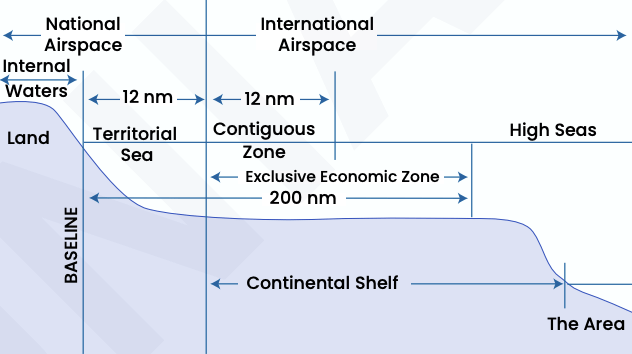
- International law defines high seas as areas of the ocean that are not part of a country's Exclusive Economic Zone, territorial sea, internal waters, or archipelagic waters.
- No country directly owns or regulates the high seas and their resources.
- The high seas make up 64% of the ocean.
Legal Boundaries of Maritime Zones of Ocean and Airspace
Extension of AFSPA to Nagaland and Arunachal Pradesh
- The Ministry of Home Affairs has designated certain areas as 'disturbed areas' under the Armed Forces (Special Powers) Act, 1958 for a six-month period.
- Currently, AFSPA is being enforced in parts of Nagaland, Assam, Manipur, and Arunachal Pradesh.
- In Jammu and Kashmir, AFSPA is in effect through the Armed Forces (J&K) Special Powers Act, 1990.
AFSPA Overview:
- AFSPA stands for the Armed Forces (Special Powers) Act.It aims to grant special powers to armed forces in disturbed areas in the North Eastern States of India.
- Section 3 of the Act allows the Governor of a State, Administrator of a Union territory, or the Central Government to declare a disturbed area in whole or in part.
- A disturbed area is where the use of armed forces to aid civil power is deemed necessary.
- Section 4 of the Act grants special powers to armed forces, which must be used with extreme caution.
- The armed forces can fire upon or use force against individuals violating laws after giving a warning.
- They can also arrest individuals without a warrant if there is reasonable suspicion.
- Army soldiers operating under AFSPA are protected from legal actions unless authorized by the central government.
Issues with AFSPA
- Fundamental rights are being violated, including Articles 14, 19, and 21 of the Constitution.
- It goes against international laws such as the Universal Declaration of Human Rights and the International Covenant on Civil and Political Rights.
- The implementation of AFSPA leads to conflicts between the Centre and states, undermining states' autonomy even in times of peace.
Way-forward:
- Removing AFSPA and adding suitable clauses to the Unlawful Activities (Prevention) Act, 1967 as recommended by the Jeevan Reddy committee in 2004
- Enforcing a decentralized governance approach to give more power to local communities at the grassroots level.
"CDSCO Drug Alert: Widespread Quality Issues in India"
- An alert has been issued stating that over 50 drugs, such as paracetamol and vitamin D3 supplements, are not meeting standard quality requirements.
- The alert also pointed out that many states have not provided data on the quality of drugs.
Drug Regulation in India
- Drug regulation is governed by the Drugs and Cosmetics Act, 1940 and the Drugs and Cosmetics Rules, 1945.
- The CDSCO, led by the Drugs Controller General of India, is responsible for monitoring drugs regularly.
- The NSQ list is released monthly by the CDSCO to evaluate drug quality and safety.
- The NPPA sets and adjusts prices for controlled bulk drugs and ensures drug availability.
- State governments also regulate drugs through State Drug Regulating Agencies due to public health being a state subject.
Issues of Drug Regulation in India
- Unequal application: The Drug Controller General of India has banned a certain number of fixed dose combinations that are manufactured under state units.
- Officer discretion in regulation: The Drugs and Cosmetics Act or Rules do not offer any specific guidelines for regulating drugs, leaving it up to the individual officers.
- Insufficient trained staff: The Mashelkar Committee in 2003 identified a lack of adequately trained personnel in the industry.
- Additional problems: Lack of coordination between State Drug Regulatory Authorities and the central government, inadequate infrastructure, funding issues, and more.
Way forward on improving Drug Regulation Ecosystem
- Promoting the use of digital software such as XLN in all services and states to enhance technology utilization.
- The Mashelkar committee has suggested restructuring the National Drug Authority to improve drug regulation.
- There is currently no system in place to guarantee the implementation of recall orders.
"PM Unveils 3 PARAM Rudra Supercomputers"
- Super computers worth Rs 130 crore have been developed domestically as part of the National Supercomputing Mission (NSM) and are now in use in Pune, Delhi, and Kolkata.
- The Giant Meter Radio Telescope (GMRT) in Pune will be used to study Fast Radio Bursts (FRBs) and other astronomical phenomena.
- The Inter-University Accelerator Centre (IUAC) in Delhi will support research in material science and atomic physics.
- The S.N. Bose Centre in Kolkata will focus on advanced research in physics, cosmology, and earth sciences.
- The Prime Minister also launched new HPC systems called 'Arka' and 'Arunika' which will improve accuracy and predictions for tropical cyclones, heavy precipitation, thunderstorms, and more.
About Supercomputers:
- Supercomputers are the biggest and most powerful mainframe systems that handle complex calculations by dividing tasks into smaller parts and processing them simultaneously.
- The speed of a supercomputer is quantified by the number of floating-point operations it can perform in a second (FLOPS).
National Supercomputing Mission (NSM):
Started in 2015
- Goal is to offer supercomputing infrastructure for academia, researchers, MSMEs, and startups
- Managed by DST and MeitY
- Executed by C-DAC, Pune and IISc, Bengaluru
- Used for Computational Biology, Atomic Energy Simulations, National Security/ Defence Applications, Seismic Analysis, etc.
About C-DAC
- Established in 1988, the leading research and development organization of the MeitY has a track record of delivering the PARAM series of supercomputers.
- This series includes the PARAM 8000, which was India's first Giga-scale supercomputer in 1990, as well as the PARAM 10000 released in 1998.