
Daily Current Affairs UPSC 24 October 2024
Welcome to our daily current affairs blog post for UPSC aspirants! In today's edition, we will be discussing the most significant events and news updates that took place on 24th October 2024. Staying updated with current affairs is crucial for UPSC preparation, as it not only helps you stay informed but also enhances your understanding of various subjects. So, let's dive into the important happenings of the day and explore their potential impact on the upcoming UPSC examinations.

Additional Judges of High Courts
- Recently, the Union Government appointed 4 Additional Judges for the Bombay High Court for a 2-year period.
About Additional Judges of High Courts:
- These Additional Judges are appointed by the President of India under Article 224 (1).
- They can serve for a maximum of 2 years and must retire at the age of 62.
- The appointment is made if there is a temporary increase in the court's workload or due to arrears of work.
PM SHRI scheme
- Delhi has signed a Memorandum of Understanding with the Centre to implement the PM-SHRI (PM Schools for Rising India) scheme.
About PM SHRI Scheme:
- The scheme, launched in 2022, aims to establish over 14500 PM SHRI Schools by strengthening existing schools managed by various government bodies.
- It is in line with the National Education Policy (2020) and will be implemented from 2022-23 to 2026-27.
- The scheme will utilize the administrative structure of Samagra Shiksha, KVS, and NVS for its implementation.
ZyVac TCV
- WHO prequalification status obtained by ZyVac TCV.
- Eligibility for United Nations procurement programs.
About ZyVac TCV:
- Typhoid Vi conjugate vaccine providing immunization against Salmonella typhi infection.
- Conjugate vaccines link antigens to polysaccharides for immunity stimulation.
- Subunit vaccines contain specific components from disease-causing microbes.
- Developed and manufactured by Zydus Lifesciences Ltd.
Cloud Chamber
- India's first convective cloud chamber to be built at IITM, Pune under 'Mission Mausam'.
- Mission Mausam aims to improve weather forecasting and manage weather events like rainfall, hail, fogs.
About Cloud Chamber:
- Cloud chamber is a closed cylinder for forming clouds under controlled conditions.
- Helps in understanding cloud physics in Indian weather systems.
Snow Leopard
- Celebrated on October 23.
- Raises awareness about the conservation of snow leopards.
About Snow Leopard:
- Habitat in mountains of Central and South Asia.
- Range countries include India.
- Distribution in India includes UTs of Ladakh and J&K, and states such as Himachal Pradesh, Uttarakhand, Sikkim, and Arunachal Pradesh.
- Prey includes ibex and blue sheep.
- State animal of Himachal Pradesh and Ladakh.
- Characteristics include short forelimbs and long hind limbs for mountainous environments.
Conservation Status:
- IUCN: Vulnerable.
- CITES: Appendix I.
- Protected under Wildlife (Protection) Act, 1972: Schedule I.
National Commission Scheduled Castes
- Recently, the Delhi High Court stated that NCSC does not have the authority to investigate or issue directions similar to a civil or criminal court.
About National Commission Scheduled Castes (NCSC):
- NCSC is a Constitutional body established under Article 338 of the Constitution.
- Composition includes a Chairperson, Vice-Chairperson, and three other members appointed by the President of India.
- Members hold office for a term of 3 years and can serve for a maximum of 2 terms.
Functions of NCSC:
- Investigate and monitor all issues related to constitutional and legal safeguards for Scheduled Castes.
- Inquire into specific complaints regarding the deprivation of rights and safeguards of Scheduled Castes.
PM YASASVI
- Ministry of Social Justice and Empowerment highlighted the impact of PM-YASASVI initiative.
About PM-YASASV:
- Objective: Provide educational support for socially and economically disadvantaged students.
- Umbrella scheme for students from Other Backward Classes, Economically Backward Classes, and Denotified Tribes.
- Subsumed earlier initiatives like Dr. Ambedkar Post-Matric Scholarship Scheme for EBCs and DNTs.
Pink Cocaine
Recently, Pink cocaine has been seized in many countries.
About Pink cocaine:
- Pink cocaine seized in many countries, also known as "tusi"
- Contains ketamine, not cocaine, with hallucinogenic properties.
- Composition includes methamphetamine, ketamine, and MDMA with dye.
- Health effects: heart attacks, high blood pressure, stroke, behavioral changes, addiction, anxiety, depression, psychosis.
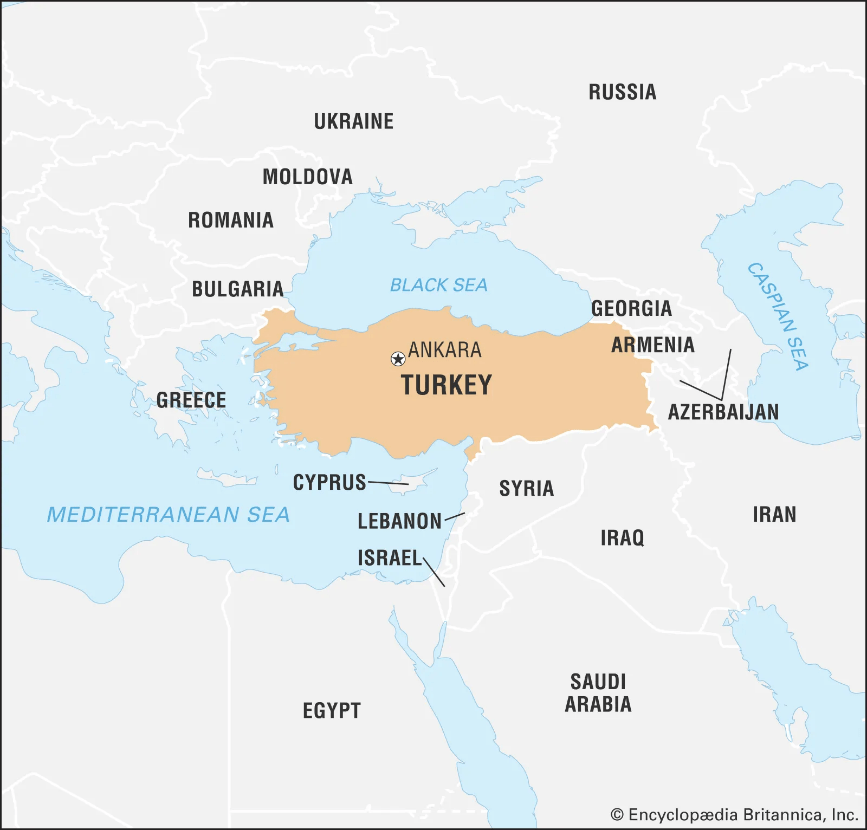
Turkiye (Capital: Ankara)
- Turkey conducts military strikes on Kurdish militant targets in Iraq and Syria.
Political Features:
- Located in both Asia and Europe
- Shares borders with Georgia, Armenia, Azerbaijan, Iran, Iraq, Syria, Greece, and Bulgaria
- Bounded by Black Sea (north), Mediterranean Sea and Aegean Sea (Southwest, West)
Geographical Features:
- Major rivers include Euphrates, Tigris, and Kizilirmak
- Highest point is Mount Ararat
- Important straits include Bosphorus strait and Dardanelles strait
States have the power to regulate Industrial alcohol or denatured spirit: Supreme Court
- SC held that the term "intoxicating liquor" in Entry 8 of List II (State List) includes industrial alcohol.
- Overruled a 1990 judgment that stated States cannot tax industrial alcohol.
Brief Background:
- Union currently regulates industrial alcohol under the Industries (Development and Regulation) Act of 1951.
- Union defends this law based on power from Entry 52 (Union List) and Entry 33 (Concurrent List).
- Entry 52: Industries.
- Entry 33: Trade and commerce in, and the production, supply, and distribution of certain products.
- States argue that industrial alcohol can be misused to produce consumable alcohol illegally, necessitating legislation.
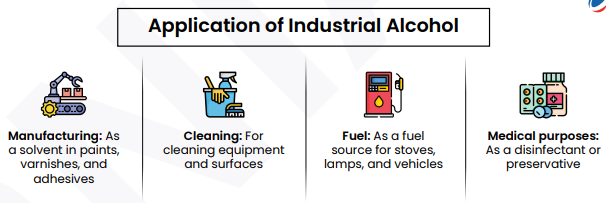
About Industrial Alcohol:
- Major type of alcohol, alongside usable alcohol.
- Usable alcohol mainly refers to ethyl alcohol (ethanol) for human consumption.
- Industrial alcohol can include isopropyl alcohol or denatured alcohol made unfit for drinking by adding substances to make it poisonous or unpleasant to taste.
India’s first ever Great Indian Bustard hatched through Artificial Insemination
- India's first successful artificial insemination of the Great Indian Bustard (GIB) was achieved at the National Breeding Centre in Jaisalmer, Rajasthan.
- This milestone was accomplished under the Bustard Recovery Program, which aims to conserve and increase the population of GIBs.
About Bustard Recovery Project:
- The Bustard Recovery Project was initiated for a period of five years from 2016 to 2021, with an extension granted until 2024.
- The project focuses on conservation breeding, capacity building, advocacy for bustard conservation, and promoting bustard-friendly land uses.
About Great Indian Bustard:
- The Great Indian Bustard, also known as Godawan locally in Rajasthan, is a critically endangered species.
- It is primarily found in Rajasthan and Gujarat, with small populations in Maharashtra, Karnataka, and Andhra Pradesh.
- The GIB is listed under Schedule I of the Wildlife Protection Act, 1972, and Appendix I of CITES.
- There are less than 150 GIBs left in the wild, making conservation efforts crucial for their survival.
Characteristics and Threats:
- The GIB is a grassland species endemic to the Indian subcontinent, known for its distinctive black crown and gular pouch used for attracting mates.
- They are omnivorous, feeding on grass seeds, insects, and sometimes small rodents and reptiles.
- Threats to the GIB include hunting, habitat loss, collision with power lines, and agricultural expansion, highlighting the importance of conservation efforts.
Supreme Court issues Directions to ensure Prisoners get Free and Timely Legal Aid
- Recent Supreme Court directions in Suhas Chakma vs. UoI case aim to ensure prisoners receive free and timely legal aid.
- Practice directions issued to all courts to ensure beneficial schemes by legal services authority reach all prisoners.
Court Direction Highlights:
- NALSA and State/District Legal Service Authorities to ensure efficient operation of SOPs for legal aid services to prisoners.
- Awareness generation through literature in local languages and promotional methods.
- Display boards in public places with contact information for legal aid offices.
Legal Aid Framework in India:
- Article 39A of the Constitution: Ensures free legal aid for all citizens to access justice regardless of economic or other barriers.
- Legal Service Authority Act, 1987: Establishes Legal Services Authorities at various levels to provide legal aid services.
- National, State, District, and Taluka level authorities and committees ensure legal aid is accessible at all levels of the judicial system.
Eligibility criteria for Legal Aid under the Legal Services Authority Act, 1987
- Women and children are eligible for legal aid services.
- Members of Scheduled Castes or Scheduled Tribes can receive legal aid.
- Industrial workmen are eligible for legal assistance.
- Persons with disabilities have access to legal aid services.
- Victims of human trafficking or begging can receive legal aid.
- Victims of mass disasters or violence are eligible for legal assistance.
- Persons in custody in protective homes or psychiatric hospitals can receive legal aid.
Rights of Persons with Disabilities (Amendment) Rules, 2024 notified
- The Union Ministry of Social Justice and Empowerment has notified the amended Rules under the Rights of Persons with Disabilities Act, 2016.
Key Changes in the Amended Rules:
- Application requirements for disability certificate include proof of identity, recent photograph, and Aadhaar card.
- Only medical authorities can issue disability certificates in the applicant's district of residence.
- Processing time extended to three months.
- Applications will lapse if undecided for over 2 years, requiring re-application or reactivation.
- Introduction of new colour-coded UDID cards based on the level of disability.
Concerns with the Amended Rules:
- Exclusion of persons without Aadhaar, particularly those in rural or marginalized communities.
- Longer processing time may hinder genuine persons with disabilities from accessing necessary services and entitlements.
Rights of Persons with Disabilities Act, 2016 Overview
- Defines disability as physical, mental, intellectual, or sensory impairment.
- Recognizes 21 categories of disabilities.
- Prohibits discrimination against persons with disabilities in various aspects of life.
Commitment to Reducing Inequality (CRI) Index 2024 released
- CRI released by Oxfam and Development Finance International.
- Assesses commitment of 164 countries to fight inequality.
- Based on Public Services Spending, Progressive taxation, and Labour rights and wages.
- SDG 10 aims to reduce inequality.
Key Highlights of the Index:
- Top performers: Norway, Canada, Australia.
- Worst performers: South Sudan, Nigeria.
- India's rank: 127.
- Other South Asian countries like Nepal (115) and Sri Lanka (118) performed better than India.
Rising Inequality:
- Gap between Global South and Global North growing rapidly.
- Factors: Conflict, debt crisis, climate shocks.
- 84% of countries reduced spending on education, health, social protection.
- Billionaires doubled in last decade while many face hunger.
Key Recommendations to Reduce Inequality:
- Implement National Inequality Reduction Plans (NIRPs) with monitoring.
- Health budget should be 15% of total public expenditure, education 20%.
- Increase progressive taxation on richest 1%.
Measures taken in India to reduce inequality
- Job Creation: MGNREGA.
- Financial Inclusion: PM Jan Dhan Yojana.
- Education and Skilling: Right to Education Act, 2009.
- Other initiatives like Startup India.
16th BRICS Summit concluded with the adoption of the Kazan Declaration
- The 16th BRICS Summit recently concluded in Kazan, Russia.
- The summit adopted the Kazan Declaration, a comprehensive document outlining key areas of cooperation and the bloc's unified stance on global issues.
- The theme of the summit was "Strengthening Multilateralism for Just Global Development and Security."
Key Highlights of the Declaration:
- Global Governance and Multilateralism
- Commitment to cooperate for International Financial Architecture Reform.
- Economic Cooperation
- BRICS Cross-Border Payment System: Focus on minimizing trade barriers and promoting use of local currencies.
- BRICS Clear Depositary: Independent cross-border settlement and depositary infrastructure
- BRICS Interbank Cooperation Mechanism (ICM): Facilitating innovative financial practices and approaches
- BRICS Grain Exchange: Initiative to establish a grain trading platform within BRICS
- Other
- BRICS R&D Vaccine Center & BRICS Integrated Early Warning System for preventing mass infectious diseases risks.
- Recognition of India's initiative to create an International Big Cats Alliance.
- Creation of a BRICS Partner Country category, adding 13 new partner countries such as Cuba, Turkey, and Vietnam.
Background on BRICS:
-
- The term "BRICs" was coined by British economist Jim O' Neill in 2001.
- The grouping was formalized during the first meeting of BRIC Foreign Ministers in 2006.
- BRIC became BRICS with the inclusion of South Africa in 2010.
- The members of BRICS include Brazil, China, India, Russia, and South Africa.