
Daily Current Affairs UPSC 14 August 2024
Welcome to our daily current affairs blog post for UPSC aspirants! In today's edition, we will be discussing the most significant events and news updates that took place on 14th August 2024. Staying updated with current affairs is crucial for UPSC preparation, as it not only helps you stay informed but also enhances your understanding of various subjects. So, let's dive into the important happenings of the day and explore their potential impact on the upcoming UPSC examinations.

Exercise Tarang Shakti
- Phase-I of Exercise Tarang Shakti was held at Sulur airbase in Tamil Nadu by the Indian Air Force (IAF).
- Exercise Tarang Shakti is India's inaugural multinational air exercise.
- The exercise is designed to demonstrate India's military strength and promote cooperation between participating militaries.
- The IAF plans to hold Exercise Tarang Shakti every two years.
Ballast water
- Scientists believe that ballast water transported by ships is a means of introducing exotic and invasive species to coastal regions.
- Ballast water is either fresh or saltwater stored in ships' ballast tanks and cargo holds to help with stability and maneuvering.
- If untreated ballast water is discharged at a ship's destination, it could introduce new invasive marine species.
- The International Convention for the Control and Management of Ships' Ballast Water and Sediments (BWM Convention) was established in 2004 to regulate the transfer of potentially invasive species.

DDoS Cyber attack
- A recent DDoS attack caused issues during an interview with a former US President on Social Media platform X.
- DDoS attacks are malicious attempts to disrupt normal traffic by overwhelming a server, service, or network with a flood of Internet traffic.
- In a DoS attack, a single internet connection is used to bombard a target with fake requests or exploit cybersecurity vulnerabilities.
- DDoS attacks can involve multiple compromised computer systems as sources of attack traffic.
FloodWatch India Application
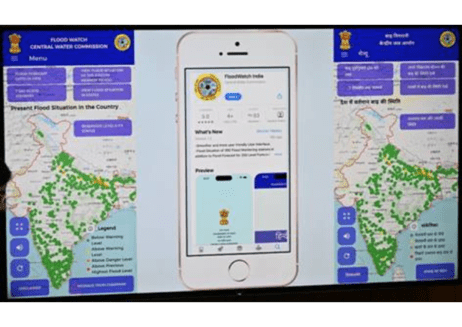
- The Ministry of Jal Shakti has launched an updated version of the 'FloodWatch India' mobile application.
- The new version will now cover information from 592 flood monitoring stations and 150 major reservoirs, an increase from the previous 200 stations.
- The FloodWatch India Application was developed by the Central Water Commission (CWC), a leading technical organization in the field of water resources in India.
- The aim of the application is to use mobile phones to provide real-time flood information and forecasts up to 7 days to the public.
- The application utilizes advanced technologies such as satellite data analysis, mathematical modeling, and real-time monitoring to achieve its goals.
GAURAV
- DRDO successfully tested the Long Range Glide Bomb 'GAURAV' from the Su-30 MK-I platform.
- GAURAV is a 1,000 kg class glide bomb that can hit targets at long distances.
- The glide bomb uses a hybrid navigation scheme combining Indian Navigation System (INS) and Global Positioning System (GPS) data to steer towards the target accurately.
- The bomb was designed and developed by the Research Centre Imarat (RCI) in Hyderabad.
Man Portable Anti-tank Guided Missile
- DRDO recently conducted a successful test of the Man-Portable Anti-Tank Guided Missile (MPATGM) that was built in India.
- The MPATGM is a portable missile system designed to target enemy tanks and armored vehicles.
- The weapon system includes a Launcher, Target Acquisition System, and Fire Control Unit.
- It is equipped with advanced infrared homing sensors and integrated avionics, allowing it to be used effectively in both day and night operations.
Forever chemicals
- US researchers have developed methods to track the origin and destination of Forever Chemicals, also known as PFAS.
- Forever Chemicals are man-made toxic substances that do not break down naturally and can remain in the environment for thousands of years.
- These chemicals are used in various applications such as water-proofing, heat resistance, detergents, food packaging, and non-stick technologies.
- There are concerns that exposure to Forever Chemicals could result in health issues like liver damage, low infant birth weights, hormonal imbalances, fertility problems, immune system effects, and cancer.
Jiyo Parsi Scheme
- The Jiyo Parsi scheme Portal was launched by the Minister of Minority Affairs to allow Parsis to apply for assistance online, track their application status, and receive financial aid through Direct Benefit Transfer.
- The Jiyo Parsi scheme, implemented in 2013-14, is a Central Sector Scheme aimed at reversing the declining Parsi population by implementing scientific protocols and interventions to stabilize their numbers.
- The scheme includes three main components: Medical, Health of Community, and Advocacy, all designed to support the Parsi community and promote population growth.
Madame Bhikaji Cama (1861-1936)
Remembering Madame Bhikaji Cama on her death anniversary
- Madame Bhikaji Cama was a renowned revolutionary leader and freedom fighter from Gujarat.
- Known as the "Mother of the Indian Revolution", she was a strong advocate for Indian freedom abroad.
Key Contributions of Madame Bhikaji Cama
- Started the Paris edition of Bande Mataram to spread information about the freedom movement.
- Co-founded the Paris Indian Society in 1905.
- First person to hoist the Indian flag on foreign soil in Stuttgart in 1907.
- Designed the Indian flag with Shyamji Krishna Varma.
Values embodied by Madame Bhikaji Cama
Conviction, courage, integrity, nationalism, and more.

UNSC Reform Needed for Global Challenges
- India, representing the G4 Nations, stated that the United Nations Security Council (UNSC) requires reforms to address global issues such as extremism and cyber security threats.
- The G4 Nations, consisting of Japan, Brazil, Germany, and India, are seeking permanent membership on the Council.
- The group has suggested expanding the Council's membership from 15 to 25, with the addition of six permanent and four non-permanent members.
The Need for United Nations Security Council (UNSC) Reform
- Lack of Representation: G4 Nations argue that regions like Africa, Latin America, and the Caribbean are not adequately represented in the UNSC.
- Declining Credibility: The UNSC has failed to resolve conflicts, such as the situation between Russia and Ukraine.
- Interest-Based Decision Making: Permanent members often use their veto power to serve their own interests, as seen when China vetoed an Indian resolution on global terrorism.
- India's Perspective: India seeks a greater voice in global issues, particularly those affecting the global south and policies on topics like terrorism.
Challenges in Implementing Reforms
- Amendments to the UN Charter are necessary for reform.
- Opposition from groups like the Coffee Club, which includes countries like Italy and Pakistan.
- Limited progress in Intergovernmental Negotiations (IGN) on Council reform.
About the United Nations Security Council (UNSC)
- Establishment: Created in 1945 by the UN Charter as one of the organization's six principal organs.
- Function: Responsible for maintaining international peace and security.
- Structure: Consists of 15 members, with 5 permanent members (US, China, UK, Russia, France) and 10 non-permanent members elected for two-year terms.
"Government Partners with Global Miners to Increase Coal Production"
- The Union Ministry of Coal introduced a new initiative to modernize coal mining by involving Global Mining Developers cum Operators (MDOs) for large coal mine projects under Coal India Limited.
- In 2019, the Department for Promotion of Industry & Internal Trade permitted 100% Foreign Direct Investment (FDI) through automatic route for the sale of coal and coal mining activities, along with associated processing infrastructure.
- This decision is subject to the regulations outlined in the Coal Mines (Special Provisions) Act, 2015, the Mines and Minerals (Development and Regulation) Act, 1957, and other relevant laws.
Roles and responsibilities of MDOs
- Implementing cutting-edge technology to update mining methods and enhance operational effectiveness.
- Overseeing important tasks like Rehabilitation and Resettlement (R&R) matters, land procurement, and environmental approvals.
- Collaborating with State and Central Pollution Control Boards to ensure strict compliance with environmental regulations.
Recent reforms in the Coal Sector
- Composite licensing: The Mines and Minerals (Development and Regulation) Amendment Act, 2021, allows for Composite Prospecting Licence-cum-Mining Lease (PL-cum-ML) in the coal sector.
- Commercial Coal Mining: Private players were introduced into the coal sector through commercial coal mining auctions launched in 2020.
- Other reforms include the Integrated Coal Logistic Policy and Plan, investment in Coal Gasification, and more.

Presumption of Bail: Supreme Court's Stance
- The Supreme Court of India recently stated that bail should be granted as a general rule, with jail being the exception, even in special laws like the Unlawful Activities (Prevention) Act 1967.
- The court emphasized that denying bail in appropriate cases goes against the rights guaranteed under Article 21, which protects individuals from being deprived of their life or personal liberty without due process of law.
Legal Provisions of Bail
- Bail in Bailable Offences is governed by Section 479 of the Bhartiya Nagarik Suraksha Sanhita, 2023.
- Undertrial prisoners can be detained for a maximum of one-half of the maximum period of imprisonment.
- First-time offenders may be granted bail if they have been detained for over one-third of the maximum period of imprisonment.
- Special laws like the POCSO Act (2012) and the Protection of Women from Domestic Violence Act (2005) also have provisions regarding the granting of bail.
Concerns with denial of bail (Prison Statistics India, 2022)
- A significant portion of the prison population consists of undertrials, making up approximately 75.8% of all prisoners.
- Indian prisons are experiencing overcrowding, with an occupancy rate of 131.4%.
- Vulnerable sections of society are disproportionately affected, with over 60% of inmates being either illiterate or having education below Class X.
- Human rights violations such as unhealthy living conditions and unequal treatment are prevalent in the prison system.
Measures taken
- Plea Bargaining allows defendants and prosecutors to negotiate before a trial.
- E-prisons Software helps state authorities efficiently access inmate data.
- The Model Prison Manual 2016 outlines guidelines for providing facilities to undertrial inmates, including legal defense and aid.
- The Model Prisons Act, 2023 focuses on rehabilitating and transforming inmates into law-abiding citizens.
"Revamping Centrally Sponsored Schemes: NITI Aayog's Initiative"
- The Development Monitoring and Evaluation Office (DMEO) of NITI Aayog has started the process of evaluating all Centrally Sponsored Schemes (CSSs) of the Government of India.
- DMEO, established in 2015, is a part of NITI Aayog and is responsible for monitoring and evaluating various government schemes.
- CSSs have been divided into 9 sectors for evaluation purposes, including Agriculture, Women and Child Development, and Education.
Overview of Centrally Sponsored Schemes
- Centrally Sponsored Schemes (CSSs) are schemes funded by the Centre and implemented by States or their agencies, unless they fall under the Union List.
- Examples of CSSs include Ayushman Bharat Pradhan Mantri Jan Arogya Yojana (PMJAY).
- States contribute a certain percentage of funding under CSSs, with ratios like 50:50, 70:30, 75:25, or 90:10.
- Currently, there are 75 CSSs, accounting for around 10.4% of the Centre's total budgeted expenditure.
The Need for Revamping CSSs
- Rationalization of CSSs is necessary, including cutting down or merging schemes through impact assessment and setting sunset clauses.
- States have raised concerns about lack of flexibility in funding patterns, overlap with State schemes, and delays in fund disbursement from the Centre.
Recommendations for Rationalization of CSSs
- The Sub-Group of Chief Ministers recommended prioritizing sectors like Poverty Elimination and Social Inclusion in CSSs.
- CSSs should be categorized into Core and Optional Schemes for better management.
- 25% of the allocation in a Scheme should be flexi-fund, following Ministry of Finance guidelines.
- NITI Aayog should have concurrent jurisdiction in monitoring CSSs in States and Central Ministries for effective implementation.
"Successful Conclusion of India-Australia Maritime Security Dialogue"
- The dialogue covered topics such as maritime domain awareness, Humanitarian Assistance and Disaster Relief (HADR) coordination, etc.
- The 14th meeting of the India-Australia Joint Working Group on Counter-Terrorism was also held during the dialogue.
- These engagements are seen as an important element of the India-Australia Comprehensive Strategic Partnership (CSP).
About India-Australia Comprehensive Strategic Partnership (CSP)
- The CSP was established in 2020, upgrading the bilateral relationship from a Strategic Partnership in 2009.
- It is based on mutual understanding, trust, and shared values of democracy and rule of law.
- The CSP is significant for India in various aspects such as maritime cooperation, economic cooperation, defence cooperation, and regional and multilateral cooperation.
Importance of CSP for India
- Maritime cooperation includes support for India's Indo-Pacific Oceans Initiative (IPOI) and the Australia-India Indo-Pacific Oceans Initiative Partnership (AIIPOIP).
- Economic cooperation is highlighted with the Economic Cooperation and Trade Agreement (ECTA) coming into force in 2022, potentially creating at least 10 lakh jobs in India.
- Defence cooperation involves agreements like the Arrangement concerning Mutual Logistics Support (MLSA) and joint military exercises like AUSTRAHIND.
- Regional and multilateral cooperation includes engagement in forums like G-20, WTO, IOR-ARC, ASEAN Regional Forum, QUAD, and support for the adoption of the Comprehensive Convention on International Terrorism (CCIT) at the UN General Assembly.
"2023 Report on Women and Men in India Released"
- The Report has been prepared by the National Statistical Office, Ministry of Statistics and Programme Implementation (MoSPI).
- It provides a comprehensive view of the situation of women and men, covering areas such as Population, Education, etc.
Key Findings
Population
- By 2036, India’s population is projected to be 152.2 Crore, with an improved female percentage of 48.8% compared to 48.5% in the 2011 census.
- The Sex Ratio is expected to increase from 943 (2011) to 952 (2036).
- The percentage of India's working-age population (aged 15-59 years) is forecasted to rise from 60.7% (2011-12) to 64.9% by 2036.
Health
- Life expectancy for males and females is expected to increase from 68.6 and 71.4 years (2016-20) to 71.2 and 74.7 years, respectively (2031-36).
- Non-Institutional deliveries have decreased to 8.2% (2019-21).
Employment
- The Labour Force Participation Rate (LFPR) for males has increased from 75.8 (2017-18) to 78.5 (2022-23), while for females, it has risen from 23.3 to 37 during the same period.
Others:
- In the 2019 national elections, women’s voter turnout (67.2%) exceeded men’s for the first time.
- 47.6% of the total recognized start-ups (by Department for Promotion of Industry and Internal Trade (DPIIT)) are led by women.