
Q 22. Non-Cooperation Programme Components (Modern History)
Q22. Consider the following subjects with regard to Non-Cooperation Programme:
1. Boycott of law-courts and foreign cloth
2. Observance of strict non-violence
3. Retention of titles and honours without using them in public
4. Establishment of Panchayats for settling disputes
How many of the above were parts of Non-Cooperation Programme?

The Non-Cooperation Movement is asked many times in UPSC PYQs.
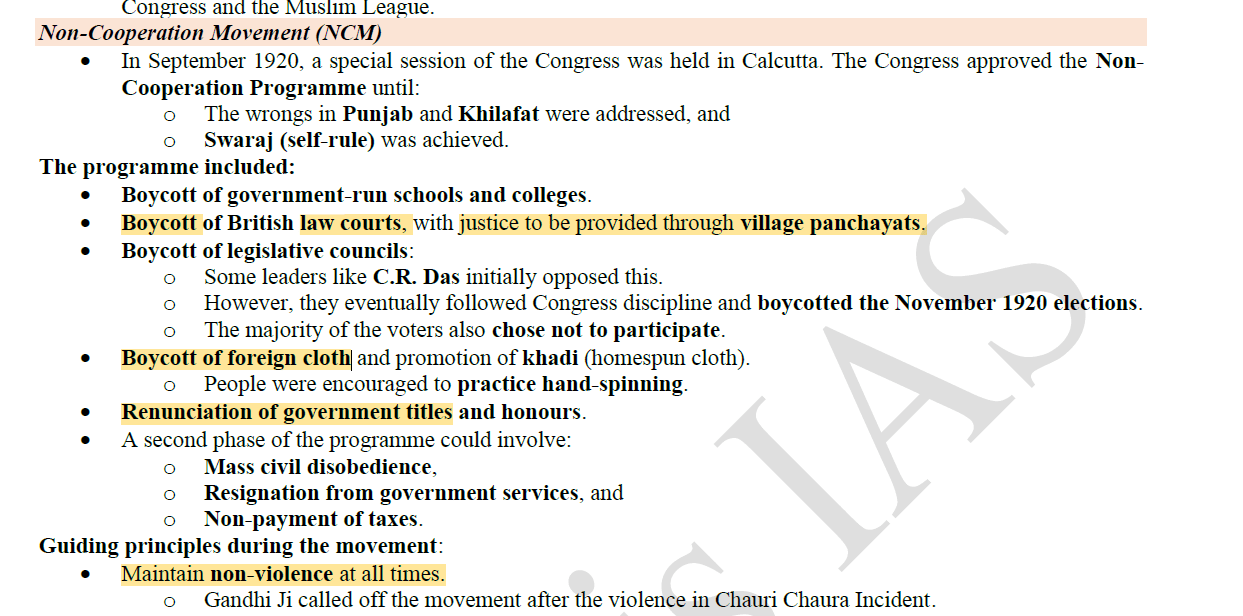
1. Boycott of law-courts and foreign cloth:
○ This was indeed a part of the Non-Cooperation Programme. The movement encouraged the boycott of British goods, including foreign cloth, and the boycott of British institutions, including law courts, to resist colonial rule.
2. Observance of strict non-violence:
○ Non-violence was a fundamental principle of the Non-Cooperation Movement, as advocated by Mahatma Gandhi. The movement aimed to achieve its goals through peaceful means without resorting to violence.
3. Retention of titles and honours without using them in public:
○ This was not a part of the Non-Cooperation Programme. The movement encouraged the renunciation of titles and honours conferred by the British as a form of protest against colonial rule.
4. Establishment of Panchayats for settling disputes:
○ The establishment of Panchayats was encouraged as part of the movement to promote self-reliance and self-governance, reducing dependence on British judicial systems.
● Conclusion:
○ Statements 1, 2, and 4 were part of the Non-Cooperation Programme, while statement 3 was not. Therefore, only three of the given subjects were part of the programme.
Q 30. Non-Cooperation Movement Objectives and Strategy (Modern History)
Q30. Consider the following statements in respect of the Non-Cooperation Movement:
1. The Congress declared the attainment of 'Swaraj' by all legitimate and peaceful means to be its objective.
2. It was to be implemented in stages, with civil disobedience and non-payment of taxes for the next stage only if 'Swaraj' did not come within a year and the Government resorted to repression.
Which of the statements given above is/are correct?
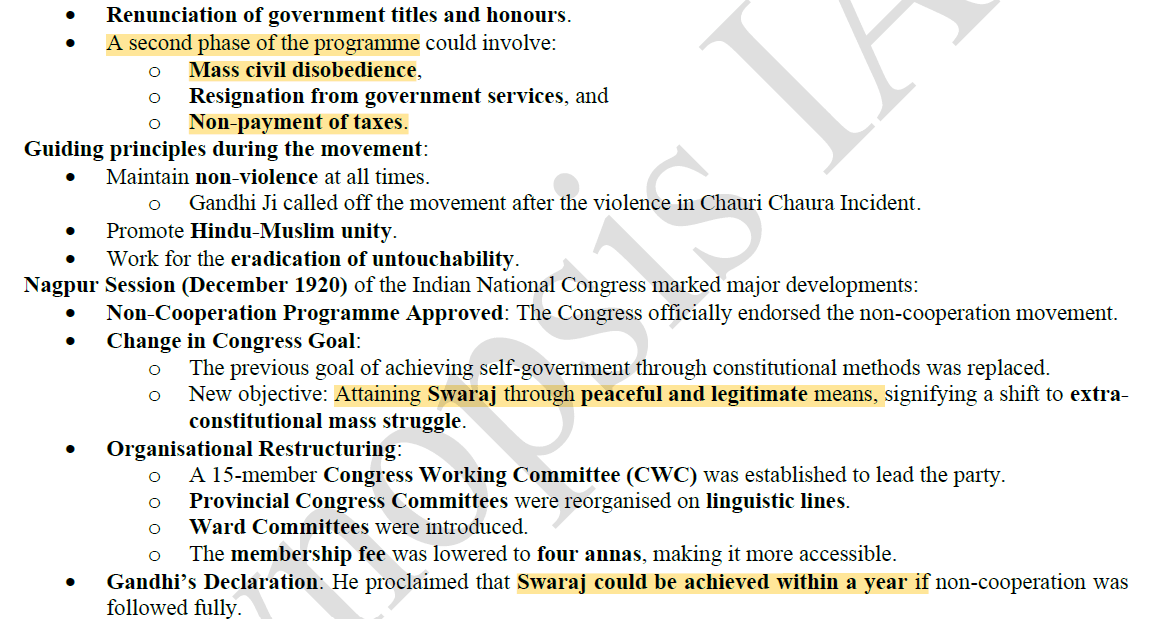
The Non-Cooperation Movement is asked many times in UPSC PYQs.
- Statement 1 is correct: The Non-Cooperation Movement, initiated by the Indian National Congress under the leadership of Mahatma Gandhi, aimed at the attainment of 'Swaraj' (self-rule) by all legitimate and peaceful means. This was a fundamental objective of the movement, reflecting the Congress's commitment to achieving independence through non-violent methods.
- Statement 2 is correct: The movement was designed to be implemented in stages, with the initial phase focusing on non-cooperation with the British government. The plan included escalating to civil disobedience and non-payment of taxes if 'Swaraj' was not achieved within a year and if the government resorted to repression. This strategic approach was intended to apply pressure on the colonial authorities while maintaining a non-violent stance.
Q 93. Chauri Chaura Incident (Modern History)
Q93. Who provided legal defence to the people arrested in the aftermath of Chauri Chaura incident?
Elimination Technique Based Question
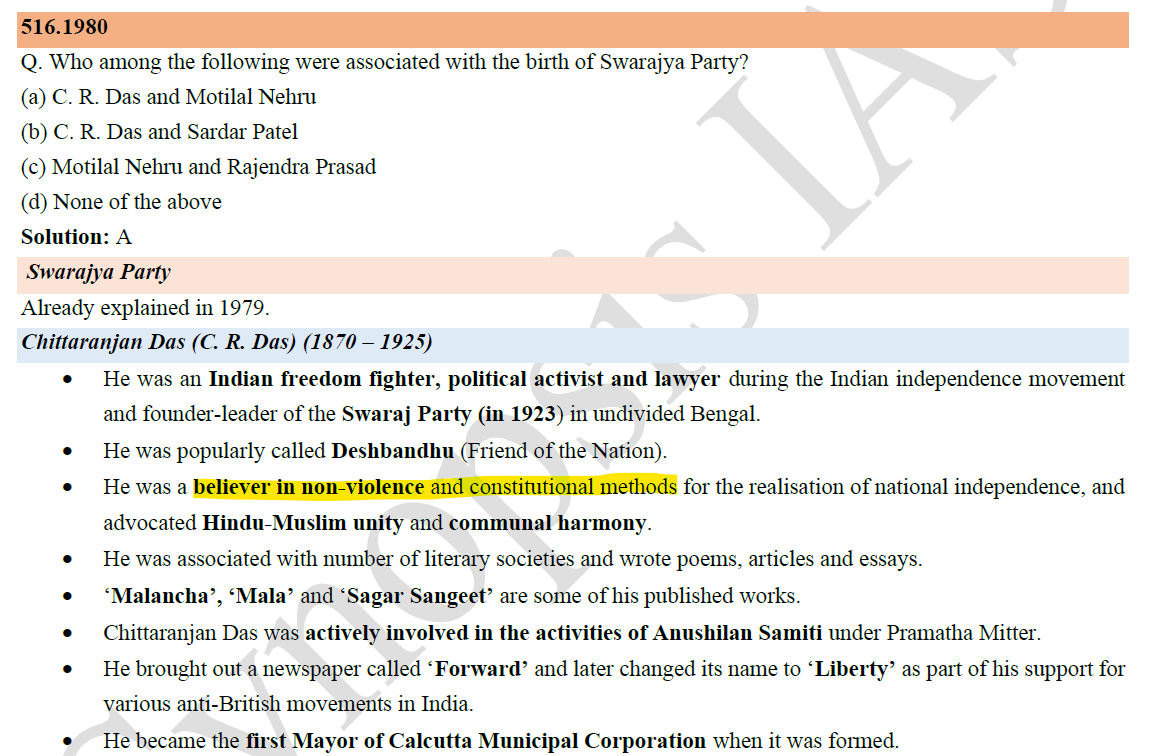
Eliminate Option 1: C. R. Das believed in Non Violence. Please refer to solution to UPSC 1980 question.
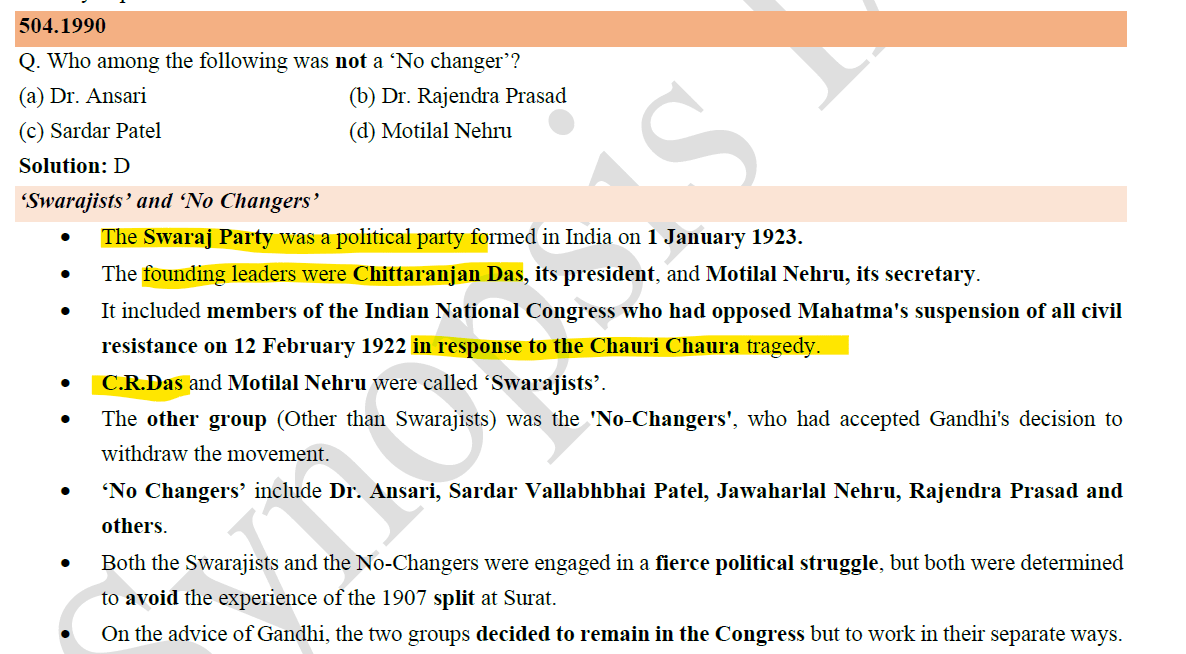
C. R. Das formed Swaraj Party in response of Chauri Chaura case, not went to provide legal defence. (UPSC 1990 question)
Eliminate Option 3 and 4: Khwaja Hasan Nizami and M. A. Jinnah had active role in Pakistan formation, there is no other significant contribution found in freedom struggle.
Hint for Option 2: The Chauri Chaura incident occured in Gorakhpur, Uttar Pradesh; and Madan Mohan Malaviya was from Uttar Pradesh.
- Madan Mohan Malaviya and Krishna Kant provided legal defense to those arrested following the Chauri Chaura incident. This incident occurred on February 4, 1922, when a large group of protesters participating in the non-cooperation movement clashed with police, leading to the death of 22 policemen.
- Madan Mohan Malaviya was a prominent Indian leader and lawyer known for his role in the Indian independence movement. He was instrumental in defending the accused in this case, showcasing his commitment to justice and legal advocacy.
- Krishna Kant assisted Malaviya in the legal defense, highlighting their joint efforts to ensure a fair trial for the accused individuals.
Q . Freedom Struggle Movements and Personalities
1. Boycott of law-courts and foreign cloth
2. Observance of strict non-violence
3. Retention of titles and honours without using them in public
4. Establishment of Panchayats for settling disputes
How many of the above were parts of Non-Cooperation Programme?
1. Boycott of law-courts and foreign cloth: This was indeed a part
of the Non-Cooperation Programme. The movement encouraged the boycott of
British goods, including foreign cloth, and the boycott of British
institutions, including law courts, to resist colonial rule.
2. Observance of strict non-violence:
Non-violence was a fundamental principle of the Non-Cooperation Movement, as
advocated by Mahatma Gandhi. The movement aimed to achieve its goals through
peaceful means without resorting to violence.
3. Retention of titles and honours without using
them in public: This was not a part of the Non-Cooperation Programme. The
movement encouraged the renunciation of titles and honours conferred by the
British as a form of protest against colonial rule.
4. Establishment of Panchayats for settling
disputes: The establishment of Panchayats was encouraged as part of the
movement to promote self-reliance and self-governance, reducing dependence on
British judicial systems.
Q . Freedom Struggle Movements and Personalities
Consider the following statements in respect of the Non-Cooperation Movement: 1. The Congress declared the attainment of 'Swaraj' by all legitimate and peaceful means to be its objective. 2. It was to be implemented in stages, with civil disobedience and non-payment of taxes for the next stage only if 'Swaraj' did not come within a year and the Government resorted to repression. Which of the statements given above is/are correct?
● Explanation
of Statement 1:
○ The Non-Cooperation Movement,
initiated by the Indian National Congress under the leadership of Mahatma
Gandhi, aimed at achieving 'Swaraj' or self-rule. The Congress indeed declared
the attainment of 'Swaraj' by all legitimate and peaceful means as its primary
objective. This was a significant shift from earlier methods, emphasizing
non-violent resistance and non-cooperation with the British authorities.
● Explanation of Statement 2:
○ The movement was designed to
be implemented in stages. Initially, it involved the boycott of government
schools, colleges, law courts, and foreign goods. The plan was to escalate to
civil disobedience and non-payment of taxes if the British government did not
concede to the demands within a year and if it resorted to repression. This
strategic approach was intended to apply increasing pressure on the colonial
government while maintaining a non-violent stance.
● Conclusion:
○ Both statements accurately
reflect the strategic planning and objectives of the Non-Cooperation Movement,
making option C the correct choice.
Q . Freedom Struggle Movements and Personalities
Who provided legal defence to the people arrested in the aftermath of Chauri Chaura incident?
○
The Chauri Chaura incident occurred on February 4, 1922, when a large group of
protesters participating in the Non-Cooperation Movement clashed with police,
leading to the death of three civilians and 22 policemen.
○ In the aftermath, many people
were arrested and charged with serious offenses.
○ Madan Mohan Malaviya, a
prominent Indian leader and freedom fighter, along with Krishna Kant, provided
legal defense to those arrested. Malaviya was known for his legal acumen and
commitment to justice, which he demonstrated by defending the accused in this
case.
○ This incident led to Mahatma
Gandhi calling off the Non-Cooperation Movement, as he was deeply disturbed by
the violence.
Q . Freedom Struggle Movements and Personalities
1. Party — Its Leader
1. Bharatiya Jana Sangh — Dr. Shyama Prasad Mukherjee
2. Socialist Party — C. Rajagopalachari
3. Congress for Democracy — Jagjivan Ram
4. Swatantra Party — Acharya Narendra Dev
How many of the above are correctly matched?
- Statement 1 is correct: Dr. Shyama Prasad Mukherjee was the leader of Bharatiya Jana Sangh.
- Statement 2 is incorrect: C. Rajagopalachari was not the leader of the Socialist Party; he led the Swatantra Party.
- Statement 3 is correct: Jagjivan Ram was associated with the Congress for Democracy.
- Statement 4 is incorrect: Acharya Narendra Dev was not the leader of the Swatantra Party; he was associated with the Socialist Party.
- Therefore, only pairs 1 and 3 are correctly matched.
Q . Freedom Struggle Movements and Personalities
Statement-I: 7th August is declared as the National Handloom Day.
Statement-II: It was in 1905 that the Swadeshi Movement was launched on the same day.
Which one of the following is correct in respect of the above statements?
Q . Freedom Struggle Movements and Personalities
1. Barindra Kumar Ghosh
2. Jogesh Chandra Chatterjee
3. Rash Behari Bose
Who of the above was/were actively associated with the Ghadar Party?
Q . Freedom Struggle Movements and Personalities
With reference to 8th August, 1942 in Indian history, which one of the following statements is correct?
- Quit India Resolution: 1942
- Expansion of Viceroy’s Executive Council: 1861
- Resignation of congress ministeries: 1939
- Cripps proposal: March 1942
Q . Freedom Struggle Movements and Personalities
In the context of Colonial India, Shah Nawaz Khan, Prem Kumar Sehgal and Gurbaksh Singh Dhillon are remembered as
Q . Freedom Struggle Movements and Personalities
1. Person — Position held
1. Sir Tej Bahadur Sapru: President, All India Liberal Federation
2. K.C. Neogy: Member, The Constituent Assembly
3. P.C. Joshi: General Secretary, Communist Party of India
Which of the pairs given above is/are correctly matched?
Q . Freedom Struggle Movements and Personalities
With reference to Swadeshi Movement, consider the following statements: 1. It contributed to the revival of the indigenous artisan crafts and industries. 2. The National Council of Education was established as a part of Swadeshi Movement. Which of the statements given above is / are correct?
Q . Freedom Struggle Movements and Personalities
A: Lord Linlithgow described the August Movement of 1942 as the most serious revolt after the Sepoy mutiny. R: Peasants joined the movement in large number in some places.
Q . Freedom Struggle Movements and Personalities
In 1920, which of the following changed its name to “Swarajya Sabha”?
Q . Freedom Struggle Movements and Personalities
1. Mutiny in Royal Indian Navy
2. Quit India Movement launched
3. Second Round Table Conference
What is the correct chronological sequence of the above events?
Q . Freedom Struggle Movements and Personalities
1. Radhakanta Deb – First President of the British Indian Association
2. Gazulu Lakshminarasu Chetty – Founder of the Madras Mahajana Sabha
3. Surendranath Banerjee – Founder of the Indian Association
Which of the above pairs is/are correctly matched?
Q . Freedom Struggle Movements and Personalities
The ‘Swadeshi’ and ‘Boycott’ were adopted as methods of struggle for the first time during the
Q . Freedom Struggle Movements and Personalities
1. The Rowlatt Act was based on the recommendations of the ‘Sedition Committee’.
2. In Rowlatt Satyagraha, Gandhiji tried to utilize the Home Rule League.
3. Demonstrations against the arrival of Simon Commission coincided with Rowlatt Satyagraha.
Select the correct answer using the code given below.
● The Rowlatt committee was a sedition committee set up in 1917 to look up the growing terrorism in India against the British government. The act extended the emergency measures of preventive indefinite detention, incarceration without trial and judicial review
● The Home Rule League was prominent from 1916 to 1918. Gandhi ji had incorporated many big and small organization of national interest into this protest against the Rowlatt Act and All India Home Rule League was amongst them.
● The Simon Commission was sent to India in 1927 while the Rowlatt Satyagraha happened in 1919.
Q . Freedom Struggle Movements and Personalities
Who of the following organized a march on the Tanjore coast to break the Salt Law in April 1930?
Q . Freedom Struggle Movements and Personalities
The Ghadr (Ghadar) was a
Q . Freedom Struggle Movements and Personalities
Quit India Movement was launched in response to
Q . Freedom Struggle Movements and Personalities
1. The most effective contribution made by Dadabhai Naoroji to the cause of Indian National Movement was that he
1. exposed the economic exploitation of India by the British.
2. interpreted the ancient Indian texts and restored the self-confidence of Indians.
3. stressed the need for eradication of all the social evils before anything else.
Which of the statements given above is/are correct?
Q . Freedom Struggle Movements and Personalities
With reference to Indian freedom struggle, Usha Mehta is well-known for
Q . Freedom Struggle Movements and Personalities
Which one of the following observations is not true about the Quit India Movement of 1942?
Q . Freedom Struggle Movements and Personalities
What was the immediate cause for the launch of the Swadeshi movement?
Q . Freedom Struggle Movements and Personalities
In the ‘Individual Satyagraha’, Vinoba Bhave was chosen as the first Satyagrahi. Who was the second?
Q . Freedom Struggle Movements and Personalities
In the context of the Indian Freedom struggle, 16th October 1905 is well known for which one of the following reasons?
Q . Freedom Struggle Movements and Personalities
During the freedom struggle, Aruna Asaf Ali was a major woman organizer of underground activity in
Q . Freedom Struggle Movements and Personalities
Which one of the following began with the Dandi March?
Q . Freedom Struggle Movements and Personalities
Who among the following used the phrase ‘Un-British’ to criticize the English colonial control of India?
Q . Freedom Struggle Movements and Personalities
During the Indian Freedom Struggle, who of the following raised an army called “Free Indian Legion”?
Q . Freedom Struggle Movements and Personalities
Which one of the following aroused a wave of popular indignation that led to the massacre by the British at Jallianwala Bagh?
Q . Freedom Struggle Movements and Personalities
Where were the Ghadar revolutionaries, who became active during the outbreak of the World War I based?
Q . Freedom Struggle Movements and Personalities
What was Komagata Maru?
Q . Freedom Struggle Movements and Personalities
1. Lord Mountbatten was the Viceroy when Simla Conference took place.
2. Indian Navy Revolt, 1946 took place when the Indian sailors in the Royal Navy at Bombay and Karachi rose against the Government.
Which of the statements given above is/are correct?
● Statement 1 is incorrect: Lord Wavell was the Viceroy when Shimla Conference took place in June, 1945.
Q . Freedom Struggle Movements and Personalities
1. On the eve of launch of Quit India Movement, Mahatma Gandhi
1. asked the government servants to resign.
2. asked the soldiers to leave their posts.
3. asked the Princes of the Princely States to accept the sovereignty of their own people.
Which of the statements given above is/are correct?
Q . Freedom Struggle Movements and Personalities
During the Indian Freedom Struggle, who among the following proposed that Swaraj should be defined as complete independence free from all foreign control?
Q . Freedom Struggle Movements and Personalities
The name of the famous person of India who returned the Knighthood conferred on him by the British Government as a token of protest against the atrocities in Punjab in 1919 was
Q . Freedom Struggle Movements and Personalities
1. Chauri-Chaura Outrage
2. Minto-Morley Reforms
3. Dandi March
4. Montagu-Chelmsford Reforms
Which one of the following is the correct chronological order of the events given above?
Q . Freedom Struggle Movements and Personalities
With reference to Indian Freedom Struggle, which one of the following statements is NOT correct?
Q . Freedom Struggle Movements and Personalities
The leader of the Bardoli Satyagraha (1928) was
Q . Freedom Struggle Movements and Personalities
With reference to the Indian Freedom struggle, which one of the following statements is not correct?
Q . Freedom Struggle Movements and Personalities
During the Indian Freedom struggle, the Khudai Khidmatgars, also known as Red Shirts, called for
Q . Freedom Struggle Movements and Personalities
Which one of the following submitted in 1875 a petition to the House of Commons demanding India’s direct representation in the British Parliament?
Q . Freedom Struggle Movements and Personalities
With reference to the period of extremist nationalist movement in India with its spirit of Swadeshi, which one of the following statements is not correct?
Q . Freedom Struggle Movements and Personalities
Who among the following organized the famous Chittagong armoury raid?
Q . Freedom Struggle Movements and Personalities
The Hunter Commission was appointed after the
● The Jallianwala Bagh massacre Hunter Commission, a 1919 investigation into a British massacre that killed 379 Indian civilians headed by William Hunter, Lord Hunter
Q . Freedom Struggle Movements and Personalities
List-I
A. Chittagong Armoury
B. Abhinav Bharat
C. Anushilan Samiti
D. Kuka Movement
List-II
1. Kalpana Dutt Rao
2. Guru Ram Singh
3. Vinayaka Daodar Savarkar
4. Aurobindo Ghosh
Codes:
A B C D
Q . Freedom Struggle Movements and Personalities
The native state of Tripura became involved in the Freedom movement early in the 20th century because
Q . Freedom Struggle Movements and Personalities
The Indian National Army (INA) came into existence in 1943 in
Q . Freedom Struggle Movements and Personalities
A: The basic weakness of the early nationalist movement lay in its narrow social base.
R: It fought for the narrow interests of the social groups which joined it.
Q . Freedom Struggle Movements and Personalities
Which Indian nationalist leader looked upon the war between Germany and Britain as a godsent opportunity which would enable Indians to exploit the situation to their advantage?
Q . Freedom Struggle Movements and Personalities
‘Abhinava Bharat’ a secret society of revolutionaries was organized by
Q . Freedom Struggle Movements and Personalities
1. Tilak's Home Rule League
2. Komagatamaru Incident
3. Mahatma Gandhi’s arrival in India
Select the correct answer using the codes given below:
Q . Freedom Struggle Movements and Personalities
Which one of the following events, was characterized by Montague as 'Preventive Murder'?
Edwin Montague, condemned Jallianwalla Bagh massacre’s severity, and called it as “Preventive Murder”. C.F.Andrews called Jallianwala Massacre as ruthless Murder.
Q . Freedom Struggle Movements and Personalities
1. The August offer
2. The I.N.A trial
3. The Quit India Movement
4. The Royal Indian Naval Ratings' Revolt.
Select the correct answer using the codes given below:
Chronological sequence
August Offer–1940
Quit India Movement–1942
INA Trial–1945
Royal Indian Navy Ratings Revolt– 1946
Q . Freedom Struggle Movements and Personalities
Which one of the following defines extremist ideology during the early phase of Indian freedom movement?
- The extremist leaders did not believe in the soft and persuasive approach. They took more aggressive stance.
Q . Freedom Struggle Movements and Personalities
Who was the leader of the Ghaddar Party?
- The Ghadar Party, originally known as the Pacific Coast Hindustan Association, was founded on July 15, 1913 in the United States by Lala Har Dayal, Sant Baba Wasakha Singh Dadehar, Baba Jawala Singh, Santokh Singh, and Sohan Singh Bhakna.
Q . Freedom Struggle Movements and Personalities
Assertion (A): The Khilafat movement did bring the urban Muslims into the fold of the National Movement. Reason (R): There was a predominant element of anti–imperialism in both the National and Khilafat Movement.
Q . Freedom Struggle Movements and Personalities
Which one of the following events was characterized by Montague as ‘Preventive Murder’?
Q . Freedom Struggle Movements and Personalities
Who was the leader of the Ghadar party?
Q . Freedom Struggle Movements and Personalities
The Indian Muslims in general, were not attracted to the Extremist movement because of the
Q . Freedom Struggle Movements and Personalities
A: The Khilafat Movement did bring the urban Muslims into the fold of the National Movement. R: There was a predominant element of anti-imperialism in both the National and Khilafat Movements.
Q . Freedom Struggle Movements and Personalities
Which one of the following defines extremist ideology during the early phase of Indian freedom movement?
Q . Freedom Struggle Movements and Personalities
What is the correct sequence of the following events? 1. Tilak’s Home Rule League 2. Kamagatamaru incident 3. Mahatma Gandhi’s arrival in India Codes:
Q . Freedom Struggle Movements and Personalities
What is the correct sequence of the following events? 1. The August Offer 2. The INA Trial 3. The Quit India Movement 4. The Royal Indian Naval Ratings Revolt Select the correct answer using the codes given below:
Q . Freedom Struggle Movements and Personalities
Match List-I with List-II and select the correct answer: List-I A. Chittagaon Armoury raid B. Kakori Conspiracy C. Lahore Conspiracy D. Ghadar Party List-II 1. Lala Hardayal 2. Jatin Das 3. Surya Sen 4. Ram Prasad Bismil 5. Vasudeo Phadke Codes:
Q . Freedom Struggle Movements and Personalities
List-I
A. Abhinav Bharat Society
B. Anushilan Samiti
C. Gadar Party
D. Swaraj Party
List-II
1. Sri Aurobindo Ghosh
2. Lala Hardayal
3. C.R. Das
4. V.D. Savarkar
Codes:
Q . Freedom Struggle Movements and Personalities
The Non Cooperation Movement led to:
1. Congress becoming a mass movement for the first time.
2. Growth of Hindu-Muslims unity.
3. Removal of fear of the British might from the minds of the people.
4. British government's willingness to grant political concessions to Indians.
Of these statements:
- Non-Cooperation and Khilafat Movements were launched in 1920.
- The two movements emerged from separate issues, but they adopted a common programme of action that of non- violent and non-cooperation.
- There was increasing Hindu-Muslim unity against the British.
Q . Freedom Struggle Movements and Personalities
Who among the following was the leader of a number of anti-British revolts in Sambalpur?
Q . Freedom Struggle Movements and Personalities
Those who joined Mahatma Gandhi during the Champaran struggle included
Q . Freedom Struggle Movements and Personalities
What is common among Madam Bhikaji Cama, M. Barkatulla, V.V.S. Iyer and M.N. Roy?
Q . Freedom Struggle Movements and Personalities
I. To rouse anti-British feelings among the Muslims of India
II. To reform the Muslim society
III. To demand separate electorates and preserve the Khilafat
IV. To save the Ottoman Empire and preserve the Khilafat.
Choose the correct answer from the codes given below:
Q . Freedom Struggle Movements and Personalities
Consider the following two statements called Assertion (A) and Reason (R) and answer by using the codes given below the statements. Assertion (A): The Quit India Movement of 1942 marked the culmination of the Indian Freedom Movement. Reason (R): After the Quit India Movement, it was only a question of time and determining the actual mechanics of the transfer of power.
● Option B: Both A and R are true, but R is not an explanation of A
2. Explanation
● Assertion (A): The Quit India Movement of 1942 indeed marked a significant phase in the Indian Freedom Movement, as it was a mass protest demanding an end to British rule in India.
● Reason (R): After the Quit India Movement, the British government realized that maintaining control over India was becoming increasingly difficult, and it was only a matter of time before power was transferred.
● Analysis: While both statements are true, the Reason (R) does not directly explain why the Quit India Movement marked the culmination of the Indian Freedom Movement. The movement was a pivotal moment, but the culmination was due to a combination of factors, including international pressure and changing political dynamics post-World War II.
Q . Freedom Struggle Movements and Personalities
Who among the following was a revolutionary who later turned into a yogi and philosopher?
Q . Freedom Struggle Movements and Personalities
The I.N.A. was organized by Netaji Subhash Chandra Bose at
Q . Freedom Struggle Movements and Personalities
1. Singh Sabha Movement
2. Quit India Movement
3. Dandi March
4. Gurdwara Reform Movement
The correct chronological sequence of correct answer using the codes given below them:
Chronological Order
- Singh Sabha Movement – 1870s
- Gurdwara Reform Movement – 1920’s
- Dandi March – 12 Mar 1930 to 6 Apr 1930
- Quit India Movement – 8 August 1942
Q . Freedom Struggle Movements and Personalities
The most effective contribution made by Dadabhai Naoroji to the cause of Indian National Movement was that he
- His Drain of wealth theory that exposed the economic exploitation of colonized rule was the most effective contribution of Dadabhai Nauroji.
Q . Freedom Struggle Movements and Personalities
Which one of the following was the most immediate factor for the spread of Swadeshi and Boycott agitation during the first decade of the present century?
Q . Freedom Struggle Movements and Personalities
List 1
A. Madan Mohan Malviya
B. Sohan Singh Bhakna
C. Annie Besant
D. Rajagopalachari
List 2
1. Ghadar Movement
2. Swatantra Party
3. Hindu Mahasabha
4. Theosophical Society of India
A B C D
Correct Matches
- Madan Mohan Malviya - Hindu Mahasabha
- Sohan Singh Bhakna - Ghadr Movement
- Annie Besant - Theosophical Society of India
- Rajagopalachari - Swatantra Party
Q . Freedom Struggle Movements and Personalities
1. (A) M. N. Roy
(i) Swarajist Party
2. (B) C. R. Das
(ii) Hindustan Socialist Republican Association
3. (C) Chandra Shekhar Azad
(iii) Congress Socialist Party
4. (D) Acharya Narendra
(iv) Communist International
Correct Matches
Leader Organization
M. N. Roy Communist International
C. R. Das Swarajist Party
Chandra Shekhar Azad Hindustan Socialist Republican Association
Acharya Narendra Congress Socialist Party
Q . Freedom Struggle Movements and Personalities
‘Ghadar party’ in U.S.A. was formed by
Q . Freedom Struggle Movements and Personalities
Khilafat movement stressed on
Q . Freedom Struggle Movements and Personalities
Arrange the following in a chronological order
(i) Foundation of Muslim League
(ii) Jallianwala Bagh Massacre
(iii) Khilafat Movement
(iv) Civil Disobedience Movement
Foundation of Muslim League - 1906
Jallianwala Bagh Massacre - 1919
Khilafat Movement - 2020
Civil Disobedience Movement – 1930-32
Q . Freedom Struggle Movements and Personalities
“Anushilan Samithi” was the terrorist organisation with its headquarters at
Q . Freedom Struggle Movements and Personalities
Q . Freedom Struggle Movements and Personalities
1.
2.
3.
4.
2. Explanation:
● Option A: The *Khalifa* was indeed regarded as the religious head of the Muslim community, which was a widely accepted notion among Muslim rulers, including those in India.
● Option B: The *Khalifa* was also considered the legal head, as he held significant influence over Islamic jurisprudence and legal matters.
● Option C: It is incorrect to state that all Muslim states paid tributes to the *Khalifa*. While the *Khalifa* held a position of religious significance, political and financial allegiance varied greatly among different Muslim states, and not all paid tributes.
● Option D: The *Khalifa* was involved in religious and legal matters, but the efficiency of his decisions would depend on various factors, including the context and the specific case. However, this option does not directly contradict the historical role of the *Khalifa*.
Q . Freedom Struggle Movements and Personalities
“Anushilan Samithi” was the terrorist organisation with its headquarters at
● Option B: Calcutta
2. Explanation
○ *Anushilan Samithi* was a prominent revolutionary organization in the early 20th century, primarily active in Bengal.
○ It was established with the aim of achieving Indian independence from British rule through armed struggle.
○ The organization was known for its radical approach and was involved in several revolutionary activities.
● Headquarters: The main base of operations for Anushilan Samithi was in Calcutta (now Kolkata), which was a hub for revolutionary activities during the Indian independence movement.
○ The choice of Calcutta as the headquarters was strategic due to its political significance and the presence of a large number of like-minded revolutionaries.
Q . Freedom Struggle Movements and Personalities
Which pair among the following had the similar views during the national movement?
1.
2.
3.
4.
● Explanation:
○ *Chittaranjan Das* and *Motilal Nehru* were prominent leaders in the Indian National Movement who shared similar views, particularly during the *Non-Cooperation Movement*.
○ Both leaders were instrumental in the formation of the *Swaraj Party* in 1923, which aimed to enter the legislative councils to obstruct colonial governance from within.
○ Their collaboration was based on the belief that legislative obstruction could be a powerful tool against British rule, differing from the more radical or passive approaches of other leaders.
○ This partnership highlighted their shared vision for achieving self-governance through constitutional means.
Q . Freedom Struggle Movements and Personalities
Q . Freedom Struggle Movements and Personalities
The first Civil Disobedience Movement was started by Gandhiji after the
- The Non Cooperation movement of 1920 started after the Rowlatt Act and Jallianwalla Massacre of 1919 and ended after the Chauri Chaura incident in 1922.
- The Non Cooperation movement was Gandhi’s first movement that involved mass civil disobedience as a methodology.
- The earlier movements like Champaran, Ahmedabad and Kheda movements were localized in nature.
Q . Freedom Struggle Movements and Personalities
Match the following:
1. A. Civil Disobedience Movement
B. Indian Home Rule League
C. Moderate leader
D. Brahmo Samaj
2. 1. B. G. Tilak
2. Raja Ram Mohan Roy
3. Mahatma Gandhi
4. G. K. Gokhale
A B C D
Civil Disobedience Movement: Mahatma Gandhi
Indian Home Rule League: B. G. Tilak
Moderate leader: G. K. Gokhale
Brahmo Samaj: Raja Ram Mohan Roy
Q . Freedom Struggle Movements and Personalities
Which of the following pairs is correct?
Q . Freedom Struggle Movements and Personalities
The partition of Bengal was undertaken with the view of
Bengal was a highly politically active province of India and a centre of National movement. One of the reson for its partition was to weaken it by dividing the Hindus of the West and the East Bengal and increasing Hindu-Muslim tensions. This was the ‘Divide and Rule’ policy of the British government.
Q . Freedom Struggle Movements and Personalities
The capital of India was shifted from Calcutta to Delhi in the year
Q . Freedom Struggle Movements and Personalities
The Indian national movement became organised for the first time in
- Indian national movement became organized for the first time during the period of Swadeshi movement in 1905-06.
- The movement was stated by the Indian against the partition of Bengal by Lord Curzon.
- It was for the first time the organized mass resistance was seen against the British government in India.
- In this period the congress leadership shifted to extremist leaders like Lal-Bal-Pal.
- The extremist leaders involved wider sections of people in the movement in an organized manner.
- They involved lower middle class people also.
- They tried to instil self-respect and patriotism in the people by invoking past heroes like Ashoka, Shivaji, Maharana Pratap and Rani Laxmibai.
Q . Freedom Struggle Movements and Personalities
The wrongly matched pair among the following is
- Khilafat was a pan-Islamist political protest campaign launched by Muslims of British India led by:
o Shaukat Ali,
o Maulana Mohammad Ali,
o Hakim Ajmal Khan, and
o Abul Kalam Azad.
- It was aimed to restore the caliph of the Ottoman Caliphate.
- Mohammed Ali Jinnah was not associated with this movement
Q . Freedom Struggle Movements and Personalities
What is the correct chronological order of the following events in the national movement?
I. Champaran Satyagraha
II. Non-Cooperation Movement
III. Quit India Movement
IV. Dandi March
The chronological sequence is Champaran Satyagraha (1917), Non-Cooperation Movement (1920), Dandi March (1930) and Quit India Movement (1942).
Q . Freedom Struggle Movements and Personalities
Arrange the following in chronological order:
1. I. Home Rule League
2. II. Swadeshi Movement
3. III. Bardoli Movement
4. IV. Round Table Conference
- Swadeshi Movement (1905),
- Home Rule League (1916),
- Bardoli Movement (1928) &
- Round Table Conference (1930-32).
Q . Freedom Struggle Movements and Personalities
Quit India Movement was launched in
● Option C: 1942
2. Explanation
○ The Quit India Movement, also known as the August Movement, was a significant milestone in the Indian independence struggle against British rule.
○ It was launched by the Indian National Congress under the leadership of Mahatma Gandhi on August 8, 1942, during the Bombay session of the All-India Congress Committee.
○ The movement called for an end to British rule in India and was marked by widespread protests and demonstrations across the country.
○ The slogan "Do or Die" was popularized during this movement, emphasizing the urgency and determination of the Indian people to achieve independence.
○ The movement faced severe repression from the British authorities, but it played a crucial role in galvanizing Indian public opinion against colonial rule.
Q . Freedom Struggle Movements and Personalities
Which of the following events is not correct?
Simon commission arrived in British India to study constitutional reform in 1927.
Gandhi-Irwin Pact was a political agreement signed by Mahatma Gandhi and Lord Irwin on 5 March 1931.
Salt Satyagraha took place in 1930.
Quit India Movement was started on 8th August 1942.
Q . Freedom Struggle Movements and Personalities
In the 19th century the people who participated in the national movement were mostly
Q . Freedom Struggle Movements and Personalities
Which of the following pairs is incorrect?
Q . Freedom Struggle Movements and Personalities
What is most significant regarding partition of Bengal in 1905?
● Option D: _This paved the way for involvement of people in national movement_
2. Explanation
○ The _Partition of Bengal in 1905_ was a significant event in Indian history as it led to widespread protests and marked the beginning of a more organized and united national movement against British rule.
● Key Points:
● Public Outcry: The partition was seen as an attempt to divide and rule by creating religious divisions, which led to a strong backlash from both Hindus and Muslims.
● Swadeshi Movement: It sparked the Swadeshi Movement, encouraging Indians to boycott British goods and promote indigenous products.
● National Unity: The opposition to the partition fostered a sense of national unity and political awareness among Indians, paving the way for future movements for independence.
Q . Freedom Struggle Movements and Personalities
What was the objective of Home Rule Movement?
● Option A: _Self-government at all levels_
2. Explanation
○ The Home Rule Movement was initiated during the early 20th century in India with the primary objective of achieving _self-government_ for Indians within the British Empire.
○ It was inspired by the Irish Home Rule Movement and aimed to establish a system where Indians could have greater control over their own affairs.
○ The movement sought to involve more Indians in the governance process and to push for political reforms that would lead to _self-governance_ at all levels.
● Annie Besant and Bal Gangadhar Tilak were prominent leaders who advocated for this cause, emphasizing the need for political autonomy and democratic rights for Indians.
Q . Freedom Struggle Movements and Personalities
Assertion (A): In 1946 in Bombay the ratings of the Royal Indian Navy rose in open mutiny against the British. Reason (R): The Royal Indian Navy joined the INA
Q . Freedom Struggle Movements and Personalities
Non-Cooperation Movement was called off by Gandhiji because
Q . Freedom Struggle Movements and Personalities
Civil Disobedience Movement was started in India in 1930 for
Q . Freedom Struggle Movements and Personalities
The year 1919 is associated with
Dandi March – 12 Mar 1930 – 6 Apr 1930
Jallianwala Bagh Tragedy – 13 April 1919
Chauri Chaura Incident – 4 February 1922
Partition of Begal – 16 October 1905
Q . Freedom Struggle Movements and Personalities
Which important event immediately preceded Jallianwala Bagh massacre?
Q . Freedom Struggle Movements and Personalities
Non-Cooperation Movement was suspended in 1921 because
Q . Freedom Struggle Movements and Personalities
Under whose leadership, the Indian National Army was formed?
Q . Freedom Struggle Movements and Personalities
Who said these words at the time of Quit India Movement—’Do or die’?
Q . Freedom Struggle Movements and Personalities
Why did Gandhiji stop the Non-cooperation Movement?
- Non-Cooperation movement (NCM) was suspended by Gandhi due to the violent event of Chauri Chaura.
Q . Freedom Struggle Movements and Personalities
The Indian National Movement refers to the events in the British rule in India? Arrange the following in chronological order:
1. I. Rowlatt Act
2. II. Hunter Report
3. III. Jallianwallah Bagh Tragedy
Rowlatt Act – Feb 1919
Jallianwallah Bagh Tragedy – April 1919
Hunter Report – May 1920
Q . Freedom Struggle Movements and Personalities
The Indian National Movement refers to the
Q . Freedom Struggle Movements and Personalities
Which of the following represents the integration of Hindus and Muslims for a common cause?
Q . Freedom Struggle Movements and Personalities
Which of the following periods can be considered as the era of mass revolution?
Q . Freedom Struggle Movements and Personalities
The Indian patriot, who died in jail due to hunger strike, was
Q . Freedom Struggle Movements and Personalities
“Inquilab Zindabad” slogan was given by
Q . Freedom Struggle Movements and Personalities
Rabindranath Tagore surrendered his title to the British because of
Q . Freedom Struggle Movements and Personalities
“Khilafat” movement subsided because of the
● Option C: Accession of Kamal Pasha on the throne of Turkey
2. Explanation
○ The *Khilafat Movement* was initiated by Indian Muslims to protest against the dismemberment of the Ottoman Empire after World War I and to protect the *Caliphate*, which was a symbol of Islamic unity.
● Mustafa Kemal Pasha, also known as *Atatürk*, rose to power in Turkey and established a secular government, abolishing the Caliphate in 1924.
○ This move rendered the Khilafat Movement irrelevant, as the primary objective of the movement was to preserve the Caliphate.
○ Consequently, the movement lost its momentum and eventually subsided.
Q . Freedom Struggle Movements and Personalities
The Home Rule movement was launched by
Q . Freedom Struggle Movements and Personalities
Who said first: “Swaraj is my birth right and I shall have it”.
Q . Freedom Struggle Movements and Personalities
Swadeshi movement started during
Q . Freedom Struggle Movements and Personalities
“Red Shirts” movement aimed at
Q . Freedom Struggle Movements and Personalities
Who participated the least in the Indian National Movement?
Q . Freedom Struggle Movements and Personalities
Which party was in power in U.K. when India became independent?