
Explain the processes involved in magmatic differentiation. IAS 2024, 10 Marks
Explain the processes involved in magmatic differentiation. IAS 2024, 10 Marks

Introduction:
Magmatic differentiation is the process by which a single homogeneous magma can evolve into multiple different types of igneous rocks. This process occurs as magma cools and solidifies, leading to the formation of different mineral compositions and textures.
Processes Involved in Magmatic Differentiation
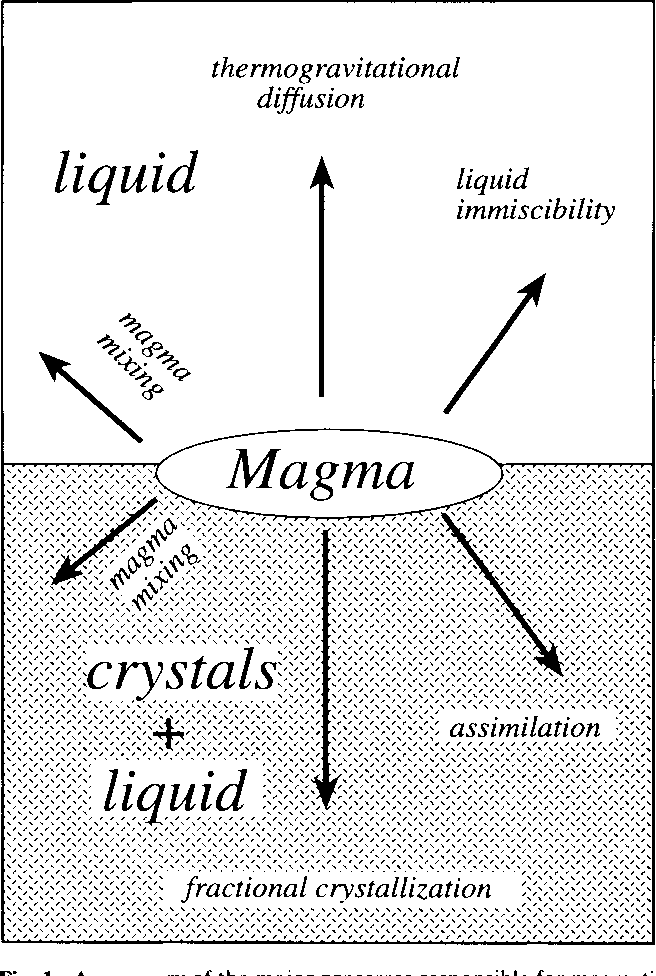
1. Fractional Crystallization
- The process where crystals formed during cooling are separated from the remaining liquid magma.
- Mechanism:
- Denser crystals settle at the bottom of the magma chamber (gravity settling).
- The composition of the residual melt changes as crystallization progresses, enriching the melt in components not incorporated in the crystals.
- Examples: Formation of layered igneous complexes like the Bushveld Complex.
2. Partial Melting
- Melting of a portion of the source rock, producing a magma with a composition different from the parent rock.
- Mechanism:
- Different minerals have varying melting points; low-melting-point minerals melt first, enriching the melt in certain elements.
- Partial melting typically generates magmas with a more felsic composition compared to the source rock.
3. Liquid Immiscibility
- Separation of a magma into two immiscible liquids with distinct compositions.
- Mechanism:
- Occurs due to differences in temperature and composition, leading to the formation of two magmatic liquids that do not mix.
- Example: Formation of Fe-rich and silica-rich liquids in mafic systems.
4. Assimilation
- Incorporation of surrounding country rock into the magma.
- Mechanism:
- Heat from the magma melts the surrounding rocks, which mix into the magma, altering its composition.
- Example: Contamination of basaltic magma by silica-rich rocks can lead to andesitic compositions.
5. Magma Mixing
- Physical mixing of two magmas with different compositions.
- Mechanism:
- When two magmas of contrasting temperatures, viscosities, or compositions come into contact, they may partially or completely mix to form a hybrid magma.
- Example: Andesitic magma formation by mixing basaltic and rhyolitic magmas.
6. Filter Pressing
- Separation of liquid from a crystal-rich mush under pressure.
- Mechanism:
- Pressure exerted by overlying material squeezes out liquid, leaving behind solid crystals.
- Example: Extraction of evolved melt from crystal mush in granitic systems.
7. Volatile Transport
- Definition: Separation of a vapor phase from the magma due to saturation of volatiles (e.g., water or CO₂).
- Mechanism:
- The volatiles migrate to the top of the magma chamber, potentially altering the composition of surrounding rocks or forming hydrothermal deposits.
Conclusion:
Magmatic differentiation is a complex process involving a combination of crystal settling, fractional crystallization, assimilation, and magma mixing. These processes work together to create a diverse range of igneous rocks with varying mineral compositions and textures.