
Discuss in detail, with diagrams, the landforms and features resulting from deposition by rivers. IAS 2024, 20 Marks
Discuss in detail, with diagrams, the landforms and features resulting from deposition by rivers. IAS 2024, 20 Marks

Introduction:
Deposition is the process by which sediment carried by a river is dropped or deposited on the riverbed or its banks. This process leads to the formation of various landforms and features along the course of the river.
Landforms Resulting from Deposition by Rivers
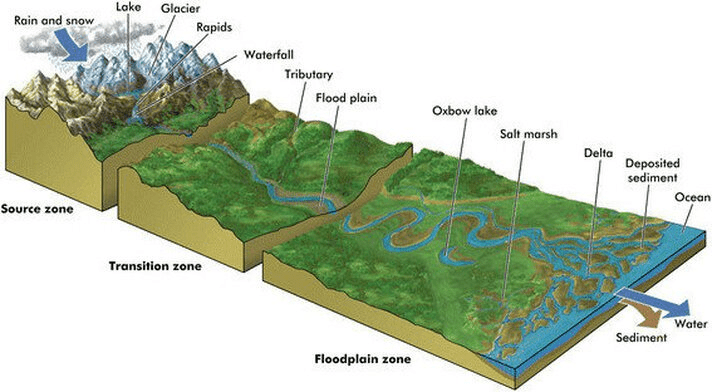
1. Floodplains
- Flat areas adjacent to a river, formed by the deposition of sediments during flooding.
- Formation Process:
- During floods, rivers overflow their banks and deposit fine sediments like silt and clay.
- Repeated flooding creates a fertile layer of alluvium.
- Features: Fertile soils suitable for agriculture.
2. Levees
- Raised embankments formed along riverbanks.
- Formation Process:
- Coarser sediments are deposited close to the river channel during flooding, creating natural barriers.
- Features: Protect adjacent lands from minor flooding.
3. Deltas
- Triangular landforms where rivers meet a larger water body like an ocean or a lake.
- Formation Process:
- Rivers lose energy upon entering a larger body, causing sediment deposition.
- Divided into arcuate (fan-shaped), bird-foot, and cuspate deltas depending on sediment type and wave activity.
- Examples: Nile Delta, Ganges-Brahmaputra Delta.
4. Alluvial Fans
- Fan-shaped deposits at the base of a mountain where a river exits a steep valley.
- Formation Process:
- Sediment spreads out as the river slows down and loses energy on flatter terrain.
- Features: Coarser material is deposited closer to the mountain, with finer sediments spread further away.
5. Meanders and Oxbow Lakes
- Sinuous bends in a river, with oxbow lakes formed from abandoned meanders.
- Formation Process:
- Deposition occurs on the inside of a meander bend where the river flow is slower.
- Over time, meanders become more pronounced and may get cut off to form oxbow lakes.
- Examples: Found in lowland rivers like the Mississippi.
6. Point Bars
- Crescent-shaped deposits on the inner side of meanders.
- Formation Process:
- Slower water flow on the inner side leads to deposition of sand and gravel.
- Features: Vegetation may stabilize the deposits.
7. Natural Polders
- Enclosed floodplains formed between river levees and the surrounding areas.
- Formation Process:
- Fine silt and clay are deposited in these low-lying areas during floods.
- Features: Often waterlogged or reclaimed for agriculture.
Diagrammatic Representation
Conclusion:
Deposition by rivers leads to the formation of a variety of landforms and features that play a crucial role in shaping the landscape and supporting ecosystems. Understanding these landforms is essential for managing river systems and protecting the environment.