
Discuss in detail the ideas of geomorphic cycle proposed by Davis and Penck. IAS 2024, 15 Marks
Discuss in detail the ideas of geomorphic cycle proposed by Davis and Penck. IAS 2024, 15 Marks

Introduction:
Geomorphology is the study of the Earth's landforms and the processes that shape them. Two prominent geomorphologists, William Morris Davis and Albrecht Penck, proposed the concept of geomorphic cycles to explain the evolution of landscapes over time.
Davisian Geomorphic Cycle
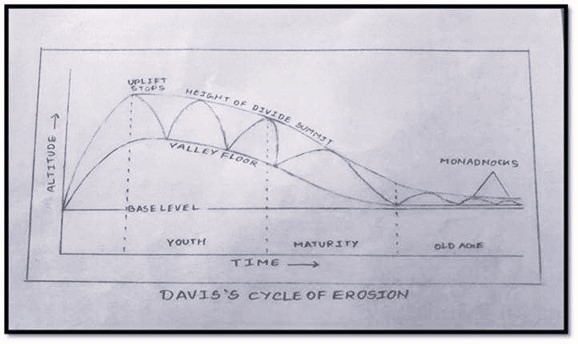
William Morris Davis proposed the cycle of erosion, which describes the sequential development of landforms through stages under a particular set of conditions.
- Key Features:
- Landscapes evolve from youthful to mature to old age.
- Assumes uniform structure, climatic stability, and tectonic stability.
- Emphasis on time-dependent processes.
- Stages of the Cycle:
- Youth:
- Landforms: V-shaped valleys, steep slopes.
- Dominance of vertical erosion.
- Maturity:
- Development of meanders, broader valleys, and floodplains.
- Lateral erosion becomes dominant.
- Old Age:
- Formation of peneplains (extensive low-relief surfaces).
- Decreased erosion due to loss of gradient.
- Youth:
- Criticism:
- Simplistic; fails to account for interruptions (e.g., tectonic uplift).
- Overemphasis on time and uniform processes.
Penck's Geomorphic Cycle
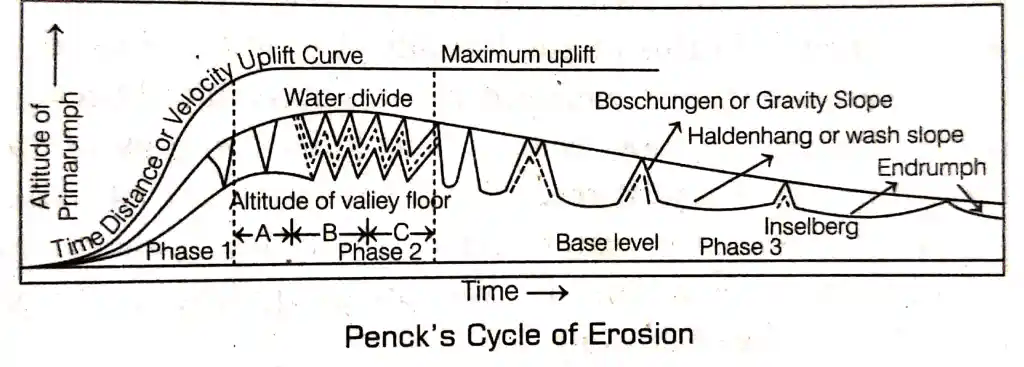
Walther Penck introduced an alternative model of slope evolution, challenging Davis's ideas by focusing on simultaneous uplift and denudation.
- Key Features:
- Slope evolution occurs through parallel retreat rather than progressive reduction.
- Uplift and erosion act contemporaneously.
- Highlights spatial variations in slope evolution.
- Phases of Landscape Development:
- Primärstadium (Initial Stage): Rapid uplift creates steep slopes.
- Dominanzstadium (Dominance Stage): Erosion begins to dominate, reducing gradients.
- Endstadium (Final Stage): Formation of low-relief landscapes through erosion and denudation.
- Criticism:
- Complex; difficult to test empirically.
- Underestimates climatic and lithological factors.
Comparison Between Davis and Penck
| Aspect | Davis | Penck |
|---|---|---|
| Focus | Sequential stages over time | Simultaneous uplift and erosion |
| Process Emphasis | Time-dependent processes | Tectonic uplift and erosion interplay |
| Slope Evolution | Declining gradients | Parallel slope retreat |
| Climatic Influence | Less emphasized | Considered indirectly |
Conclusion:
The concepts of geomorphic cycles proposed by Davis and Penck have been influential in shaping our understanding of landscape evolution. While both theories have their strengths and weaknesses, they provide valuable insights into the complex processes that shape the Earth's landforms.