
"At depth of compensation, the pressure generated by all overlying landmass substances on the earth is everywhere equal." Describe the hypotheses which support this statement. IAS 2024, 15 Marks
"At depth of compensation, the pressure generated by all overlying landmass substances on the earth is everywhere equal." Describe the hypotheses which support this statement. IAS 2024, 15 Marks

Introduction:
Compensation depth refers to the level at which the pressure exerted by the overlying landmass substances on the Earth is equal. This phenomenon occurs at a specific depth below the Earth's surface.
"Uniform Pressure Hypothesis"
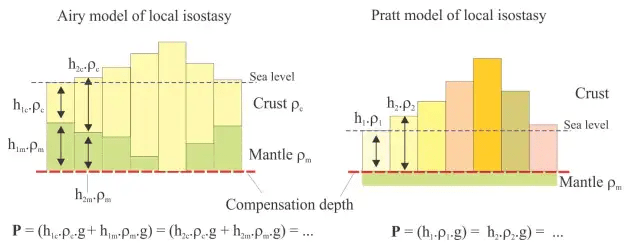
1. Airy's Hypothesis
- Basis: Variations in topographic height are compensated by differences in the thickness of the Earth's crust.
- Concept:
- Mountains have deeper roots, much like icebergs in water.
- Thicker crust in mountainous regions "floats" higher in the denser mantle.
- Example: The Himalayas have a deep crustal root, balancing their elevated height.
2. Pratt's Hypothesis
- Basis: Variations in density of crustal blocks result in topographic differences.
- Concept:
- Regions with higher elevation have lower-density material.
- The Earth's crust compensates for differences by density adjustments rather than thickness.
- Example: Oceanic crust (dense) versus continental crust (less dense).
3. Flexural Isostasy (Vening Meinesz's Model)
- Basis: The Earth's crust behaves like an elastic plate and can bend under the weight of topography.
- Concept:
- The load of mountains is spread over a broader region due to crustal rigidity.
- This model also accounts for subsidence and uplift near large loads like glaciers.
- Example: The bending of the crust under the Greenland ice sheet.
4. Heiskanen's Hypothesis
- Basis: Combines both Airy’s and Pratt’s theories.
- Concept:
- Topographic variations are compensated by both thickness and density changes.
- This hybrid approach addresses limitations of the individual models.
- Example: Uplift in regions with mixed geological characteristics.
5. Global Isostatic Adjustment
- Principle: Over time, the Earth’s lithosphere adjusts to reach equilibrium.
- Application:
- Post-glacial rebound where land rises after ice sheets melt.
- Sediment deposition causing subsidence in deltas.
Importance of Depth of Compensation
- It represents the level at which the pressure exerted by overlying materials becomes uniform due to isostatic adjustments.
- This principle ensures that the Earth's crust and mantle are in dynamic equilibrium, influencing tectonics, erosion, and sedimentation.
Conclusion:
The depth of compensation is a significant concept in geology, as it represents the point at which pressure from overlying landmass substances is equalized. This equilibrium of pressure has implications for geological processes, tectonic activity, and the overall stability of the Earth's crust.