
PRINCIPLES OF ENVIRONMENTAL IMPACT ASSESSMENT (EIA) | ENVIRONMENTAL GEOGRAPHY Optional for UPSC
PRINCIPLES OF ENVIRONMENTAL IMPACT ASSESSMENT (EIA) | ENVIRONMENTAL GEOGRAPHY Optional for UPSC

Introduction
- Environmental Impact Assessment (EIA) is a process used to assess the potential environmental consequences of proposed projects or activities.
- It is defined as an activity designed to identify the impact on the bio geophysical environment, on man and well-being of legislative proposals, projects, policies, operational procedures and to interpret and communicate information.
- Environmental Impact Assessment (EIA) and Environmental Impact Statement (EIS) 'refer to the studies and statement which firstly attempt to produce estimates of future environmental changes attributable to a proposed action, and secondly attempt to suggest the likely impact these changes (environmental changes to be brought in by human actions) on man's future well-being' (K.J. Gregory and D.E. Walling, 1981).
Thinkers' Views on EIA
1. Carl Sauer:
- Emphasized the need for careful assessment and consideration of environmental impacts before initiating any developmental activities.
2. William Morris Davis:
- Argued for the understanding of natural processes and their potential impacts on the environment.
- Highlighted the significance of evaluating the effects of human interventions on the physical environment.
3. Ellen Churchill Semple:
- Emphasized the need for comprehensive assessments of environmental impacts before implementing large-scale projects.
4. Richard Hartshorne:
- Advocated for considering environmental factors in regional planning and development.
- Emphasized the need for integrating environmental impact assessments into decision-making processes.
5. Yi-Fu Tuan:
- Argued for incorporating cultural and social dimensions into environmental impact assessments.
- Advocated for a people-centered approach that takes into account the well-being of communities affected by environmental changes.
6. David Harvey:
- Critiqued the capitalist economic system and its impact on the environment.
- Called for the recognition of social and environmental justice in EIA processes.
- Urged for a transformative approach to development that addresses the root causes of environmental degradation.
7. National Environmental Policy Act (NEPA),1969 USA
- The concept and methods of environmental impact assessment has its root in the enactment of National Environmental Policy Act (NEPA),1969.
Principles of Environmental Impact Assessment (EIA)
- Environmental Impact Assessment (EIA) is a critical process for evaluating the environmental effects of proposed developments before they proceed. The principles of EIA ensure that the process is effective, inclusive, and capable of mitigating negative environmental impacts.
- There are eight leading principles that govern the entire EIA process: participation, transparency, security, accountability, credibility, cost efficiency, flexibility and practicality.
Early Identification
- Identifying potential environmental impacts early in the project life cycle is crucial. This allows for the integration of environmental considerations into the project planning phase.
- Incorporating environmental assessments from the beginning helps in designing projects that are environmentally sustainable and socially acceptable.
Participation
- Public Involvement: Ensures that all stakeholders, including local communities, NGOs, and other interest groups, are actively involved in the EIA process. This helps in gathering diverse perspectives and concerns which might be overlooked otherwise.
- Consultation Mechanisms: Public hearings, workshops, and surveys are conducted to collect inputs. Transparent communication channels are established to facilitate ongoing dialogue.
Examination of Alternatives
- Analysis: Evaluating different project alternatives allows for the comparison of potential impacts and benefits. This helps in selecting the most sustainable and least harmful option.
- Comparison: Systematic comparison aids in understanding the trade-offs between various project scenarios, leading to better decision-making.
Transparency
- Open Access to Information: All EIA documents, including assessments, reports, and decision-making criteria, are made publicly available.
- Clarity in Process: The steps and criteria for decision-making are clearly defined and communicated to all stakeholders.
Security
- Data Protection: Sensitive environmental and socio-economic data collected during the EIA process is protected from unauthorized access.
- Confidentiality Agreements: Stakeholders are assured that proprietary or sensitive information will be kept confidential, fostering a more open sharing of data.
Accountability
- Clear Responsibilities: Roles and responsibilities of all parties involved in the EIA process are clearly defined, including project developers, EIA consultants, and regulatory authorities.
- Monitoring and Compliance: Establishment of mechanisms to monitor the implementation of EIA recommendations and compliance with environmental standards.
Credibility
- Scientific Rigor: EIA studies are based on sound scientific methods and principles to ensure accurate and reliable assessments.
- Expert Involvement: Engagement of qualified and experienced professionals to conduct the EIA.
Cost Efficiency
- Resource Optimization: Efficient use of financial and human resources to conduct EIA, avoiding unnecessary expenditures.
- Cost-Benefit Analysis: Thorough analysis to balance the costs of EIA with the benefits of environmental protection and project sustainability.
Flexibility
- Adaptive Approach: EIA process is adaptable to different project scales, types, and contexts. Flexibility in methodology to address specific environmental and social conditions.
- Iterative Process: Continuous review and update of EIA findings and recommendations as new information becomes available or project conditions change.
Practicality
- Realistic Recommendations: EIA provides actionable and feasible mitigation measures that can be realistically implemented by project developers.
- User-Friendly Documentation: EIA reports are concise, clear, and understandable to non-specialists, facilitating better implementation.
Systematic and Analytical Process
- Step-by-Step Process: EIA follows a systematic process that includes screening, scoping, impact assessment, mitigation, and monitoring.
- Methods: Utilizing both quantitative and qualitative methods ensures a thorough and robust assessment.
Precautionary Principle
- Preventive Action: Taking preventive action in the face of uncertainty helps in avoiding potential harm when there is a lack of scientific certainty.
- Avoiding Harm: This principle emphasizes caution and proactive measures to protect the environment.
Compliance with Legal Requirements
- Adherence: Following national and international legal frameworks and guidelines is critical for regulatory compliance.
- Ensuring Compliance: This ensures that projects adhere to established environmental standards and policies.
Steps included
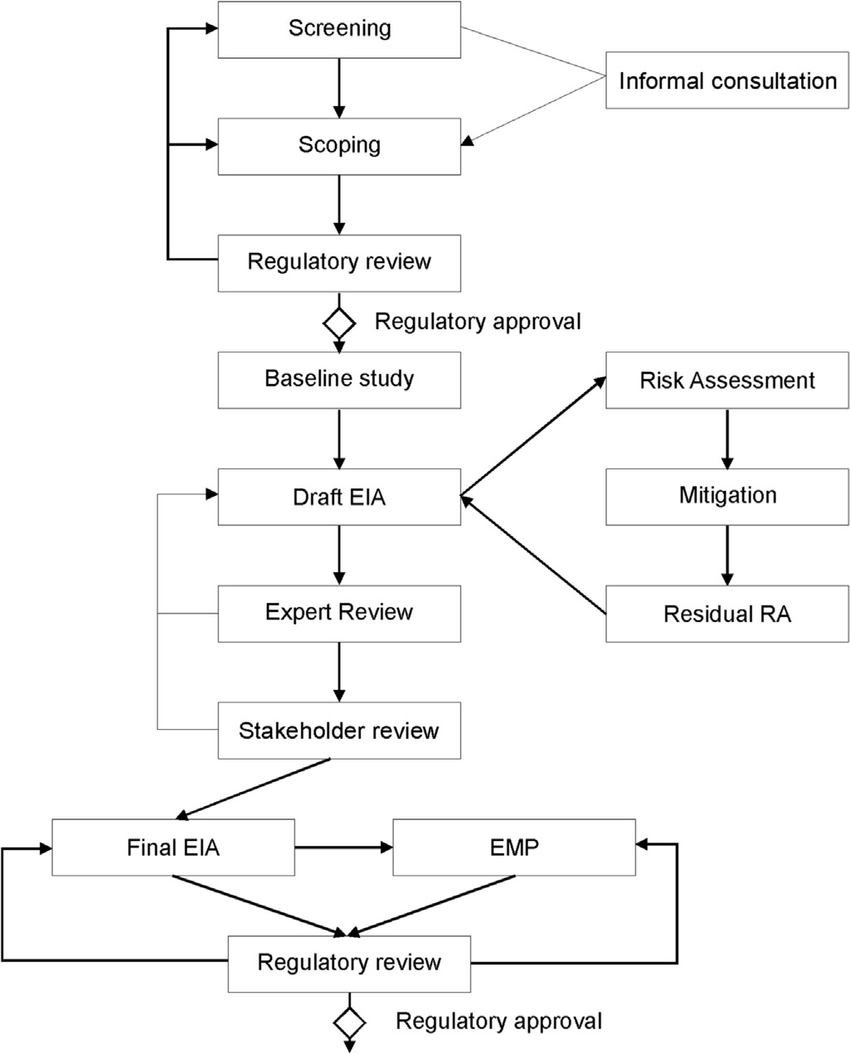
- Describe the present environment (the baseline conditions).
- Describe the project, including purposes and needs.
- Describe the effects of the project.
- Describe the impacts, both sort-term and long-term.
- Suggest and compare alternatives (projects).
- Provide a projection of the future of the site with and without the project.
- Suggest mitigating (remedial measures) activities.
Case Studies
1. Narmada Dam Project:
- Background: The Narmada Dam Project aimed to construct a large dam on the Narmada River, creating a reservoir and generating hydroelectric power.
- EIA Process: The EIA conducted for this project included assessing the potential impacts on the environment, wildlife, and displacement of local communities.
- Findings: The EIA identified concerns such as loss of fertile land, submergence of forests, and displacement of indigenous communities.
- Mitigation Measures: The project implemented measures such as compensatory afforestation, rehabilitation and resettlement of affected communities, and wildlife conservation plans.
2. The Vedanta Bauxite Mining Project in Odisha:
- Background: Vedanta sought clearance for bauxite mining in the Niyamgiri Hills to extract raw material for their aluminum refinery.
- EIA Controversy: The EIA faced significant controversy due to concerns over tribal rights, forest conservation, and impact on local ecosystems.
- Public Opposition: Local communities and environmental activists raised objections, highlighting the potential destruction of sacred tribal lands and biodiversity hotspots.
- Legal Intervention: The case reached the Supreme Court, which ruled against the mining project, citing violation of tribal rights and environmental norms.
3. The Delhi Metro Rail Project:
- Background: The Project aimed to improve urban transportation by constructing an extensive metro network in the city.
- EIA Process: The EIA assessed the environmental impacts of construction activities, noise pollution, air quality, and water management.
- Mitigation Measures: The project incorporated measures like dust suppression, noise barriers, rainwater harvesting, and use of green building materials.
- Sustainable Features: The project implemented energy-efficient technologies, promoted public transportation, and reduced reliance on private vehicles.
4. The Posco Steel Plant Project in Odisha:
- Background: The Posco steel plant proposed to establish a mega steel plant and captive port in Odisha, attracting investment and job opportunities.
- EIA Concerns: The EIA faced criticism for inadequate assessments, improper public consultations, and overlooking potential impacts on local communities and ecology.
- Environmental Activism: Activists and affected communities protested against the project, citing concerns over displacement, deforestation, and pollution.
- Project Scrapped: Due to persistent opposition and legal challenges, the project was eventually scrapped, emphasizing the importance of robust EIA processes.
5. The Jaitapur Nuclear Power Plant Project:
- Background: The Jaitapur Nuclear Power Plant aimed to establish a large nuclear power facility in Maharashtra to meet the increasing energy demands.
- EIA Controversy: The EIA faced criticism for insufficient assessment of potential nuclear accidents, radioactive waste management, and coastal ecology impacts.
- Public Protests: Local communities and environmental groups protested against the project, expressing concerns about the safety and long-term environmental impacts.
- Ongoing Debate: The project remains a subject of ongoing debate and scrutiny, with calls for a comprehensive and transparent EIA process.
Need of EIA
- Ensuring Sustainable Development: EIA aligns projects with sustainable development principles and identifies negative impacts for mitigation.
- Protecting the Environment: EIA evaluates impacts on air, water, soil, biodiversity, and ecosystems, aiming to prevent or minimize adverse effects.
- Public Participation and Transparency: EIA involves public input, ensuring transparency and making project information accessible.
- Assessing Alternatives: EIA considers different project options and their impacts to select the most sustainable option.
- Early Identification of Risks: EIA identifies potential hazards and implements preventive measures during planning and design stages.
- Compliance with Legal Requirements: EIA ensures adherence to environmental laws, regulations, and standards.
- International Best Practices and Standards: EIA follows global guidelines and standards for environmental impact assessment.
- Integration of Environmental Considerations: EIA integrates environmental factors into decision-making for balanced development.
- Continuous Monitoring and Adaptive Management: EIA includes post-implementation monitoring to evaluate impacts and adjust measures for long-term sustainability.
Limitations of EIA
- Inadequate Assessment Scope: Limited assessment of environmental impacts beyond immediate project effects.
- Lack of Public Participation: Insufficient involvement of the public and affected communities in decision-making.
- Bias and Conflict of Interest.
- Insufficient Enforcement and Compliance: Weak monitoring and enforcement of EIA recommendations.
- Cumulative Impact Assessment: Failure to consider cumulative effects of multiple projects.
- Incomplete or Inaccurate Information: Concerns regarding incomplete, inaccurate, or biased data in EIAs.
- Limited Consideration of Alternatives: Failure to thoroughly evaluate alternative options.
- Political Influence and Expediency: Political pressure compromising the integrity of the EIA process.