
LINKAGE OF RIVERS | ENVIRONMENTAL GEOGRAPHY Optional for UPSC
LINKAGE OF RIVERS | ENVIRONMENTAL GEOGRAPHY Optional for UPSC

Introduction
- Linkages of rivers refer to the interconnection of rivers through canals or channels.
- This concept aims to transfer water from water-rich regions to water-scarce regions to address water scarcity and promote efficient water resource management.
Thinkers’ Perspectives on River Linking
1. Proponents of River Linking
- Dr. K.L. Rao: Believed that river linking could address the uneven distribution of water resources in India, benefitting agriculture and reducing drought conditions.
- Dr. A.P.J. Abdul Kalam: Supported the concept of interlinking rivers to mitigate water scarcity and promote economic development. He emphasized the need for comprehensive planning, environmental sustainability, and stakeholder engagement while implementing river linking projects.
- Prof. Jagdish Bhagwati: He argued that such projects could enhance regional cooperation, foster economic growth, and lead to shared benefits among countries or regions involved.
2. Critics of River Linking
- Medha Patkar: Opposed river linking, highlighting its adverse environmental and social impacts. She raised concerns about displacement of communities, loss of livelihoods, and ecological damage resulting from river interlinking projects.
- Dr. Madhav Gadgil: Criticized river linking projects, arguing that they could lead to the destruction of ecosystems and biodiversity. Advocated for decentralized water management, watershed development, and the conservation of local water resources.
Background
- Sir Arthur Cotton, the chief engineer of Madras Presidency in 1919, originally coined the idea.
- In 1960, KL Rao, the Minister of State for Energy and Irrigation at the time, revived the concept by proposing the linkage of the Ganga and Cauvery rivers.
- The idea gained momentum in 1982 with the establishment of the National Water Development Agency by former Prime Minister Indira Gandhi.
- In 2002, the Supreme Court directed the government to create a plan by 2003 and implement it by 2016.
- To fulfill this directive, the government formed a task force in 2003.
- In 2012, the Supreme Court further instructed the government to commence the project.
- The Ken-Betwa River Linking Project received Cabinet approval in 2014 but is yet to be carried out.
- The first successful linking of the Godavari and Krishna rivers was completed in 2015.
- In March 2021, the governments of Uttar Pradesh and Madhya Pradesh signed an agreement to link the Ken and Betwa rivers.
- The government aims to complete the pan India river interlinking projects within a decade.
Advantages of Linkages of Rivers
- Increased water availability: Linking rivers can augment the water supply in regions facing water scarcity by transferring water from surplus areas.
- Drought mitigation: The interconnected river systems can help mitigate drought conditions in water-stressed regions.
- Improved irrigation and agriculture: Linkages can enhance irrigation potential and support agricultural development in water-deficient areas.
- Hydropower generation: The combined flow of linked rivers can facilitate increased hydropower generation, contributing to energy production.
- Flood control: Effective river linking can assist in flood management by diverting excess water to regions in need.
Environmental and Ecological Concerns
- Ecological impact: Altering the natural flow of rivers through linking can disrupt ecosystems, affecting flora, fauna, and aquatic life.
- Loss of wetlands: River interlinking may result in the loss of wetlands, which serve as vital habitats for numerous species and contribute to ecological balance.
- Disruption of Natural Flow Patterns: Altering the natural flow can lead to changes in sediment transport, nutrient distribution, and ecological processes.
- Loss of Biodiversity: River linkages can result in the loss of biodiversity by fragmenting habitats and hindering the movement of aquatic species.
- Disruptions to native species: The interconnection of rivers may introduce invasive species into new ecosystems, causing further disruptions to native species.
- Impact on Riparian Ecosystems: Changes in water flow and altered hydrological regimes can harm vegetation, wetlands, and wildlife that depend on these habitats.
- Water Quality and Pollution: The transfer of water from one river basin to another can introduce pollutants and non-native species, impacting water quality and ecosystem health.
- Alteration of River Hydrology: Linking rivers may cause changes in hydrological regimes, affecting downstream water availability, flood patterns, and groundwater recharge.
- Socio-economic Implications: The displacement of communities due to the construction of canal networks for river linkages can have adverse socio-economic impacts.
Case Studies on Linkages of Rivers
1. Indian River Interlinking Project
- It is one of the most ambitious water management projects globally.
- It aims to interconnect 37 major rivers in India through a network of canals and reservoirs.
- The project aims to address regional disparities in water availability, improve irrigation facilities, and generate hydroelectric power.
- Proponents argue that it will enhance agricultural productivity and mitigate the impact of droughts and floods.
2. China's South-North Water Diversion Project
- It involves transferring water from the water-rich Yangtze River basin to the water-deficient Yellow River basin.
- The project consists of three routes: Eastern, Central, and Western, and aims to supply water to major cities, support agriculture, and mitigate water scarcity in northern China.
- Critics have raised concerns about environmental impacts, displacement of communities, and the high cost of the project.
3. Lesotho Highlands Water Project
- The project in Southern Africa involves transferring water from Lesotho's water-rich mountains to South Africa's water-deficient Gauteng province.
- The project supplies water for domestic and industrial purposes, hydropower generation, and agricultural irrigation.
- It has been successful in improving water availability and supporting economic growth in the region.
4. North American Water and Power Alliance (NAWAPA)
- It is a proposed project to divert water from water-abundant regions in Alaska and Canada to water-scarce areas in the southwestern United States and Mexico.
- The project aims to meet increasing water demands, generate hydroelectric power, and mitigate drought risks.
- However, it has faced significant opposition due to environmental concerns, potential ecosystem disruption, and the high cost involved.
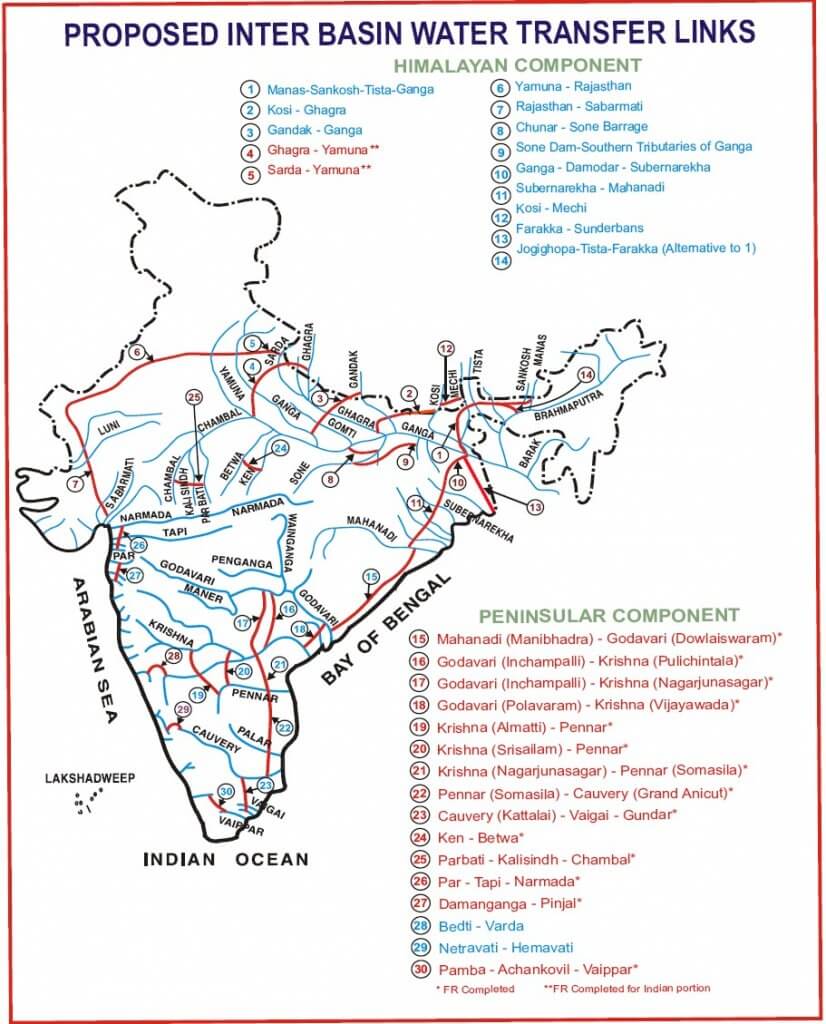
Major river linking projects in India
Its has been split into three parts:
- Himalayan River component.
- Peninsular river component.
- Inter state component.
Ganga- Cauvery Link Canal
- Project was prepared by a United Nations team at the request of the Indian government.
- It aimed to reduce the impact of floods in the Ganga basin while also supplying water to the country's central and eastern regions, which suffer from chronic water scarcity.
- Project was deemed impractical due to the enormous financial costs and extremely high energy requirements.
- Project also had significant environmental challenges.
Beas- Satluj Link Canal
- It involves diverting some water from the Beas River into the Satluj River via two tunnels and an open channel.
- It was done in order to generate power and increase the storage capacity of the Bhakra reservoir (Gobindsagar).
- Project was built as part of the master plan to capture the water from the three eastern rivers, the Satluj, Beas, and Ravi, for irrigation and integrated power generation.
Ken-Betwa Link Project
- The Ken-Betwa link envisions diverting surplus water from the Ken basin to the water-stressed Betwa basin.
- This link canal will provide irrigation to short areas of MP's upper Betwa basin as well as en-route areas of MP and UP.
Mahanadi - Godavari link
- This link has been proposed between the Mahanadi River's Manibhadra reservoir and the Godavari's Dowleswaram barrage.
Krishna (Srisailam) – Pennar link
- The aim is to transfer a part of the additional water available at Srisailam by partial exchange of the surplus waters of the Mahanadi and the Godavari rivers proposed to be brought to the Krishna River.
- The diversion of the water is proposed by utilising the existing Srisailam reservoir and Srisailam Right Main Canal.
Par-Tapi-Narmada Link Project
- It would transfer water from the water surplus regions of Western Ghats to the water deficit regions of Saurashtra and Kutch (Gujarat).
- Par-Tapi-Narmada Link canal was proposed to divert excess water from rivers such as the Par, Auranga, Ambica, Purna, and Tapi up to the Narmada Command's Vadodara branch.
Evaluation
- Given the potential environmental and ecological concerns, comprehensive environmental assessments must be conducted before implementing river linkages.
- These assessments should consider the long-term impacts on ecosystems, biodiversity, water quality, and socio-economic aspects.
Conclusion
- Linkages of rivers can offer benefits such as increased water availability, drought mitigation, and improved irrigation.
- However, environmental and ecological concerns should be carefully considered and mitigated.
- Perspectives on river linking vary, with proponents emphasizing development and critics emphasizing environmental and social impacts.
- Balancing the potential benefits with the need for sustainable and inclusive development is crucial when considering river linking projects.