
Droughts | ENVIRONMENTAL GEOGRAPHY Optional for UPSC
Droughts | ENVIRONMENTAL GEOGRAPHY Optional for UPSC

Introduction
- A drought is defined as drier than normal conditions.
- Meaning a drought is "a moisture deficit relative to the average water availability at a given location and season".
- A drought can last for days, months or years.
- It often exerts substantial impacts on the ecosystems and agriculture of affected regions, and causes harm to the local economy.
- Humans have usually viewed droughts as "disasters" due to the impact on food availability and the rest of society.
Drought vs Desertification
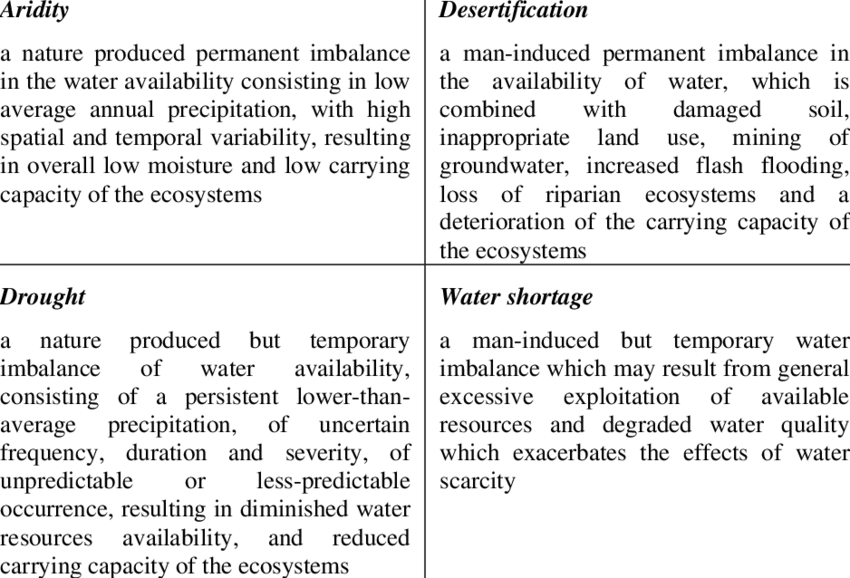
- While drought is a temporary weather event characterized by water scarcity, desertification is a long-term process of land degradation that leads to the transformation of fertile land into desert-like conditions.
- Both drought and desertification have severe consequences for ecosystems, agriculture, and human populations, but they differ in terms of duration and underlying causes.
Here's a comparison of drought and desertification:
| Aspects | Drought | Desertification |
|---|---|---|
| Definition | A temporary period of abnormally dry weather conditions that result in water scarcity | The long-term process of land degradation in arid, semi-arid, and dry sub-humid areas, leading to the transformation of fertile land into desert-like conditions |
| Causes | Insufficient rainfall, evaporation rates exceeding precipitation, climate change | Overgrazing, deforestation, climate change, inappropriate land use, soil erosion |
| Duration | Can last for weeks, months, or even years | Occurs over decades or centuries |
| Effects | Water scarcity, reduced crop yields, livestock deaths, economic losses | Loss of vegetation, soil erosion, reduced biodiversity, displacement of local communities |
| Geographic Scope | Can occur in various regions, affecting specific areas or entire countries | Primarily affects arid and semi-arid regions around the world |
| Examples | California drought in 2012-2017, Australian Millennium Drought (2000-2009) | Sahel region in Africa, Thar Desert in India, parts of the Great Plains in the United States |
Categorization
- Meteorological drought-It is a measure of departure of precipitation from normal. Due to climatic differences, what might be considered a drought in one location of the country may not be a drought in another location. It usually precedes the other kinds of drought.
- Agricultural drought – It refers to a situation where the amount of moisture in the soil no longer meets the needs of a particular crop. It affects the crop productivity. It can arise from any conditions such as change in precipitation level, poorly planned irrigation, poor soil condition and erosion etc.
- Hydrological drought- It occurs when surface and subsurface water supplies are below normal. It can also be triggered through various reasons apart from shortfall of rain. Ex: Lake Balkhash drying out.
- Socioeconomic drought- It refers to the situation that occurs when physical water shortages begin to affect people. It is a similar concept to water scarcity.
- Flash drought- It is characterized by a period of rapid drought intensification with impacts on agriculture, water resources, ecosystems, and the human environment.
Perspectives on Droughts
1. Environmental Determinism:
- According to environmental determinism, droughts are seen as a result of unfavorable environmental conditions. It suggests that regions with naturally arid climates, such as deserts, are more prone to droughts due to their limited water resources.
- Example: regions with arid climates, such as the Sahara Desert, experience frequent and prolonged droughts due to the lack of rainfall and limited water resources.
2. Possibilism:
- From a possibilist perspective, while environmental factors influence the occurrence of droughts, human ingenuity and resourcefulness can mitigate their impacts.
- Example: The construction of large-scale irrigation systems, such as the ancient Qanat system in Persia or modern-day water management techniques in drought-prone regions like California, demonstrates the possibilist approach.
- Example: the success of agricultural practices like drip irrigation or desalination plants in regions with limited water resources enables communities to cope with drought conditions more effectively.
3. Radical Perspective:
- Droughts are a consequence of socio-political factors, such as land ownership, resource exploitation, and unequal access to water.
- The marginalized communities often bear the brunt of drought impacts due to systemic inequalities.
- Example: The work of Vandana Shiva, an environmental activist, criticizes large-scale industrial agriculture and argues that it contributes to drought vulnerability and the displacement of small farmers in India.
4. Marxist Perspective:
- Droughts are seen as consequences of capitalist-driven practices, such as intensive agriculture and water privatization.
- It argues that these practices prioritize profit over sustainable resource management, leading to water scarcity and exacerbating drought impacts on marginalized communities.
5. Spatial Analysis:
- Geographical thinkers employing spatial analysis would study the spatial patterns of drought occurrence, identifying regions or areas prone to droughts based on factors such as climate, topography, and water availability.
- They would also analyze the spatial impacts of droughts on various aspects, including agriculture, ecosystems, and human settlements.
- Example: Geographical Information Systems (GIS) are commonly used in spatial analysis to map and analyze drought patterns, identify vulnerable regions, and assist in decision-making for drought mitigation and preparedness.
Causes
- Drought can be triggered by a high level of reflected sunlight and above average prevalence of high-pressure systems, winds carrying continental, rather than oceanic air masses.
- Ridges of high-pressure areas aloft can prevent or restrict the developing of thunderstorm activity or rainfall over one certain region.
- Feedback mechanisms such as local arid air, hot conditions which can promote warm core ridging, and minimal evapotranspiration can worsen drought conditions.
- Within the tropics, distinct, wet and dry seasons emerge due to the movement of the Intertropical Convergence Zone or Monsoon trough. The dry season greatly increases drought occurrence.
- El-Nino Phenomena can also cause drought like conditions.
- Global climate change affect drought related factors like rain pattern, evaporation etc.
- Human activities like over farming, excessive irrigation, deforestation, and erosion that affect land water holding capacity.
Effects
Environmental:
- Lower surface and subterranean water-levels,
- Lower flow-levels (with a decrease below the minimum leading to direct danger for amphibian life),
- Increased pollution of surface water,
- The drying out of wetlands,
- More and larger wildfires,
- Higher deflation intensity,
- Loss of biodiversity,
- Dust bowl, desertification, dust storms etc form of land degradation.
- Worse health of trees and the appearance of pests and dendroid diseases.
Economic:
- Lower agricultural, forests, game and fishing output,
- Higher food-production costs,
- Lower energy-production levels in hydro plants,
- Losses caused by depleted water tourism and transport revenue,
- Problems with water supply for the energy sector and for technological processes in metallurgy, mining, the chemical, paper, wood, foodstuff industries etc.,
- Disruption of water supplies for municipal economies.
Social:
- Negative effect on the health of people directly exposed to this. phenomenon (excessive heat waves).
- Possible limitation of water supplies.
- Increased pollution levels.
- High food-costs.
- Stress caused by failed harvests, water scarcity, etc.
Distribution
Types of Region: Drought is a recurring feature of the climate in most parts of the world, becoming more extreme and less predictable due to climate change.
Major drought prone region: Afghanistan, Angola, Brazil, Burkina Faso (W. Africa), Chile, Ethiopia, Iraq are the countries facing sever water scarcity. Flash drought hotspots exist over Brazil, the Sahel, the Great Rift Valley, and India, with notable local hotspots over the central United States, southwestern Russia, and northeastern China.
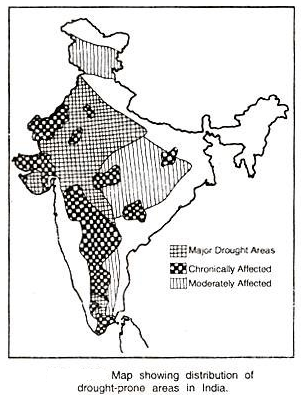
Drought prone areas in India: The 1962 Irrigation Commission defined a drought-prone area as one which receives less than 10 cm rainfall and even three-fourths of this is not received in 20 per cent or more of the years under consideration; or an area in which 30 per cent or less of the total cropped area is irrigated.
- Extreme drought conditions cover 12% of the total drought-prone area; these areas include western Rajasthan and Gujarat, western Uttar Pradesh, north-west Madhya Pradesh.
- Severe drought conditions prevail over 42% of the total drought-prone area; these areas are the leeward side of Maidan plateau, Rayalaseema and Telengana regions of Andhra Pradesh and Marathwada and Vidarbha regions of Maharashtra.
- Moderate drought conditions affect 46% of the total drought-prone area; these areas are Orissa, central-north Madhya Pradesh,. Chhotanagpur, Jammu and Kashmir and central- east Tamil Nadu.
Remedial Measures / Disaster Management of Droughts
A. Pre-disaster stage
1. Preparedness (P):
- Developing drought management plans: creating comprehensive strategies and action plans to address potential drought situations. E.g. establishing early warning systems, monitoring networks, and coordination mechanisms.
- Capacity building and training: This includes training on water conservation techniques, efficient irrigation practices, and emergency response procedures.
- Public awareness and education: Educating the public about drought risks, water conservation, and preparedness measures through campaigns, workshops, and informational materials. e.g. workshops on implementing drip irrigation systems and rainwater harvesting techniques.
2. Mitigation (M):
- Water resource management: Implementing measures to optimize water allocation and improve water use efficiency. E.g. investing in infrastructure development for water storage, improving irrigation systems, and promoting water reuse and recycling.
- Drought-resistant agriculture: Encouraging the adoption of drought-tolerant crop varieties and sustainable farming practices that reduce water demand. E.g. providing subsidies or incentives.
- Land management and vegetation restoration: Implementing strategies to protect and restore ecosystems, such as afforestation and reforestation programs. These measures can help reduce soil erosion, increase water infiltration, and enhance water availability during drought periods.
3. Prevention (P):
- Water conservation regulations and policies: Enforcing regulations and policies to promote water conservation practices in various sectors, including agriculture, industry, and domestic use. E.g. implementing water pricing mechanisms, water-use restrictions, and promoting water-saving technologies.
- Drought forecasting and early warning systems: Developing and improving meteorological and hydrological monitoring systems to provide timely information about drought conditions.
- Infrastructure resilience: Ensuring the resilience of critical infrastructure, such as water supply systems, to withstand drought conditions. E.g. upgrading infrastructure, implementing water storage solutions, and diversifying water sources.
B. Disaster stage
1. Rescue operation (R):
- Emergency response: Mobilizing resources and personnel to provide immediate assistance and relief to affected communities. E.g. supplying safe drinking water, setting up temporary shelters, and providing medical aid.
- Evacuation and relocation: Evacuating individuals from high-risk areas to safer locations and providing temporary housing for those displaced by the drought.
C. Post-disaster stage
1. Relief (R):
- Emergency relief assistance: Providing immediate relief supplies, such as food, water, and medical aid, to affected communities.
- Financial support: Offering financial assistance or grants to individuals, businesses, and communities impacted by the drought. This helps them recover and rebuild their livelihoods.
2. Recovery (R):
- Infrastructure rehabilitation: Repairing and restoring damaged infrastructure, including water supply systems, roads, and buildings. This facilitates the return to normalcy and enables the resumption of essential services.
- Livelihood restoration: Assisting individuals and communities in recovering their livelihoods through various measures, such as providing agricultural inputs, offering vocational training, and facilitating employment opportunities.
3. Rehabilitation (R):
- Long-term planning and resilience building: Developing strategies to enhance resilience to future drought events. E.g. implementing sustainable water management practices, promoting climate-smart agriculture etc.
- Community engagement and participation: Encouraging active involvement of communities in drought management decision-making processes. This fosters ownership, cooperation, and sustainable practices.

NDMA Guidelines
- Drought Monitoring Cells (DMCs) cells at state level.
- Preparation of vulnerability maps for each state by the State DMCs.
- Real-time drought related information using I&C Technology.
- Watershed development approach for drought management.
- Comprehensive reporting through integration of ground-based information with the space-based information.
- Inclusion of agricultural production, depletion of water resources, livestock population, land degradation and deforestation as well as human health in damage assessment.
- Revamping of Drought Management Information System of Department of Agriculture.
- Automatic weather station and rain-gauges for micro level analysis and forecasting.
- Development of drought resistant crop varieties.
- Pilot studies in all categories of drought prone areas for suggesting long term mitigation measures.
- Formulation of a cloud seeding policy.
- Promoting crop diversification through sprinklers/Drip irrigation systems (micro irrigation techniques).
- Readily available credit in the drought affected areas; and extension of marketing and price support.
- Afforestation with subabul, seemaruba, casurina, eucalyptus and bio diesel plantation like Jatropha and pongomia.
- Development of insurance products for different agro-climatic zones providing coverage against drought. It will include post harvest losses, price linked insurance, satellite derived crop conditions and estimation for claims.
- Realistic national training and capacity building programme for drought management.
- Encouraging NGOs, Panchayats and Urban legistative bodies for generating awareness among farmers.
- Education through updated graduate and post graduate syllabus on agriculture.
- Fodder, Cattle feed and mineral mixture to be supplied to all productive animals to prevent distress sales of cattle.
- Drought risk management to be a part of CSR for corporate involvement.