
INFLUENCE OF MAN ON ECOLOGY AND ENVIRONMENT | ENVIRONMENTAL GEOGRAPHY Optional for UPSC
INFLUENCE OF MAN ON ECOLOGY AND ENVIRONMENT | ENVIRONMENTAL GEOGRAPHY Optional for UPSC

Introduction
- There is dynamic and intricate bond between humans and their natural surroundings.
- The Dual Role of Humans: Humans are influenced by natural controls and events, yet they also exert dominance over various Earth's physical and biological systems.
- Evolving Relationship: Over time, the relationship between humans and the environment has undergone transformations.
- For example: In the past, humans were primarily at the mercy of natural forces such as weather patterns and ecological processes. However, as civilizations progressed, humans developed the ability to manipulate their physical environment to better accommodate their needs and desires. This shift marked a significant change in the relationship between man and nature.
Thinkers’ perspectives
1. Anthropocentrism:
- Human-centered view that emphasizes the importance of human interests and welfare over other species.
- Examples: Industrial development, deforestation, and resource exploitation driven by human needs and economic growth.
2. Biocentrism:
- Emphasizes the intrinsic value of all living organisms and their right to exist.
- Humans are seen as a part of the broader ecological community rather than the central focus.
- Examples: Advocacy for conservation, protection of endangered species, and promotion of sustainable practices.
3. Ecocentrism:
- Considers the entire ecosystem as a complex web of interconnections and regards nature as having inherent value.
- Human actions are seen as part of a broader ecological system and should be in harmony with it.
- Examples: Environmental activism, support for policies that prioritize ecosystem health, and conservation efforts.
4. Deep Ecology:
- Focuses on the intrinsic value of nature, promoting a shift in human consciousness and lifestyle.
- Advocates for a fundamental change in the way humans perceive and interact with the environment.
- Examples: Environmental ethics that prioritize ecological integrity, minimal consumption, and a spiritual connection with nature.
5. Technocentrism:
- Places faith in technological advancements to address environmental challenges.
- Views human ingenuity and innovation as the primary solutions to ecological problems.
- Examples: Development and implementation of renewable energy technologies, green infrastructure, and eco-friendly inventions.
6. Social Ecology:
- Emphasizes the social and political aspects of ecological issues, highlighting the role of power dynamics and social structures.
- Argues that addressing environmental problems necessitates addressing social inequalities and transforming societal systems.
- Examples: Environmental justice movements, community organizing for sustainable practices, and advocating for equitable access to resources.
7. Sustainability:
- Advocates for balancing human needs with the long-term health of the environment and future generations.
- Promotes responsible resource use, conservation, and the development of sustainable practices.
- Examples: Transition to renewable energy sources, sustainable agriculture practices, and circular economy initiatives.
Historical perspective
1. Period of hunting and food gathering:
- Primitive man as part of the natural environment: The most primitive humans lived in harmony with nature and relied on it for their basic needs, much like other animals.
- Functional as a 'biological man': Their primary requirement was limited to obtaining food.
- Transition to exploiting natural resources: Over time, humans learned to hunt animals, marking their first intentional step towards utilizing natural resources.
- Role of fire and tools: The discovery of fire and the invention of tools and weapons enabled humans to exploit natural resources more effectively.
- Inadvertent environmental destruction: The careless use of fire for cooking and roasting led to the unintentional burning of forests, initiating the first instance of environmental destruction caused by humans.
- Example: Early humans relied on hunting and gathering for their sustenance. They would hunt animals using rudimentary tools and cook their food using fire. However, their use of fire sometimes resulted in unintentional forest fires, altering the natural environment.
2. Period of animal domestication and pastoralism:
- Creating habitats for domesticated animals: As humans began domesticating animals, they needed to create suitable habitats for them, even if temporarily.
- Changing the environment through various means: Prehistoric people modified the environment through hunting, burning forests, domesticating plants and animals, altering erosion rates through agriculture and land clearing, and introducing organisms to new areas.
- Example: Early humans started domesticating animals such as sheep and cattle, leading them to construct temporary shelters or enclosures to house these animals. Additionally, they influenced their surroundings by selectively burning forests for agricultural purposes, and introducing new species to different regions.
3. Period of plant domestication and agriculture:
- Shift to sedentary life and agriculture: The domestication of plants marked the transition to a more settled lifestyle and the birth of early human civilizations, particularly river valley civilizations.
- Impact of shifting cultivation: Primitive forms of cultivation, such as shifting or jhuming cultivation, involved clearing natural forests, causing environmental destruction.
- Development of the cultural environment: As time passed, humans developed their own cultural environment by building houses, creating villages, towns, and cities, and establishing social institutions.
- Transformation into 'economic man': Technological advancements and the development of economies led to the phase of industrialization.
- Example: With the advent of agriculture, early humans transitioned from a nomadic lifestyle to settled communities along river valleys. They cultivated crops and began building permanent dwellings, resulting in the development of social structures and the transformation of the human-environment relationship.
4. Period of science, technology, and industrialization:
- Technology and its impact on the environment: Technological advancements initiated a more antagonistic relationship between humans and their natural environment.
- Reckless exploitation of resources: Extreme teleological and economic deterministic concepts led to the indiscriminate and rapacious exploitation of natural resources.
- Example: The rise of science, technology, and industrialization brought about significant changes in human societies. However, the pursuit of economic growth and technological progress often resulted in the exploitation of natural resources without proper consideration for long-term consequences, leading to environmental degradation.
Influence of Man on Ecology and Environment
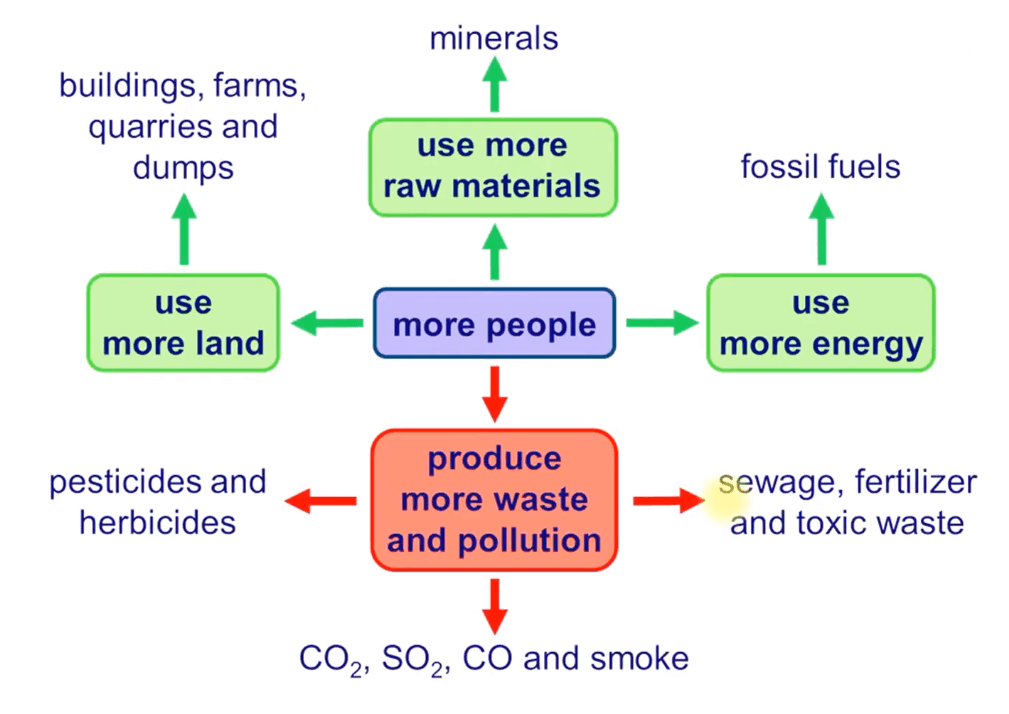
Direct Impacts:
- Land Use Changes and Construction: Alterations in land use and construction activities directly affect the environment (e.g., deforestation, urbanization).
- Agricultural Practices: Certain agricultural practices have direct consequences on ecosystems (e.g., excessive use of chemical fertilizers and pesticides).
- Weather Modification Programs: Human interventions to modify weather patterns have direct impacts (e.g., cloud seeding, hailstorm prevention).
Indirect Impacts:
- Ecosystem Disruption: Release of toxic elements disrupts food chains and webs (e.g., introduction of DDT).
- Industrial Wastes: Discharge of industrial waste pollutes water, air, and soil.
- Chemical Fertilizers, Insecticides, and Pesticides: Use of these substances in agriculture leads to unintended consequences.
- Urbanization and Land Use Changes: Long-term effects on weather and climate due to urbanization and land use changes.
- River Pollution: Pollution from untreated sewage and industrial waste transforms rivers into sewers.
Positive Influence of Man on Ecology and Environment:
1. Conservation Efforts:
- Man establishes national parks and protected areas to preserve biodiversity (e.g., Yellowstone National Park).
- Wildlife sanctuaries safeguard endangered species (e.g., Serengeti National Park).
2. Environmental Education and Awareness:
- Man raises awareness about environmental issues (e.g., campaigns on recycling).
- Educational programs incorporate environmental education (e.g., school curriculum).
3. Sustainable Resource Management:
- Man practices sustainable forestry (e.g., selective logging, reforestation).
- Fisheries management techniques prevent overfishing (e.g., quotas, closed seasons).
4. Renewable Energy Transition:
- Man shifts to renewable energy sources (e.g., solar, wind, hydroelectric).
- Denmark generates electricity from wind power, reducing reliance on fossil fuels.
5. Pollution Control and Waste Management:
- Man implements emission control technologies and regulations.
- Recycling programs and waste reduction campaigns minimize landfill waste.
6. Restoration and Rehabilitation:
- Man undertakes ecosystem restoration projects (e.g., reforestation initiatives).
- The "Great Green Wall" project in Africa combats desertification.
7. Collaboration and International Agreements:
- Global cooperation and agreements lead to positive environmental policies.
- The Paris Agreement aims to limit global temperature rise.
Negative Influence of Man on Ecology and Environment
1. Pollution
- Air pollution: Emissions from vehicles, industry, and fossil fuel combustion. Example: Increased air pollution in cities leading to respiratory problems.
- Water pollution: Discharge of untreated waste and agricultural runoff. Example: Industrial effluents polluting rivers and lakes, causing fish deaths.
- Soil pollution: Improper waste disposal and chemical use in agriculture. Example: Contamination of soil due to improper disposal of electronic waste.
2. Deforestation
- Clearing of forests for agriculture, logging, and urbanization.
- Example: Rapid deforestation of the Amazon rainforest.
- Disrupts carbon cycle and contributes to climate change.
- Example: Loss of carbon sinks in forests increasing atmospheric CO2.
3. Habitat destruction
- Conversion of natural habitats for human activities. Example: Destruction of mangroves for shrimp farming.
- Fragmentation of habitats due to infrastructure. Example: Highways dividing wildlife habitats.
4. Overexploitation
- Unsustainable hunting, fishing, and resource extraction. Example: Overfishing leading to collapse of fish stocks.
- Illegal wildlife trade for pets, medicines, and trophies. Example: Poaching of elephants for ivory tusks.
5. Climate change
- Greenhouse gas emissions from human activities. Example: Increased heatwaves, storms, and wildfires.
- Impacts ecosystems, alters weather patterns, and threatens biodiversity. Example: Coral bleaching due to warmer ocean temperatures.
6. Waste generation
- Improper waste management and excessive production. Example: Accumulation of plastic waste in oceans.
- Hazardous waste and improper disposal of electronic waste. Example: Toxic substances leaching into groundwater.
Examples of Ecological Impacts
1. Modification of Landforms
Causes:
- Mining and quarrying: Excavation and earth-moving activities can change the shape of landforms. Example: Open-pit mines and quarries create scars on the land surface.
- Deforestation: Clearing of forests disrupts natural landform processes.
- Introduction of exotic plants and animals: Non-native species can alter landforms and ecosystems. Invasive plants can displace native vegetation, affecting the stability of slopes.
- Use of agricultural machinery: Intensive farming practices can modify landforms.
- Building and use of tracks and roads: Construction of infrastructure can impact landforms. Cutting through hills for road construction can change the shape of slopes.
- Overgrazing of pastures: Excessive grazing can degrade landforms.
Direct Impacts:
- Excavation and land reclamation: Activities like mining and reclaiming land from the sea alter the shape of landforms. Excavation of minerals changes the topography of the land.
- Land scarification: Extraction of mineral resources creates disturbances on the land surface. Example: Quarries and gravel pits leave visible scars on the landscape.
- Geomorphological instability: Man-made landforms are often unstable, leading to mass movements. Example: Spoil tips from mining can slide and flow during heavy rainfall.
- Interference with natural vegetation: Alteration of vegetation affects landform processes.
- Habitat loss: Conversion of land for agriculture and introduction of invasive species result in the loss of natural habitats.
Indirect Impacts:
- Soil degradation: Removal of vegetation and disturbance of land structure affect soil quality. Example: Loss of plant litter reduces soil cohesion and porosity.
- Erosion on slopes: Human activities contribute to the formation of rills and gullies on hillsides.
- Increased discharge and sediment supply: Human-induced changes lead to higher river discharge and sediment load.
- Coastal erosion and deposition: Construction and removal of beach material impact coastal processes.
2. Atmospheric Changes
Causes:
- Mining and quarrying activities: Dust and pollutants released during extraction processes affect the atmosphere.
- Burning fossil fuels: Combustion of coal, oil, and gas releases gases and particles into the air.
- Man-induced fires: Fires caused by human activities release smoke and pollutants into the atmosphere.
Direct Impact:
- Introduction of pollutants: Solid and gaseous pollutants not naturally present in the atmosphere are released.
- Changes in atmospheric composition: Proportions of gases, including greenhouse gases, are altered.
- Alteration of Earth's surface: Human activities that modify the land surface can affect atmospheric conditions. Example: Urbanization and deforestation can change local climate patterns.
- Additional heat release: Human activities release excess heat into the atmosphere. Example: Waste heat from industrial processes contributes to urban heat islands.
Indirect Impact:
- Formation of secondary pollutants: Chemical reactions between primary pollutants generate secondary pollutants.
- Increase in atmospheric temperature: Changes in greenhouse gas concentrations lead to global warming.
- Oxygen depletion: Changes in atmospheric composition can reduce oxygen levels.
- Altered vegetation cover: Changes in water vapor levels affect plant growth and distribution.
- Disruption of global radiation and heat balances: Human-induced atmospheric changes impact the Earth's energy balance.
3. Modification of Ecosystems
Causes:
- Agriculture activities: Conversion of natural habitats for farming purposes. Example: Clearing forests for crop cultivation.
- Industrial activities: Pollutant emissions and habitat destruction associated with industrial processes. Example: Chemical spills contaminating aquatic ecosystems.
- Urbanization: Expansion of cities and infrastructure into natural areas.
Impacts:
- Simplification of ecosystems: Focusing on a single crop or species reduces biodiversity.
Example: Large-scale monoculture farming practices. - Spread of disease, pests, and parasites: Simplified ecosystems are more susceptible to outbreaks.
Example: Introduction of non-native pests damaging crops. - Eutrophication: Leaching of fertilizers into water bodies promotes excessive plant and algal growth.
Example: Runoff from agricultural fields leading to algal blooms. - Ecological imbalance: Human activities disrupt the equilibrium in ecosystems.
Example: Overfishing causing population imbalances in marine ecosystems. - Land degradation: Intensive agriculture practices lead to soil fertility loss and erosion.
Example: Dust Bowl in the Great Plains region of America in the 1930s.
