
Landslide (Mass Wasting) | ENVIRONMENTAL GEOGRAPHY Optional for UPSC
Landslide (Mass Wasting) | ENVIRONMENTAL GEOGRAPHY Optional for UPSC

- Landslides are a type of “mass wasting”, which denotes any down-slope movement of rock under the influence of gravity.
- It is a Terrestrial Hazard.
- Rapid mass wasting types are examples of common landslide. eg. Debris flows, mudflows and rock falls.
Note: Terrestrial Hazards are the extreme tectonic events, which are caused by endogenetic forces coming within the earth. These are the rapid-onset disasters. Examples – Landslide, Tsunami, Seismic or Earthquake, and Volcanic.
Thinkers’ Perspectives
1. Environmental Determinism:
- Environmental determinism posits that landslides are consequence of inherent environmental factors, such as climate, topography, and geology.
- For example, steep slopes and loose soil composition in mountainous regions increase the susceptibility to landslides.
2. Possibilism:
- Possibilism suggests that while the environment sets certain limitations, human beings have the ability to adapt and modify their surroundings.
- Possibilist perspective emphasizes the role of human agency in the context of landslides. It views that how human activities, such as deforestation or improper land use practices, can exacerbate landslide occurrences.
3. Radical Perspective:
- The radical perspective emphasizes the role of power dynamics and social inequality in shaping human-environment interactions.
- Geographical thinkers adhering to this perspective would likely examine landslides through the lens of social and economic disparities.
- This perspective investigates how marginalized communities are disproportionately affected by landslides due to their limited resources and access to safe housing.
- It analyzes how the construction of infrastructure in economically disadvantaged areas neglects proper geological assessments, thereby increasing the vulnerability of those communities to landslides.
4. Marxist Perspective:
- The Marxist perspective focuses on the influence of economic systems and class struggle on human-environment relations.
- Geographical thinkers adopting this perspective might analyze landslides in terms of capitalist modes of production and resource extraction.
- This perspective explores how capitalist-driven activities, such as mining or large-scale agriculture, contribute to landslides through environmental degradation and exploitation.
- For instance, unregulated mining practices destabilize hillsides and lead to landslide events, while benefiting powerful economic elites.
5. Humanism:
- Humanism emphasizes the subjective experiences and agency of individuals in relation to their environment.
- Geographical thinkers with a humanistic outlook would likely emphasize the human experience and response to landslides.
- This perspective focuses on topics such as the psychological impact of landslides on affected communities and the strategies individuals employ to cope and rebuild.
6. Spatial Analysis:
- Spatial analysis involves studying patterns, distributions, and interactions of phenomena across geographical space.
- Spatial analysis approaches landslides by examining spatial relationships and analyzing spatial data.
- It uses geographic information systems (GIS) to map landslide occurrences, identify high-risk areas, and analyze factors contributing to their occurrence.
- For instance, creating hazard maps that highlight regions prone to landslides based on factors like slope steepness, soil type, and precipitation patterns.
Causes (causative factors)
- Landslides are triggered by a specific event such as a heavy rainfall, an earthquake, a slope cut to build a road etc.
- However, these are result of prolonged endogenetic activities. These have long preparatory period.
- “Observer fails to detect the phenomena which preceded the slide.” (R.J. Chorley, 1985)
Hydrogeological Factors:
In majority of the cases, hydrogeological factors are the main trigger of landslides.
Reason: Filling of pores decreases the shear strength of the rock.
1. Intense rainfall:
- Due to tropical cyclone, intense thunderstorm, El Nino event in the west coast of Americas.
- Over 90% landslides were triggered by intense rainfall- A Global Survey, 2003.
2. Prolonged precipitation: A long duration lower intensity rainfall. Such as, cumulative effect of monsoon rainfall.
3. Saturation of soil: due to water infiltration, snow melting etc.
4. Rising of groundwater level or increase of pore water pressure e.g. due to aquifer recharge in rainy seasons.
5. Decrease in Water-level:
- This becomes significant after a flood i.e. on the falling limb of the hydrograph.
- In coastal areas, when sea level falls after a storm surge.
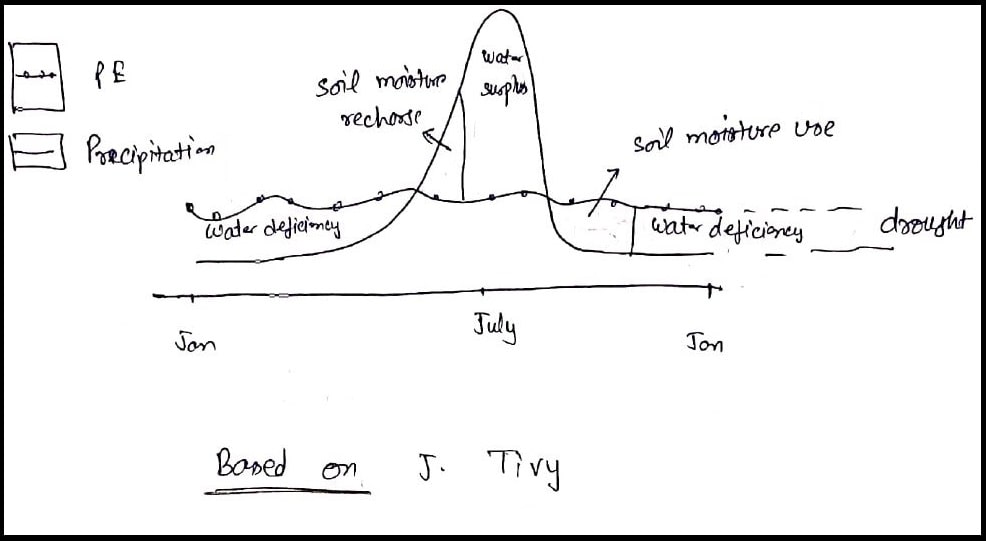
Case study- Three Gorges Dam:
- It is the world's largest power station in terms of installed capacity.
- It has increased Yangtze River's shipping capacity.
- It reduces the floods downstream.
- When the water level of the reservoir falls, landslides occur.
Geomorphological factors:
- Physical and chemical weathering: e.g. by repeated freezing and thawing, heating and cooling, mineral dissolution.
- Erosion
- Gravity
- Factor of mass movement: Fs = resistance of rock/ magnitude of force. (if Fs < 1, there will be downslope movement)
- D.J. Varne (1978): (a) decrease resistance: increase weathering; (b) increase force
- Structure of rocks: Joints, fractures, Adversely orientated discontinuities, Dip irregularities.
- Tectonic factors: like Seismic activity, Volcanic eruption, uplifting of mountains.
- Submarine landslides: due to earthquakes and volcanos.
Volcanic activity:
(a) Debris avalanche: Failures on volcanic flanks (weak deposits).
- triggered at the same time as an eruption, by gravitational deformation, or an earthquake, or heavy rainfall.
- Eg. Mount St. Helens, Washington- 1980, due to earthquake of magnitude 5. It covered an area of 60 km2.
(b) Lahars: These are volcanic landslide.
Case study 1: The Armero tragedy, 1985:
- Due to the re-eruption of a dormant volcano- Nevado del Ruiz, Colombia.
- It swept up two towns and killed 25,000 people.
- Issues: Government had received warnings to evacuate the area two months earlier.
- Death of a 13-year-old girl, Omayra Garzón highlighted the failure of officials to respond correctly. She was trapped beneath the debris for three days. Her plight was documented. Her calmness, courage and dignity touched the world.
Case study 2: Mount Pinatubo, Philippines 1991
- The eye of a Typhoon passed over the volcano during its eruption.
- The heavy rain triggered the flow of volcanic ash and boulders.
Anthropogenic factors
- Deforestation: hence less slope stability.
- Change in land use pattern e.g. construction of roads, houses etc.
- Mining and Quarrying.
- Vibration and drilling.
Landslides in India
20% landslides occur in India. Asia is the most affected continent (75% cases).
World's top two landslide hotspots are in India: the southern edge of the Himalayan arc, and the Western Ghats. - Global database on landslides

Fig. Landslide hazard map of India (Source: NDMA).
Case studies:
Malpa landslide, Pithoragarh – 1998:
- Reason: earthquakes of 1980. Steep, almost vertical slopes of rock above the valley. Intense rainfall triggered the event.
- One of the worst landslides in India. It wiped away the entire village of Malpa. All the devotees en route to "Kailash Manas Sarovar Yatra" were killed.
Vernavat Landslide, Uttarkashi- 2003:
- Uttarkashi town is surrounded by a number of hillocks. These are made of paleo-glacial waste materials left behind by melting glaciers. (highly weathered and fractured)
- River Bhagirathi flowing along the town.
- Main issue: Till the 1960s, Uttarkashi was a small hamlet that serviced pilgrims trekking to Gangotri. It was made district headquarters. In-migration, High-rise hotels etc. increased.
- No human casualty, though significant material loss.
- The administration reacted promptly and evacuated the area.
Kedarnath landslide, 2013:
- A multi-day cloudburst caused flash floods and landslides.
- It was the country's worst natural disaster since the 2004 tsunami.
Pune landslide, 2014 (Malin village):
- Heavy downpour .
- Large scale deforestation.
- Changing agricultural practices: shifted cultivation from finger millet to wheat, which required levelling of steep areas. It contributed to instability of the hills.
- Dimbhe Dam construction activities, without proper EIA.
- Stone quarrying
Kerala landslides, 2019:
- Unrestricted mining operations.
- Triggered by heavy monsoonal rain induced flood.
- soil-piping or tunnel erosion: It is a major cause. It is the subsurface erosion of soil; caused by percolating waters to produce pipe-like conduits below the ground.
Guwahati landslide, 1948: Triggered by heavy rain.
Darjeeling landslide, 1968: Due to floods.
Extra-terrestrial landslides
- Most bodies in the solar system appear to be geologically inactive.
- Most observations are made by space probes. These only observe for a limited time. Hence, not many landslides are known to have happened in recent times.
- Venus and Mars: subject to long-term satellites mapping. Many landslides have been observed.
Impacts of landslides
Primary effects:
- Loss of life of human and farm animals.
- Drinking water contamination, Loss of sewage disposal facilities.
- Damage to roads and transport infrastructure may make it difficult to mobilize emergency health treatment.
- Damage power transmission and sometimes power generation infrastructure.
- Loss of harvests.
Secondary effects:
- Economic Cost: Landslides are the third most deadly natural disasters on earth.
- Economic hardship due to a temporary decline in tourism, rebuilding costs, or food shortages leading to price increases.
- Psychological damage, serious injuries and loss of property occur.
Remedial Measures / Disaster Management of Landslides
Landslides are natural phenomenon and one cannot entirely get rid of them.
A. Pre-disaster stage:
1. Preparedness (P):
- Developing emergency response plans: This involves creating comprehensive plans that outline the roles and responsibilities of different agencies and stakeholders in the event of a landslide. These plans should include evacuation procedures, communication protocols, and resource allocation strategies.
- Conducting risk assessments: Identifying areas prone to landslides and assessing the vulnerability of infrastructure, communities, and natural resources is crucial.
- Training and capacity building: Providing training to emergency responders, local communities, and government officials on landslide preparedness, response techniques, and evacuation procedures.
2. Mitigation (M):
- Implementing engineering measures: Constructing retaining walls, engineering solutions to prevent soil erosion, slope stabilization structures, and drainage systems to reduce the risk of landslides.
- Land-use planning and zoning: This can include creating buffer zones, regulating construction practices, and relocating settlements away from landslide-prone areas.
- Afforestation: Planting trees and vegetation to stabilize slopes, increase soil cohesion, and reduce erosion. E.g. implementing erosion control measures such as terracing or contour plowing.
3. Prevention (P):
- Monitoring and early warning systems: Installing sensors and monitoring equipment to detect signs of slope instability, such as ground movement or changes in water levels.
- Public awareness and education campaigns: This empowers individuals to take proactive steps to protect themselves and their communities.
- Regular maintenance and inspection: Conducting routine inspections of infrastructure, such as roads and bridges, to identify potential landslide triggers and address them promptly.
B. Disaster stage:
1. Rescue operation (R):
- Search and rescue efforts: Deploying trained emergency response teams to locate and evacuate affected individuals, providing medical assistance and immediate relief.
- Temporary shelters and essential services: Establishing temporary shelters to accommodate displaced individuals and providing them with basic necessities such as food, water, and healthcare.
C. Post-disaster stage:
1. Relief (R):
- Provision of humanitarian aid: Delivering essential supplies, including food, clean water, medical assistance, and sanitation facilities to affected communities.
- Psychological support: Providing counseling services and mental health support to individuals affected by the landslide, as they may experience trauma, grief, or other psychological distress.
2. Recovery (R):
- Infrastructure restoration: Repairing damaged roads, bridges, utilities, and public facilities to restore basic services and connectivity in the affected area.
- Livelihood restoration: Assisting affected individuals in reviving their livelihoods through financial aid, vocational training, and support for small businesses. This helps rebuild the local economy and enables communities to regain self-sufficiency.
3. Rehabilitation (R):
- Long-term planning and reconstruction: Developing sustainable land-use plans, incorporating lessons learned from the disaster, relocating communities to safer areas, implementing strict building codes, improving infrastructure resilience.
- Community resilience building: Engaging local communities in long-term recovery and resilience-building initiatives, such as disaster risk reduction education, community-based early warning systems, and participatory decision-making processes.
Landslide mitigation
1. Reinforcement measures- Anchorage:
- An earth anchor is a metal nails device, designed to support structures.
- It increases the shear strength of the rock.
2. Protection measures- Boulder catching net
- These boulder barriers are composed of suitably rigid metal nets. Eg. Mumbai- Pune Expressway.
3. Slope stablisation
- Lowering the angle of the slope.
- Infill at the foot of the slope: eg. construction of concrete blocks, structural walls.
4. Hydrogeological methods: Drainage for Water content reduction (Hoek and Bray - 1981)
- Preventing water entering the hillside through cracks
- Selective shallow drainage to reduce water pressure.
- Intercept surface runoff.
- Lowering groundwater level: by pumps from wells.
4. Chemical methods
- Geogrids: These are geosynthetic materials, used to reinforce soils.
- Anti-erosion Solutions
5. Bioengineering methods:
- Geomats or bionets, and coir (coconut fiber) geotextiles are used globally.
- Life: 3–5 years. On degradation, it converts itself it to humus, which enriches the soil.
NDMA Guidelines on Management of Landslides and Slow Avalanches
- Updating the inventory of landslide incidences.
- Landslide hazard zonation mapping.
- Pilot projects to carry out detailed studies and monitoring.
- Complete site-specific studies of major landslides.
- To plan treatment measures and to encourage state governments for these.
- Institutional mechanisms for generating awareness.
- Capacity building: Enhancing landslide education, training of professionals and related organisations.
- Making the response regime more effective.
- Development of new codes for assessments.
- Establishment of an autonomous national Centre for landslide research, studies and management.
Other initiatives
- National Landslide Susceptibility Mapping (NLSM), 2014 by GSI: Seamless landslide susceptibility maps and landslide inventory maps of the entire landslide prone areas.
- National Landslide Risk Mitigation Project (NLRMP), NDMA: Pilot project in Mizoram.
- landslide warning system: in the Sikkim-Darjeeling Himalayas, and in Munnar, Kerala. over 200 sensors measure geophysical and hydrological parameters like rainfall, pore pressure and seismic activities.