
With the help of suitable diagrams, describe Folk's graphic classification of carbonate rocks. IAS 2024, 10 Marks
With the help of suitable diagrams, describe Folk's graphic classification of carbonate rocks. IAS 2024, 10 Marks

Introduction:
Folk's graphic classification of carbonate rocks is a widely used method to categorize and describe different types of carbonate rocks based on their texture and composition. This classification system was developed by Robert L. Folk in 1959 and has since been used by geologists to better understand the characteristics of carbonate rocks.
Folk’s Graphic Classification of Carbonate Rocks
Folk’s classification system is a widely used method to categorize carbonate rocks based on textural components and depositional characteristics. Below is a structured explanation with diagrams:
Components of Folk's Classification
- Allochemical Components (Allochems):
- Grains formed and transported before being deposited.
- Types:
- Skeletal grains: Fossil fragments.
- Ooids: Spherical coated grains.
- Peloids: Micritic grains without internal structure.
- Intraclasts: Fragmented carbonate sediments.
- Orthochemical Components:
- Material formed in situ after deposition.
- Types:
- Micrite: Microcrystalline calcite forming the matrix.
- Sparite: Sparry calcite acting as cement.
Textural Classification
- Rocks are classified based on the proportion of allochems, micrite, and sparite.
- Allochemical Rocks:
- Dominated by allochems.
- Types:
- Oosparite: Cemented ooids with sparite.
- Biomicrite: Skeletal grains in micrite.
- Intramicrite: Intraclasts with micrite matrix.
- Orthochemical Rocks:
- Dominated by micrite and sparite.
- Types:
- Micrite: Composed of microcrystalline calcite.
- Sparite: Comprised of sparry calcite.
Classification Framework
- Based on the proportion of micrite (matrix) and sparite (cement):
- Micritic Rocks: Dominated by micrite.
- Sparitic Rocks: Dominated by sparite.
- Grain-supported Rocks: Contain allochems supported by grains, with minimal micrite.
Diagram Representation
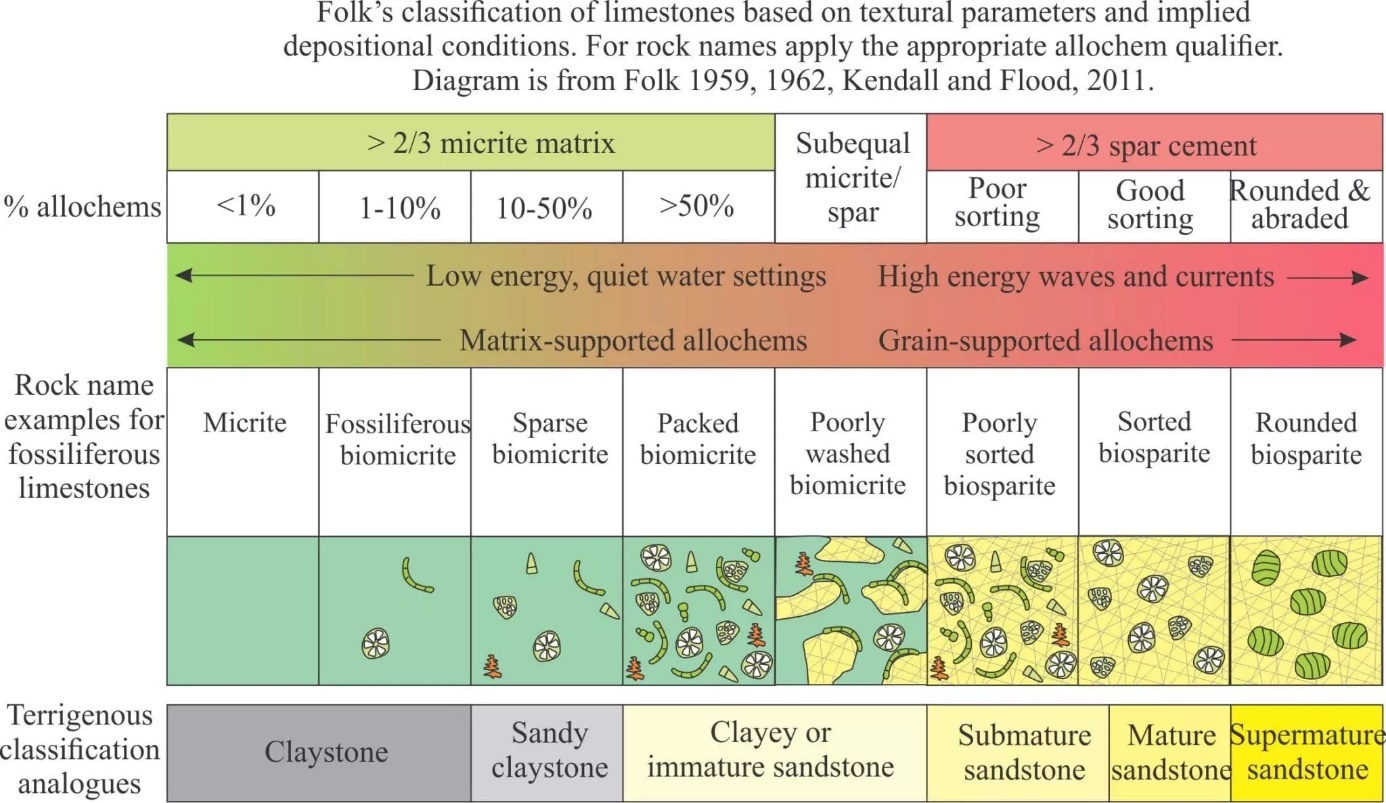
Conclusion:
Folk's graphic classification of carbonate rocks provides a systematic way to categorize and describe the various types of carbonate rocks based on their texture and composition. By using this classification system, geologists can better understand the characteristics and origins of carbonate rocks, leading to improved interpretations of sedimentary environments and geological history.