
Draw and describe the structure of mica group of minerals. Describe the chemical composition and optical properties of minerals of mica group. IAS 2024, 15 Marks
Draw and describe the structure of mica group of minerals. Describe the chemical composition and optical properties of minerals of mica group. IAS 2024, 15 Marks

Introduction:
The mica group of minerals is a diverse group of silicate minerals that are known for their perfect cleavage and sheet-like structure. They are commonly found in igneous and metamorphic rocks and have a wide range of chemical compositions.
Structure of Mica Group of Minerals
- Sheet Silicate Structure:
- Micas belong to the phyllosilicate (sheet silicate) class, characterized by a two-dimensional structure.
- The structure consists of layers of silica tetrahedra (SiO₄), where three oxygen atoms are shared between adjacent tetrahedra forming an infinite sheet.
- TOT Layers:
- Mica structures are formed by TOT layers:
- Tetrahedral Sheet (T): Composed of silica tetrahedra.
- Octahedral Sheet (O): Sandwiched between two tetrahedral sheets and contains cations like Al³⁺, Mg²⁺, or Fe²⁺.
- These sheets are bonded weakly through van der Waals forces or interlayer cations, which give micas their characteristic cleavage properties.
- Mica structures are formed by TOT layers:
- Cation Substitution: Substitution within tetrahedral and octahedral sites creates compositional variability among micas.
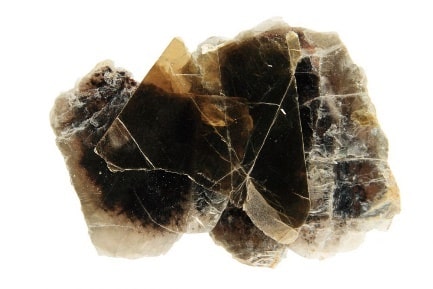
Chemical Composition of Mica Group
- General Formula: XY₂-₃Z₄O₁₀(OH, F)₂
- X: Large cations (e.g., K⁺, Na⁺, or Ca²⁺) located in the interlayer spaces.
- Y: Smaller cations like Mg²⁺, Fe²⁺, or Al³⁺ in the octahedral sheet.
- Z: Primarily Si⁴⁺, with partial substitution by Al³⁺ in the tetrahedral sheets.
- Common Micas:
- Muscovite: KAl₂(AlSi₃O₁₀)(OH)₂.
- Biotite: K(Mg,Fe)₃(AlSi₃O₁₀)(OH)₂.
- Phlogopite: KMg₃(AlSi₃O₁₀)(OH)₂.
Optical Properties of Mica Group
- Birefringence: Micas exhibit strong birefringence due to anisotropic crystal structures.
- Pleochroism: Biotite shows noticeable pleochroism, varying from brown to greenish shades.
- Refractive Indices:
- Muscovite: nα ≈ 1.56, nβ ≈ 1.59, nγ ≈ 1.61.
- Biotite: nα ≈ 1.56–1.61, nγ ≈ 1.62–1.64.
- Cleavage: Perfect cleavage along (001) plane due to weak interlayer bonding.
- Interference Colors: Display bright interference colors under polarized light in thin sections due to high birefringence.
Conclusion:
The mica group of minerals is a unique and versatile group of silicate minerals with a layered structure and a wide range of chemical compositions. Their perfect cleavage and optical properties make them valuable in a variety of industrial and scientific applications.