

Questions Asked
- Comment on Radical Humanism. (09/20)
- Analyse M.N. Roy’s ideational journey from Marxism to Radical Humanism. (02/60)
- Comment on the Marxist and Radical Humanist phases of M. N. Roy’s thought. (12/15)
- What are the major components of Modern Indian Political Thought? Examine them with reference to Gandhi and M.N. Roy. (01/60)
Introduction
- M. N. Roy was a prominent Indian philosopher of the twentieth century.
- He was famous as the Father of Indian communism and is viewed as the first revolutionary leader of India.
- He was an Indian philosopher, notably the founder of the Mexican Communist Party and also one of the members who founded the Communist Party of India.
- In the year 1940, Roy was instrumental in the formation of the Radical Democratic Party, an organisation in which he played a leading role for much of the decade of the 1940s.
- Roy later moved away from Marxism to become an exponent of the philosophy of radical humanism.
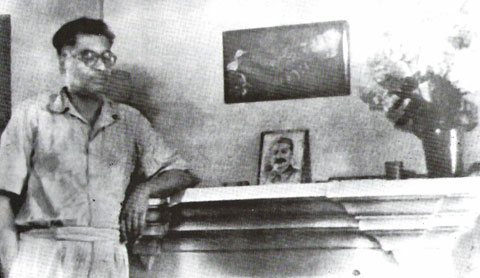
Components of Modern Indian Political Thought
- Modern Indian Political Thought examines critically the contemporary state of political theory.
- It makes an assessment of the achievement and limitations of the behavioural revolution in its totality and Conceptual frameworks adopted by the discipline.
- Main components of modern Indian Political Thought which are influenced by Gandhi and Roy -
- Secularism
- National Sovereignty
- National state
- Rationality
- Democracy
- Welfarism
- Liberalism
- Equality
- Fraternity
- Humanism
- Decentralisation
- Cooperative societies
Gandhi’s political philosophy that becomes a part of Indian political thought
- Gandhi’s political philosophy concerns the peaceful political order—Pax Gandhiana.
- Its main contention is that peace cannot be achieved by politics alone. Peace requires the confluence of the four canonical ends of life: politics and economics (artha), ethics (dharma), forms of pleasure (kama), and the pursuit of spiritual transcendence (moksha).
- Modern political philosophy isolates politics from the other three ends. Gandhi corrects this error.
- Gandhi's spiritual and moral approach to our political problem is particularly important today after the US declaration of war on terrorism.
- To realise this we have to value Gandhi's idea of reflection on our self and see what we are.
- Gandhian ideology emphasises not on idealism, but on practical idealism.
- Gandhian philosophy is a double-edged weapon. Its objective is to transform the individual and society simultaneously, in accordance with the principles of truth and non-violence.
- Idea of decentralisation
MN Roy's political philosophy
- Roy refers back to the quest for freedom to human beings' struggle for existence, and he regards search for truth as a corollary to this quest.
- The ideal of radical democracy will be attained, according to Ray, through the collective efforts of mentally free men united and determined for creating a world of freedom.
- Partyless Democracy:
- Roy was in favour of abolition of party system in India. He advocates humanist politics. This will lead to purification and rationalization of politics. According to Roy” party politics has given rise to power politics.”
- Decentralization:
- Internationalism postulates the existence of separate nation states. Roy believes that true world government can be built only by the decentralization of nation states.
- Commonwealth And Fraternity Of Freeman:
- He advocated a world federation. In his well-known work, Reason, Romanticism and Revolution, Roy wrote thus: New Humanism is cosmopolitan. A cosmopolitan commonwealth of spiritually free men would not be limited by the boundaries of national states- capitalist, fascist, socialist, communist or any other kind which will gradually disappear under the impact of the twentieth century renaissance of Man’.
Conclusion
- Both Gandhi and Roy contributed to the enrichment of modern Indian political thought as they came up with the ideas of swaraj, democracy, humanism, ramrajya, satya etc.
- Their ideas contributed even to the basis of our Indian Constitution.
- Their idea of tackling the situation is unique in their own way.
- They both promote the idea of individual freedom and development of their mind capacity.
Radical Humanism
Introduction
- The radical or new humanism of M. N. Roy is the reflection of Marxist revolution against capitalism.
- Marx initiated to replace socialism in place of capitalism.
- According to Roy, a philosophy of history which ignores other factors of human life than the forces of production and disregards moral problems cannot be a reliable guide for constructive social action.
- Roy’s humanist intellectual work is greatly influenced by philosophical radicals like Hutcheson, Shaftesbury and Bentham, who had a critical approach to the contemporary political, social and economic situations.
- He criticized the framework of nationalism which ignores individual identity of human beings with ideas like nation and nationhood.
Concept
- Radical Humanism was also known as scientific humanism.
- It undertook a scientific approach for understanding man and his place in the world. So it was called scientific humanism.
- It is known as materialism or monistic naturalism whose characteristics are naturalism, determinism and monism.
- Man is a part of nature. He lives in society. But society does not possess consciousness. It does not know what is good and bad. It is not a biological being.
- Man has all these characteristics. So, between man and society, man is important. He is the measure of everything.
- Social development means development of all people living in the society.
- In other words, society, State, government, etc. exist for the welfare of man. He is the end and the society is the means.
- It exists to guarantee his freedom and to protect his liberty. In short, he asserts the sovereignty of man.
He wrote:
- Freedom is the supreme value because the urge for freedom is the essence of human existence.
Features of radical humanism
- The new humanism of Roy reveals a new philosophy of history which would be comprehensive in nature and would eventually show civilised mankind as the mark of the way out of the crisis.
- The new humanism of Roy tries to bring back morality in social order or social revolution.
- Without morality any kind of social revolution would be futile to the community.
- The theory of new Humanism of Roy aims at inculcating a sense of primacy of values and the urge for attaining eternal freedom.
- The basic tenets of humanism were rationality, morality and freedom.
- The new Humanist Ideology enunciates the importance of freedom, knowledge and truth in one’s life.
- The re-assertion of the value foundations of politics and society is a contribution welcome to modern political thought and behavioural political analysis.
- According to Roy, individual freedom is the main content of developing radical humanism and radical democracy.
- Even Kant while developing his morality gives equal importance on individual freedom and autonomy of the will.
- Roy feels that without individual freedom social reconstruction cannot be possible.
From Marxism to radical humanism
- Roy was a born revolutionary. He was influenced by Marxist when stayed in the USA.
- He was one of the most learned people of Marxist people in the world. Later on, some differences arose between Roy and Stalin and Roy was criticized as a revolutionist.
- According to Roy, Marxist humanism is called radical because it is based on moral appeal.
- In new humanism which will work under socialism, human reason will overcome irrational forces.
- As a rational being, here man will be in charge of his own destiny. Thus, the moralist spirit of Marxism will go into the making of the new faith of our time.
- In this regard, Roy conceives Marxist humanism as the model of the builders of the future human life based on human legacy.
- With time, Roy became a critic of Marxist. In later years, he transformed his philosophy from Marxism to radical humanism which was called new humanism.
- It was a great contribution of Roy in the arena of modern political thought.
Marxism Criticism
- His critical alternative to Lenin‟s draft thesis on nationalism and colonialism is based on his attempt to understand Marxism in the perspective of colonialism.
- Opposing the ideology of the Indian National Congress, he believed that the future of the Indian liberation movement depended on the participation of the neglected society.
- According to Roy, the materialism of Marx was dogmatic and unscientific and neglected the creative role of the human subject.
- He opined that Marx under the influence of Hegel rejected the eighteenth century materialism and also humanistic materialism propounded by Ludwig Feuerbach.
- Roy strongly believed that the Marxian interpretation of history is defective because it allowed no role to mental activity in the social process.
- History can never be interpreted solely with reference to materialistic objectivism.
- According to him the existence of a social organisation precedes the existence of an individual.
- He also considered the Marxist model of revolution to be unnecessary.
Roy's view on democracy
- Roy believed in the idea of partyless democracy.
- He attacked the goal of power to be the main priority of politics.
- He also believed that the party system is an inadequate medium to represent the people.
- He said that political participation is not simply limited within casting of votes; political parties eventually lead to corruption and dishonesty.
- He formulated the notion of organised democracy and participant citizenship to overcome the defects of parliamentary democracy. For this purpose, he visioned a new social order.
- The economic activity of this new social order will be comprised of the following:
- Cooperative planning
- Centralized planning
- Science and technology.
- According to him, democracy would be successful only when spiritually free individuals assume the conduct of public affairs.
- He strongly believed that the greatest good of the greatest number can be attained only when members of the government are accountable in the first place to their respective consciences.
Criticism
- Though, M.N. Roy is remembered as one of the most modern Indian Political thinkers to challenge the traditional viewpoints,he was criticised incertain areas.
- His Marxist view of Indian society was criticised on the grounds that it was not applicable in that time.
- Moreover, he was strictly against liberal political institutions like political parties, elections, and parliament and supported a new harmonious approach with a scientific outlook.
- Even, the picture he drew of Indian society was inconsistent and superficial.
Contemporary Thinkers’ Perspective
- Comment in 150 words: “India has thrown up a form of judicial democracy that has no parallel anywhere else, and has nurtured a kind of civil society that is uniquely its own. (Bhikhu Parekh) (14/10)
- “Judiciary in India will not be a silent spectator rather active participant in India’s ‘social revolution”. -Pandit Jawaharlal Nehru.
Judicial Democracy
- Judiciary is that branch of government that interprets the laws or says what the laws mean & democracy means a form of government in which the citizens share the power.
- The Constitution of India envisaged extremely powerful, fiercely independent, ‘activist judiciary’.
- Judicial democracy charges judges with the task of subjecting democratic decision making to constitutional constraints, in certain circumstances .
- If government (executive and legislature) fails to give effect to directives, it becomes the duty of the judiciary to give effect to directives.
- For reference It is evident that because of the honorable Supreme Court Right to Education has become a fundamental right. Right to Food has become a statutory right.
Constitutional Provisions
- As per the Article 36 of constitution judiciary comes within the definition of state in part IV.
- Article 141 of the constitution states that” The law declared by the Supreme Court shall be binding on all courts within the territory of India.”
- The primary responsibility to make law is with the legislature but in a situation where the legislature has not made law, the Supreme Court can declare the law on that subject.
- For reference we can see that till parliament brought a law on the Sexual Harassment of Women at Workplaces (2013), Vishakha guidelines issued by Supreme Court (1997) were to be treated as law.
Importance of Judicial system increasing day by day
- As a protector of constitution –
- Initially SC was passive, but later on because of executive overreach, Supreme Court became active towards its obligations.
- The doctrine of basic structure was invented by SC to check emasculation of the constitution by executive which was bent on diluting the essential features of the constitution itself.
- Guardian of FRs. –
- Initially SC did not appear as a ‘sentinel qui vive’ (Guard with arms) of the FRs.
- This allowed executive to dilute the FRs for the implementation of DPSPs.
- Emergency was the darkest hour in the history of Supreme Court. When Supreme Court’s action was needed the most, it failed to protect the rights of the people. One of the blot on SC is the judgement in Habeous Corpus case. (ADM Jabalpur Vs Shrikant Shukla case).
- After emergency, there have been change in the approach, 1st reflected in Maneka Gandhi case 1978. It overruled its judgement in AK Gopalan case, held that the doctrine of due process of law is inherent in the doctrine of procedure established by law.
- Because of activist judges like P N Bhagawati, Supreme Court instituted PIL (Public Interest Litigations), which strengthened the rights of the weaker section.
- Since then, working with civil society, judiciary has strengthened human rights in India.
- Supreme Court has interpreted the meaning of Right to Life liberally to provide various rights.
- Though SC has strengthened the rights in India, but it has not been able to bring any concrete change in the situation. e.g. Supreme Court’s judgement in Sabarimala case could not be implemented on the ground because of lack of support from the governments as well as civil society.
- As a federal court –
- As per Art 131, the Supreme Court has original jurisdiction for the resolution of the disputes between center and state and among states.
- In this context, the Supreme Court has been able to play its constitutional role.
- Though the constitution restricts Supreme Court in case of inter-state water disputes, yet when required the Supreme Court did intervene using the powers under Art 136.
- Whatever progress is observed in resolution of Kaveri water issue, it is because of SC.
- After remaining silent on many occasions which include the misuse of Art 356, SC in S R Bommai case declared federalism as a basic structure and restricted the misuse of Art 356.
- SC as a protector of Rule of Law-
- The rule of law implies checking the arbitrariness of executives, it also includes checking corruption and criminalization.
- SC working with civil society and election commission took initiatives to reduce the influence of money and muscle power in the elections.
Thinkers
According to Bhikhu Parekh,
- The Republic of India is a classical example of ‘judicial co-governance’ , which is unique in itself and exists nowhere else .
- Speaking at a national colloquium on Issues of Governance and Changing Face of Indian Politics he remarks “On several occasions, the Supreme Court has saved the parliamentary system. We have become a judicial democracy.”
According to Pratap Bhanu Mehta,
- India is a classical example of ‘Judicial sovereignty’. It denotes supremacy of judiciary even over and above the supremacy of the constitution.
- Judiciary is highly politicized institution. He uses the phrase ‘politicization of judiciary’. Judiciary trying to strengthen its own powers. It seems judiciary takes opportunity from the political crisis in India to strengthen its own image. Hence he consider judiciary as a ‘self perpetuating institution’.
Jawahar Lal Nehru
- Within limits no judge and no Supreme Court can make itself a third chamber.
- No Supreme Court and no judiciary can stand in judgment over the sovereign will of Parliament.
- If we go wrong here and there, it can point it out, but in the ultimate analysis where, the future of the community is concerned, no judiciary can come in the way.
- And if it comes in the way, ultimately, the whole Constitution is a creature of Parliament.