

PYQs
- Define ideology. Critically examine the “End of Ideology. Debate. (01/60)
- Examine the debate on the ‘End of Ideology’. (11/30)
- Comment: End of Ideology debate (19/10)
Introduction
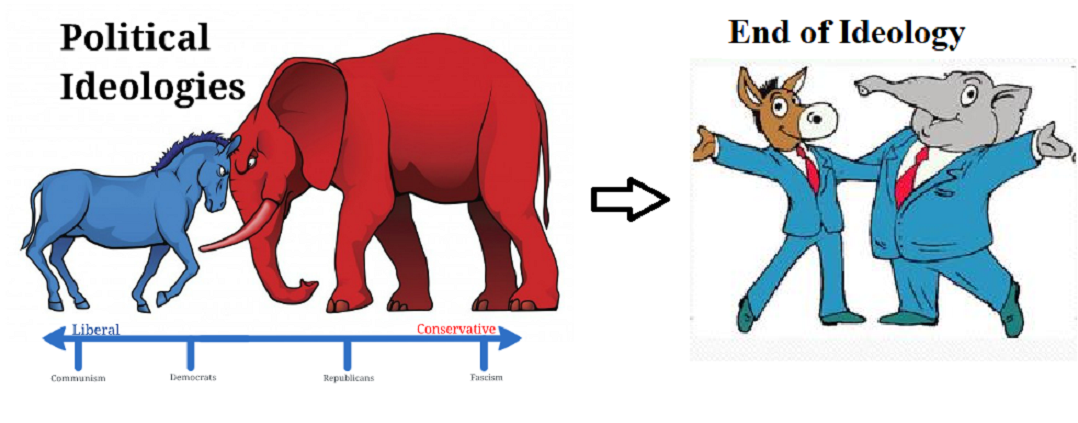
- It may be defined as the “end of debate of contradicting ideologies”.
- Daniel Bell premised the End of Ideology Hypothesis. The End of Ideology thesis argues that “ideological differences will decrease as nations experience modernization”.
- With modernization, a broad consensus among intellectuals on political issues is established, which is based on commonly accepted principles. Hence, the debate of ideology ends to a large extent.
- E.g. As per Bell, while ideological debates had been exhausted in the West, new ideologies were emerging and driving politics in Asia and Africa.
- The current western world accepts a system of political pluralism, instead of sticking to political monism (ideology).
- Good ideas are taken from different ideologies, and the negative ones are discarded. Some examples of the commonly accepted principles which leads to end of ideology are as follows:
- Acceptance of Welfare State.
- The desirability of decentralized power.
- A system of mixed economy,
- Establishment of liberal international trade.
- Economic sustainability and National security.,
- Expanding employment in the tertiary sector.
The cycle
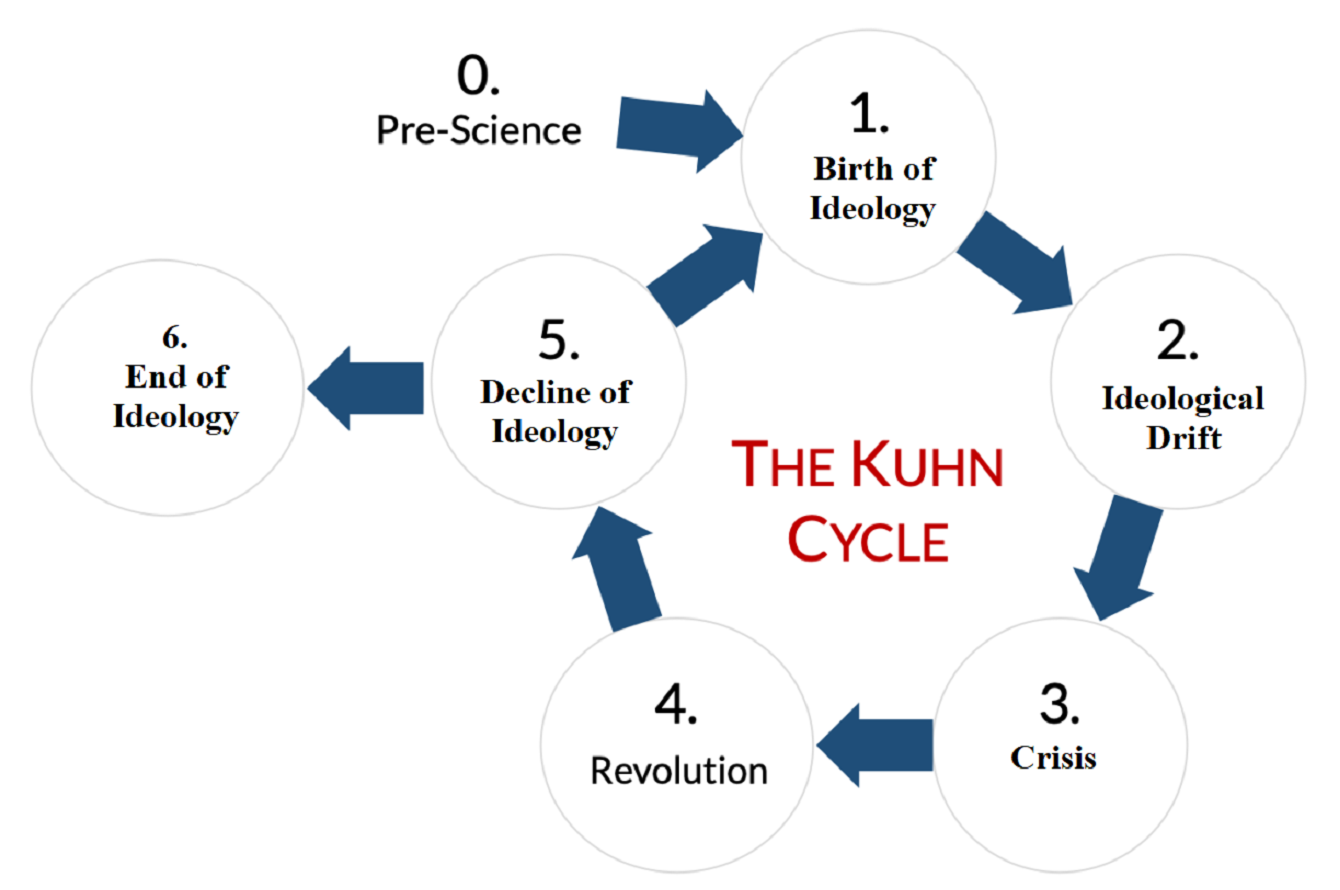
- Birth of Ideology: Ideology emerges as a 'coherent system of ideas' that “rely on a few basic assumptions which may or may not have any factual basis”.
- Revolution: In ‘The Anatomy of Revolution’, Crane Brinton said that new ideology spreads when there is extreme ideocracy, or there is discontent with an old ideology. The revolution thus is seen as a reaction to ideocracy.
- Decline of the prevailing ideology and birth of a new ideology due to revolution.
- End of ideology.
Conclusion
- At an advanced stage of development, the political ideology of the State and its citizens does not matter significantly.
- The capitalist and communist countries produce similar results at an advanced level of development.
- Political ideology has become irrelevant among "sensible" people, and that the polity of the future would be driven by a common system. John Summers (2011).