
Buddhist Tradition | PSIR Optional for UPSC
Buddhist Tradition | PSIR Optional for UPSC

- Write a note on the Buddhist tradition in Indian political thought. (12/20)
- Evaluate the contributions of Buddhist tradition to Indian political thought. (14/15)
- Do you think that the Buddhist traditions have lent greater ethical foundation to the ancient Indian political thought? Give your arguments. (21/20)
Introduction
- Buddhism is not a single monolithic religion.
- Many of its supporters have combined the teachings of the Buddha with local religious rites, beliefs and customs.
- In this tradition, some conflict occurs, because Buddhism is a philosophical system to which such additions can be easily implanted.
- Buddhism includes a variety of rituals and practices, which are intended to help in the journey to enlightenment and bring blessings on oneself and others.
- While some activities are exclusive to certain expressions of Buddhism, there are others that are found in most of the popular forms of the belief system.
Buddhist political theory
Origin of the state
- Buddhist political thought associate it with fall of the man or corruption. Corruption comes into existence because of the emergence of materialism.
Origin of the king
- Buddhism represent republican tradition. King is called as Mahasammat which shows that the king has been elected by the council.
Qualities of the king
- Buddhist king resembles Plato’s philosopher king. People have chosen ‘the noblest of all’. King embodies wisdom. King as a source of knowledge. Purpose of knowledge is to check corruption, since knowledge enforces morality.
- They believed that one needed a King and a warrior for protection. Just as the tree is the refuge of birds, so is the King refuge of his people.
- It was the moral obligation of the ruler to give protection to the ruled in return for their obedience.
Buddhist foreign policy
- Buddhist foreign policy is based on peace and non-violence. Chakravarti Samrat wins others by Dhammachakra.
To the Buddhist thinkers, the powers of rulers were:
- The strength of arms.
- The strength of wealth.
- The strength of officials.
- The strength of the high birth.
- The strength of wisdom.
In Saundarananda, reference is made to the King’s application of five expedients, namely:
- Conciliation (sama).
- Bribery (dana).
- Creating dissensions (bheda).
- Force (danda).
- Restraint (nigama) against his enemies.
Ideology of a World-Ruler
- The early Buddhist canonists give a highly idealistic picture of the world-ruler (chakravarti).
- The attributes of the ruler comprised not only universal supremacy and successful administration at home and abroad, but also and above all, righteousness or dharma.
- The world-ruler was credited with seven jewels (or treasures) consisting of the wheel-treasure, the elephant-treasure, the house-treasure, the horse-treasure, the treasure of a woman, the treasurer and the adviser.
Thinkers perspective
- According to Mark W. Muesse, a professor of religious studies, "Buddhist spirituality promotes a form of life that provides an antidote to the stresses of modern living. As a counterpoint to the haste and hurry, the noise and confusion of this world, Buddhism prescribes a life of quietness and tranquillity, a life of contemplation and gentle awareness".
- According to professor, V. R. Mehta, Buddhist tradition lack political thinking. Primarily Buddhism is a religious tradition.
Contributions of Buddhist tradition to Indian Political Thought.
In many respects Buddhist ideals of statecraft embodying principles and practices such as the rule of law, deliberative democracy, procedures of governance and the social policies of the Ashokan welfare state bear a striking similarity to Enlightenment values in Europe.
- The principle of equality “universal egalitarianism” in Buddhism, applied equally to the relationship between the ruler and the ruled, and was a governing principle in matters of statecraft.
- The Buddha suggested to the republics that if they wished to maintain their independence they should strengthen their more democratic forms of governance.
- These include holding regular and frequent assemblies to discuss affairs of state collectively with each other, endeavouring to carry out the day to day tasks of governance in harmony, and paying due heed to established practices and customs.
- This form of monastic governance contained many features of statecraft present in the self-governing confederacies and republic rather than the large monarchical kingdoms of the North, such as Kosala and Magadha.
Principles of Political Righteousness of Dharma
- The most important contribution of the early Buddhist canonists to our ancient political thought consists in their ‘total’ application of the principle of righteousness to the King’s internal administration and to his foreign policy.
- The best King was one, who devoted himself to the welfare of the whole realm including animals.
- The King should avoid specified vices and practise specified virtues.
- Righteousness of dharma imposed some principles and policies of State like protection of the good, impartial justice, friendliness towards neighbouring Kings, and temporal and spiritual benefits to all classes of people.
- According to Buddhist theory, ethical standards were applicable uniformly to the ruler and his subjects and equally upon King’s public and private acts.
- The Buddhist thinkers rejected the Brahmanical ethics in relation to statecraft such as treacherous war and questionable methods in war and diplomacy.
- Many of the crucial features of the Buddhist approach to social philosophy and political governance derive from the principles and practices governing the organisation of the monastic community (the sangha).
Principles and policies of Government
- King should avoid falsehood and anger and whatever he has done in the past under the influence of passion and sin, he should not repeat.
- The King should choose as his ministers and other officials, who are steady, learned in affairs and free from the vices of gambling, drinking and so forth.
- The King should, himself, examine the income and the expenditure.
- Punishments for wrongdoers and rewards for good and efficient should be promptly given.
Four Noble truth
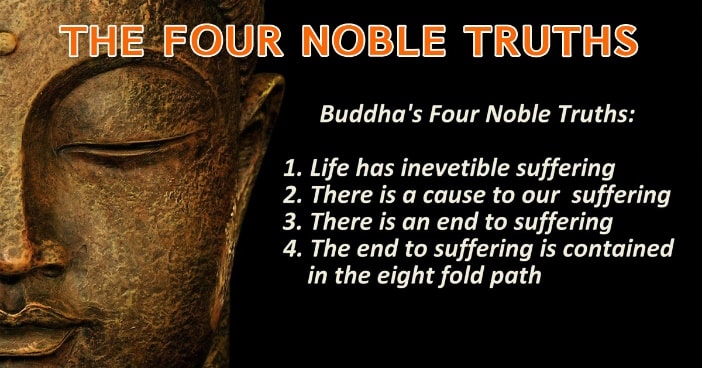
The four Noble Truths: The method for the four Noble Truths is perhaps based on the formula for a medical diagnosis. That is, it states the illness, the source of the illness, then the cure for the illness, and finally the way to bring about that cure.
It can be said that The Buddha's first sermon after his Enlightenment focused on the Four Noble Truths, which are the basis of Buddhism. The truths are
- The truth of suffering (dukkha)
- The truth of the cause of suffering (samudaya)
- The truth of the end of suffering (nirhodha)
- The truth of the path that frees us from suffering (magga)