

Questions Asked
- Dr. Ambedkar’s idea of social justice leads to ‘egalitarian justice’ as compared to Rawls’ justice as fairness’ which aims at the notion of ‘pure procedural justice’. Comment. (22/20)
- Ambedkar's ideas on constitutionalism. (2020)
- Discuss Ambedkar’s ideas on ‘annihilation of caste’. (18/15)
- Political democracy could not last unless social democracy lay at its base – B. R. Ambedkar. Comment (17/20)
- Comment: Dr. B.R. Ambedkar’s idea of state socialism. (16/10)
- Comment: Ambedkar’s Concept of Social justice. (06/20)
- Comment on views of Gandhi and Ambedkar on ‘social justice’. (11/15)
Introduction
- Ambedkar was not only a political leader and social reformer but also a scholar and thinker.
- He has written extensively on various social and political matters.
- 'Annihilation of Castes', 'Who Were the Shudras', 'The Untouchables', 'Buddha and His Dharma' are his more important writings.
- His thinking was based on a deep faith in the goals of equity and liberty.
- Liberalism and the philosophy of John Dewey also influenced his thinking.
- Jotirao Phule and Buddha have exercised a deep influence on Ambedkar's ideas on society, religion and morality.
- His political views were also influenced by his legal approach.
- "Educate Agitate And Organise" - explains the real message of BR Ambedkar.
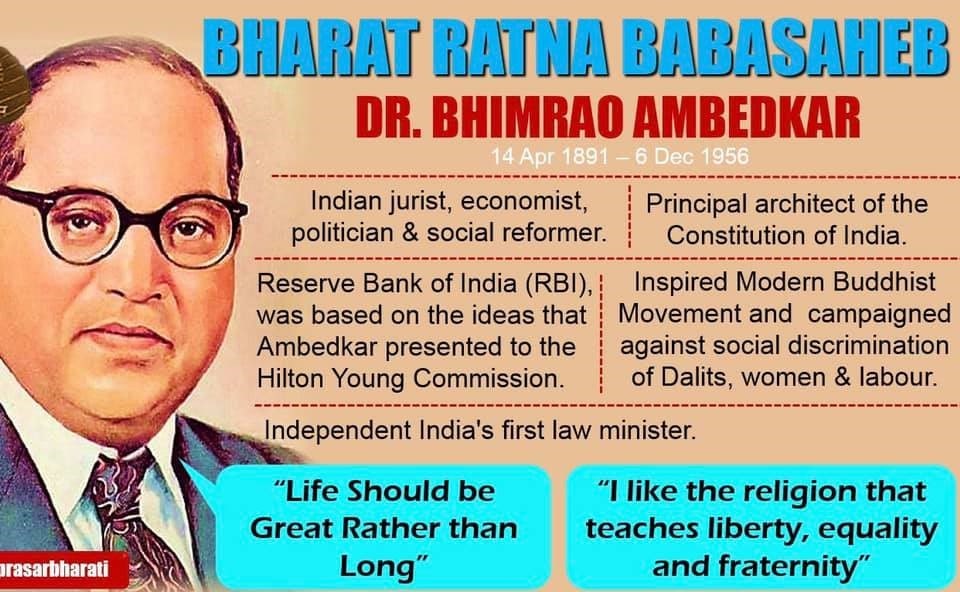
Ambedkar on Democracy
- Dr. Ambedkar was a staunch supporter of social democracy.
- To him, a society characterized by inequality and social disparity cannot sustain political democracy.
- Ambedkar's aim of democratizing society and polity has been found in various provisions of the constitution of India.
- To him the term social justice in real sense gives meaning and importance to the democratic way of life along with the rule of law and society.
- Dr. Ambedkar wanted the replacement of socio- religious or ritual status by secular status based on the principle of “one man’s one value and one man, one vote”.
Basic concept on democracy
- Dr. Ambedkar focused on three categories of democracy in India that are (1) Political Democracy (2) Social Democracy and (3) Economic Democracy.
- For him, Social and Economic democracies are the tissues and fiber of a political democracy.
- For him, democracy was “a form and a method of government whereby revolutionary changes in the economic and social life of the people are brought about without bloodshed.
- He conceived democracy as another name for equality, social and economic democracy is the fabric and fiber of political democracy.
- Ambedkar wanted to convey the message that the fundamental rights in the constitution are a supporting pillar of Indian democracy.
State Socialism
- The ideal of state socialism to be realized according to Dr. B. R. Ambedkar is of “one man, one value in all walks of life political, economic and social”.
- The ideal of one man, one value, is to be achieved by stopping religious economic and social exploitation of men by men.
- Absence of exploitation in any form is an essence of socialism.
- Dr. Ambedkar’s concept of state socialism differed from both Marxist socialism and Gandhian Socialism.
- To Dr. Ambedkar socialism does not only embrace economic equality, but also social and political equality.
- Dr. B. R. Ambedkar advocated state socialism in the field of industry and state ownership in agriculture with a collectivized method of cultivation.
- Dr.B.R. Ambedkar was one of the few Indians who demanded nationalisation of insurance before the Indians nationalized it.
- He was of the firm opinion that Only collective forms can solve the problems of the landless laborers.
- Therefore Dr. Ambedkar writes, “the plan has two special features, one is that proposes state socialism in the important fields of economic life and the second special features of the plan are that it does not leave the establishment of state socialism to the will of the legislature.
- It establishes state socialism by the law of constitution and thus makes it unalterable by any act of the legislature and the executive”.
Conclusion
- To conclude we can summarize Ambedkar's concept of state socialism stresses the three economic processes of human society.
- Adaptation of key industries and agriculture land to meet the demands of the weaker sections of the society.
- Maintenance and financing of the productive resources by the state.
- A just distribution of the common produce among the different people without any distinction of caste, creed or community.
On Social Change
"Caste is a state of mind, it is a disease of mind the teachings of Hindu religion are the root cause, caste has killed public spirit, caste has destroyed the sense of public charity caste has made public opinion impossible virtues has become caste ridden and morality has between caste bound” .B.R. Ambedkar
- Dr. Ambedkar's first objective was always social improvement.
- Economic and political problems, he argued, should be handled only after the goal of social justice had been attained.
- Reform of the family structure and religion reform were two aspects of social reform.
- Ambedkar worked tirelessly for the abolition of untouchability and the material advancement of untouchables.
- According to Dr. Ambedkar Hindu society is a collection of caste and each caste has close cooperation with no place for conversion to the upper caste.
- Upper caste Hindus deliberately try to prevent the lower castes within Hinduism from rising to the cultural level of higher castes.
- Ambedkar stood not only for the development of the dalits but also argued for the thinking of an alternate identity as against the Hindu identity which kept them low and degraded.
- He believed that if remained within the whole of the Hindu religion they could not escape the caste system and therefore doing away with Hindu religion and attacking each element of the Brahmanical superiority and hierarchy was the solution to limit caste discrimination.
Social Justice
“A Just society is that society in which ascending sense of reverence and descending sense of contempt is dissolved into the creation of a compassionate society.”—Dr. B.R. Ambedker
- Ambedkar’s concept of social justice stands for the liberty, equality and fraternity of all human beings.
- He stood for a social system that is based on right relations between man and man in all spheres of his life.
- As a rationalist and humanist, he did not approve of any type of hypocrisy, injustice and exploitation of man by man in the name of religion.
- He stood for a religion that is based on universal principles of morality and is applicable to all times, to all countries and to all races.
- It must be in accord with reason and must be based on the basic tenets of liberty, equality and fraternity.
- Ambedkar stood for a social system in which man’s status is based on his merit and achievements and where no one is noble or untouchable because of his/her birth.
- He advocated the policy of preferential treatment for the socially oppressed and economically exploited people of the country.
- The Constitution of India, which was drafted under his chairmanship, contains a number of provisions that enjoins the state to secure to all its citizens, justice, social, economic and political, along with liberty, equality and fraternity.
- It also contains a number of provisions that guarantee preferential treatment to the downtrodden people in various sectors.
- Article 17 of the Indian Constitution declares untouchability is abolished.
Gandhi and Ambedkar on ‘social justice’
Introduction
- After the second world war when a number of countries became free in Asia and Africa, social justice was popularly used in these countries.
- These countries had not only suffered from imperialist exploitation, but also from social imbalances because one section of society that collaborated with the imperialist powers, had cornered much of the benefits at the cost of the weaker section of society looked towards the state for social justice.
- In India the caste system and the problem of untouchability made the situation worse.
- Both Gandhi and Ambedkar reacted against such evils in their own way.
- Their end was the same, but they differed in their perception of the problem as well as in their approach to seek adequate solution.
Same goal but different approaches
- Gandhi burning foreign clothes and B.R.Ambedkar burning Manusmriti were no mere acts of sentiments; for both foreign clothes and Manusmriti had the effect of bondage and slavery for the countrymen were linked with injustice in the society.
- Ambedkar shared the Gandhian outlook of the equal divinity of man.
- In the opinion of Justice Krishna lyer, it would thus appear that B.R. Ambedkar and Gandhi had a common allergy to social evil and injustice.
- To break law to make the law more just is a Gandhi and vintage, noncooperation, herbal; satyagraha, civil disobedience etc. were its outward expressions. But B.R. Ambedkar seems to be more observant of law and constitutionality in political process.
- Ambedkar wanted to reorganize the society only single and equality and therefore oppose the caste system which was characterized by graded inequalities.
- Both Gandhi and B.R. Ambedkar identified the evil of untouchability as the foremost bane of the social order; they differed in their methods and approaches for its removal.
- B.R. Ambedkar wanted this to be done through laws and constitutional methods.
- Gandhi treated it as a moral stigma to be erased out by acts of atonement.
- B.R. Ambedkar held that reliance on change of heart alone is not sufficient, its moral atonement is to be re-enforced by leg-constitutional measures.
- Gandhi countered leg constitutional methods are only of very limited utility, he was for moral, and conscience related remedies for evil.
Annihilation of Caste
- Ambedkar’s main work revolves around the abolition of caste.
- His most important work on the issue of abolition of caste is Annihilation Of Caste.
- Ambedkar was not satisfied with the explanations related to caste system found in religious texts.
- Ambedkar attempted the scientific understanding of the origin of caste on the basis of anthropological researches.
- Ambedkar also rejected the theory of Aryan invasion.
- As per the theory of Aryan invasion, upper caste have been the Aryans whereas so called untouchables were the original inhabitants, often mentioned as dasas or dasyus.
- There is no such historical evidence, it means all caste in India had common origin.
- Ambedkar rejected the view of Manusmriti according to which different varnas originated from the different parts of Viratapurusa as mentioned in Rigveda also.
- In Manusmriti, untouchables are mentioned as chandals. Chandals are those who are the offspring of Shudra father and Brahmin mother, which shows the pollution of Brahmins by Shudras.
- The entire concept of untouchability is based on purity and pollution.
- Ambedkar had also explained the origin of Sudras.
- As per Ambedkar’s theory, there were only three varnas – Brahmins, Kshatriyas and Vaisyas.
- Sudras were originally Kshatriyas, however they were those Kshatriyas, which did not accept the hegemony of Brahmins, hence Brahmins stopped Upanayana sanskar for this group.
- Upanayana sanskar is linked to purification. Hence it was believed that they remain polluted.
Constitutionalism
Introduction
Constitutionalism is structured on the ideals of limited government, rule of law, regulations and democratic values. The idea of constitutionalism was a major theme during the freedom movement which matured in the thoughts of Nehru, Ambedkar and so many others.
His views on constitutionalism
- Ambedkar developed his own ideas about constitutionalism in legal-social terms.
- He was a constitutional expert who looked at legislature, a lawmaking body, as ‘a product of its social conditions’ which could be limited by a federal order in a diversity-filled country like India.
- For him, the Constitution was an organic whole which must adapt to the needs of the time.
- The amendment procedure in the Indian Constitution is testimony to it where several Articles are amended but are not deemed to be the amendment.
- Constitutionalism demands restricted powers; extension of the power of the state is anathema to constitutionalism.
- Ambedkar, while discussing the taxation system in the Bombay legislature, explicitly stated that ‘Government is a responsible body, is subject to public opinion, is subject to the opinion of this House, and therefore can never do the mischief which a private profiteer can do.’
- Ambedkar was opposed to the bureaucratic control of the politically organised society.
- The role of public opinion is an effective preventive tool to limit the powers of the government.
- Ambedkar subscribed to the idea that the creation of public opinion is a major component of the democratic political world.