

Introduction
Porifera, commonly known as sponges, are simple multicellular organisms that belong to the phylum Porifera. They are aquatic animals that lack true tissues and organs. One of the key features of Porifera is their unique skeletal structure, which plays a crucial role in their support and protection.
Skeleton in Porifera.
1. Types of Skeleton in Porifera
- Spicules:
- These are the hard, needle-like structures that form the skeletal framework of sponges.
- Spicules can be made of calcium carbonate (calcarea) or silica (silicea).
- They v ary in size and shape and are important for sponge classification.
- Spongin Fibers:
- In some sponges, the skeleton is composed of spongin, a type of protein fiber.
- These are flexible and give the sponge its elasticity.
2. Functions of Skeleton in Porifera
- Support: The skeletal system provides support, enabling the sponge to maintain its structure despite water currents.
- Protection: Spicules act as a defense mechanism by deterring predators with their sharp and hard texture.
- Filter Feeding Aid: The skeleton helps maintain the shape and internal canal system, facilitating water flow for filter feeding.
- Classification: The composition and structure of the skeletal elements are used for taxonomic classification of sponges.
3. Classification Based on Skeleton
- Class Calcarea:
- Sponges in this class have skeletons made of calcium carbonate spicules.
- Example: Sycon, Leucosolenia.
- Class Hexactinellida (Glass Sponges):
- Their skeleton is made of siliceous spicules.
- Example: Euplectella, Hyalonema.
- Class Demospongiae:
- This class has skeletons made of spongin fibers or siliceous spicules.
- Example: Spongilla, Euspongia.
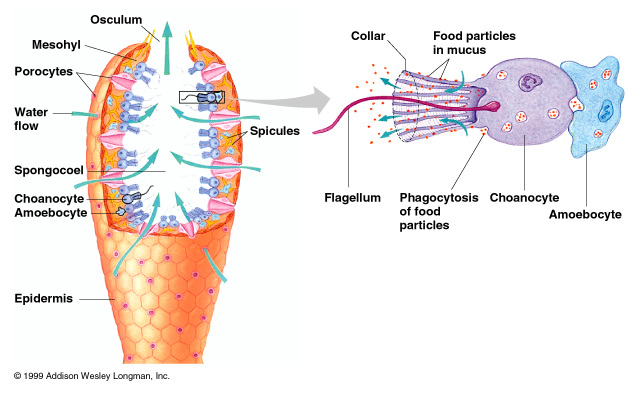
Examples of Sponges with Different Skeletal Systems
- Euspongia (Bath sponge): Composed mainly of spongin fibers.
- Sycon: Has a skeleton composed of calcium carbonate spicules.
- Euplectella (Venus flower basket): Composed of silica spicules forming a beautiful lattice-like skeleton.
Conclusion
The skeleton in Porifera is a unique and essential feature that provides support, protection, and structural integrity to these simple multicellular organisms. The combination of spongin and spicules forms a robust skeletal structure that allows sponges to thrive in their aquatic environments.